Scientists Solve Arctic Ice Mystery With Simple Discovery
Researchers discovered that Arctic sea ice moves unpredictably not because of complex forces, but because ice chunks constantly bump into each other. This surprisingly simple finding could help predict how the Arctic changes as it warms.
Scientists just figured out why Arctic sea ice doesn't behave the way it should, and the answer is beautifully simple: the ice pieces keep bumping into each other.
For years, researchers noticed that Arctic sea ice moves in ways that wind patterns alone can't explain. The ice travels at unexpected speeds and spreads much more slowly than computer models predicted.
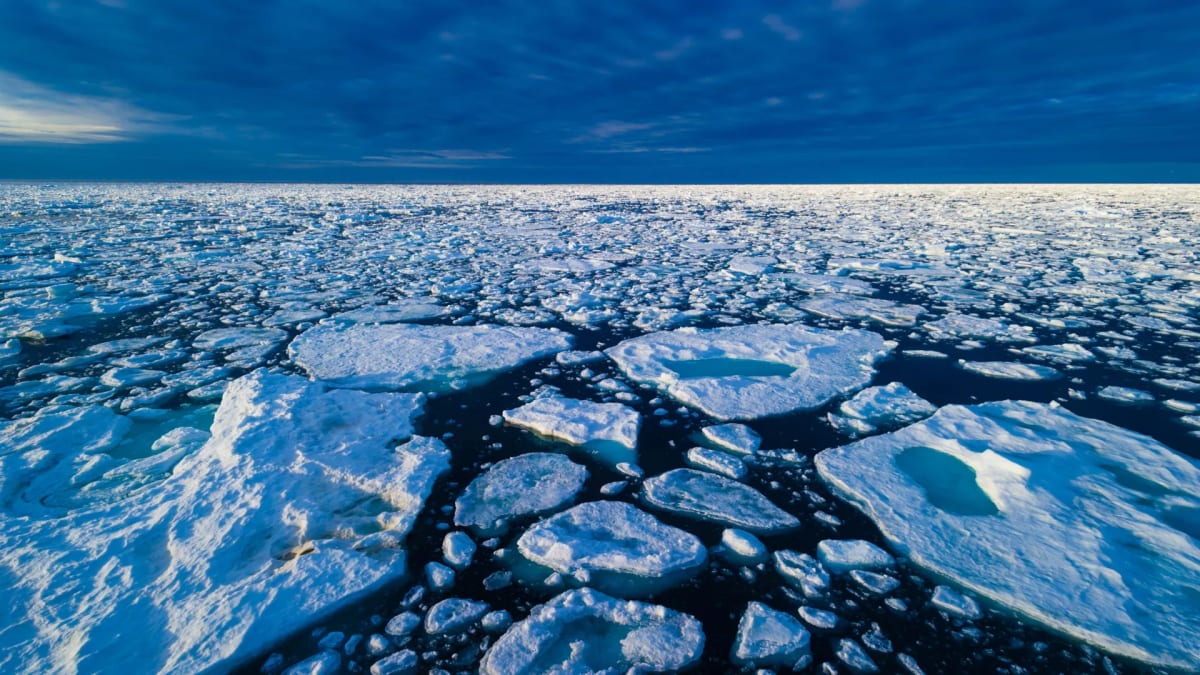
UC Riverside researchers led by Bryan Shaddy discovered the missing piece. Arctic sea ice isn't one solid sheet but thousands of separate slabs called floes, ranging from just a few meters to several kilometers wide.
When wind pushes these floes across the ocean, they constantly crash into their neighbors. Each collision transfers energy and slows things down, like a crowded subway car where nobody can move freely.
"If you get a lot of ice floes together in the same place with some wind, they bump into each other and transfer energy to neighbors," said Bhargav Rallabandi, associate professor of mechanical engineering at UCR. "We showed that that's the only ingredient you need to explain these observations."
The team created a computer model treating floating ice like grains moving through a silo, except these grains float on water and get pushed by turbulent winds. They tested it against real measurements from the Fram Strait between Greenland and Svalbard, where massive amounts of Arctic ice flow toward the Atlantic Ocean.
The model worked. It successfully matched three puzzling observations about how quickly ice spreads, the range of speeds individual pieces move, and how ice motion changes over hours and days.
The discovery matters because collisions have such a strong effect in tightly packed ice fields. Individual floes hit nearby pieces much more often than the wind itself changes direction, constantly removing energy and preventing the ice from simply accelerating and spreading freely.
Why This Inspires
This breakthrough shows how sometimes the simplest explanations are the right ones. Scientists had proposed complex theories involving unusual wind behavior, ocean eddies, and ice cracks to explain the Arctic's mysterious movements.
Instead, the answer was hiding in plain sight: pieces of ice doing what pieces of anything do when crowded together. They bump into each other.
The framework could help scientists predict how Arctic ice behaves as the region warms. Both the amount of ocean covered by ice and the size of individual floes influence how often collisions occur, which affects how rapidly ice fields spread and potentially melt.
The research, published in Physical Review Letters, might even improve global climate models. These models can't track every individual floe covering the Arctic, so scientists need ways to represent their combined behavior without tracking each piece separately.
The same principles could apply far beyond the Arctic too. Avalanches, landslides, materials science experiments, and even particle-filled inks used in 3D printing all involve many objects colliding while being pushed by unpredictable forces.
Sometimes progress comes from looking at complicated problems with fresh eyes and finding the simple truth underneath.
Based on reporting by Science Daily
This story was written by BrightWire based on verified news reports.
Spread the positivity!
Share this good news with someone who needs it