Scientists Trap Quantum Matter in Laser Grids for Half Second
Physicists have successfully created stable clusters of quantum matter inside a laser grid for the first time, holding atoms together for nearly half a second. This breakthrough could lead to more stable quantum computers and sensors that don't lose information.
Imagine trying to keep a cloud of smoke perfectly still in one spot without any container. That's basically what physicists just accomplished with atoms, and it could change how we build the computers of tomorrow.
For the first time ever, scientists have trapped quantum matter into stable packets inside a grid made of laser light. The atoms stayed concentrated in tight bundles for nearly half a second, which might not sound like much, but in the quantum world, that's an eternity.
Here's why this matters. In quantum physics, atoms usually behave like waves that spread out everywhere. Scientists need to control these atoms to build quantum computers and ultra-precise sensors, but keeping them in one place has been incredibly difficult.
The research team started with cesium atoms cooled to nearly absolute zero, the coldest temperature possible. At this frigid state, the atoms form something called a Bose-Einstein condensate, where they all start acting like one giant quantum wave.
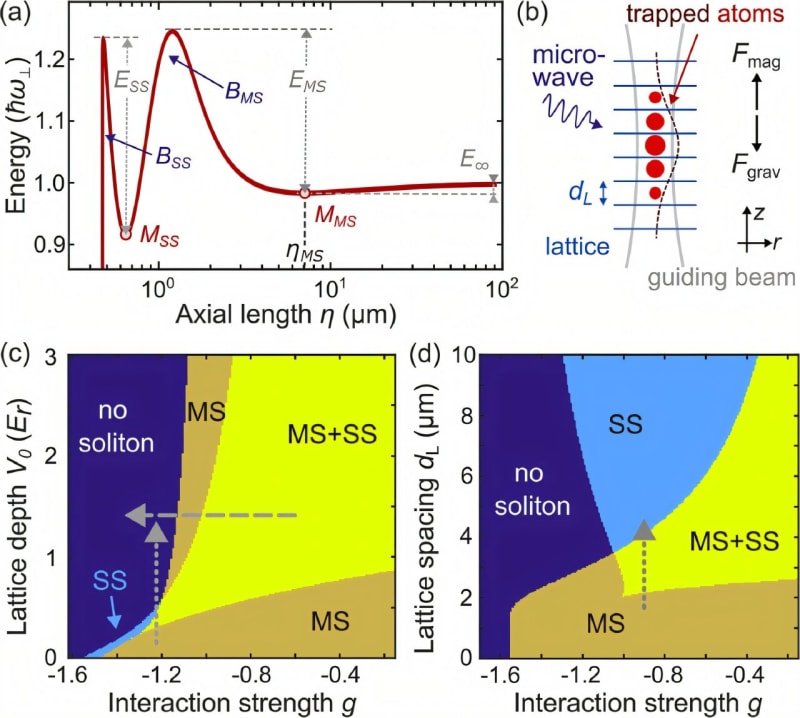
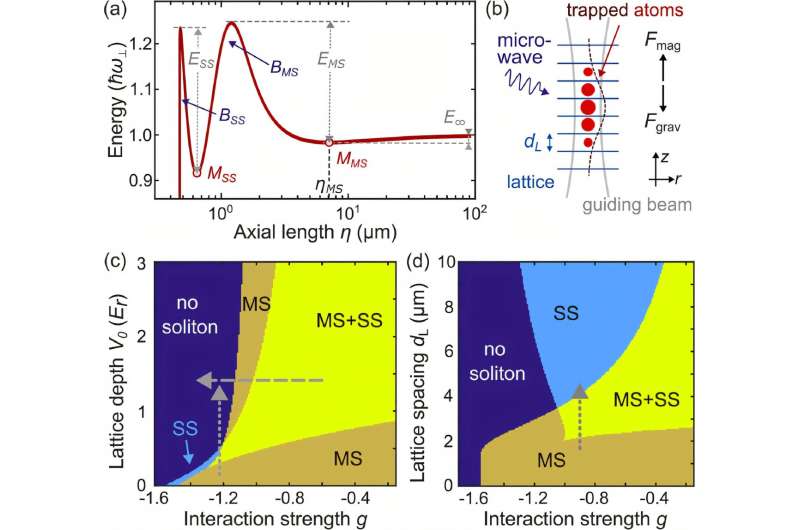
The scientists then created a grid of laser light, like an egg carton made of pure energy. They placed the atoms into this grid and used magnetic fields to make the atoms attract each other, forming tight clusters called solitons.
Getting this to work required perfect balance. Too little magnetic attraction and the atoms would drift apart. Too much and they'd collapse into nothing.
To prove they'd succeeded, the team stretched their laser grid like an accordion, pulling the atoms farther apart. Then they shined light through the grid and measured how the atoms blocked it. The test confirmed something remarkable: the atoms had formed two types of stable structures, some packed into single points and others spread across multiple spots while still acting as one unit.
The Ripple Effect
This discovery opens doors scientists have been trying to unlock for years. The same technique could help build quantum sensors so precise they could detect the tiniest changes in gravity or magnetic fields. It could also help transport quantum information without it degrading, a major hurdle in building practical quantum computers.
The researchers note their work paves the way for exploring many new types of quantum structures. Each advance brings us closer to technologies that seemed like science fiction just decades ago.
What started as atoms in a laser grid could end up revolutionizing everything from medical imaging to weather prediction to secure communications.
More Images
Based on reporting by Phys.org
This story was written by BrightWire based on verified news reports.
Spread the positivity!
Share this good news with someone who needs it