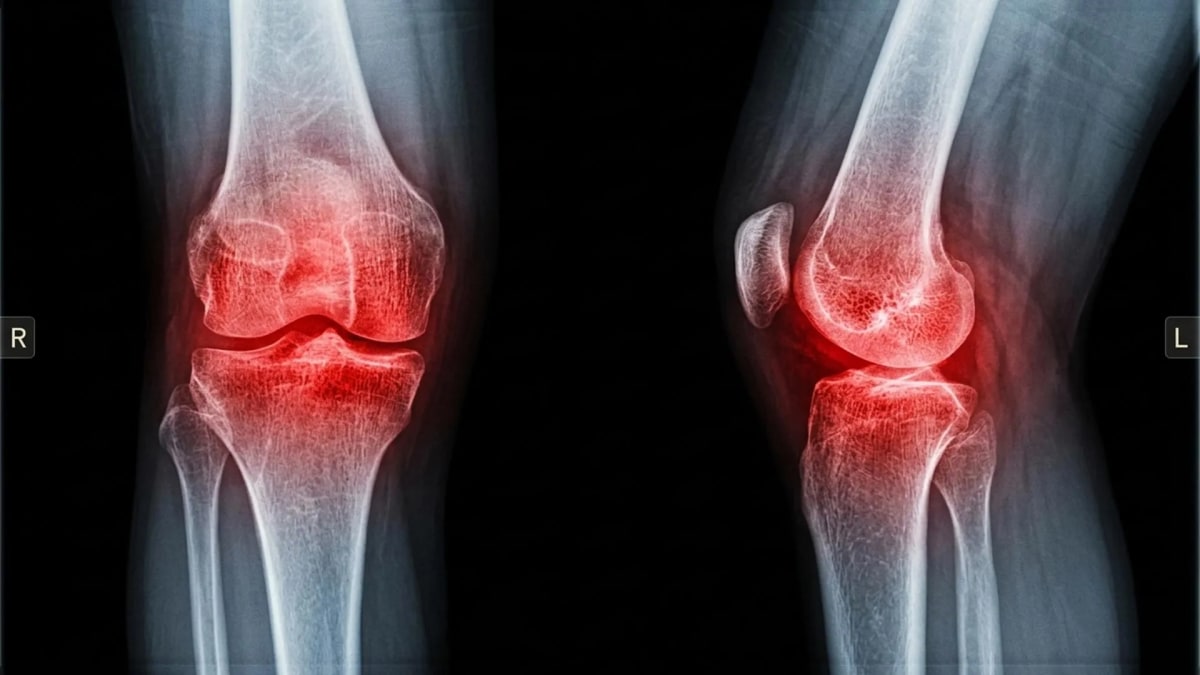
Simple Walking Change Cuts Knee Arthritis Pain Like Pills
A tiny foot angle adjustment while walking relieved knee arthritis pain as well as medication in a yearlong trial. The personalized approach even slowed joint damage inside the knee.
Nearly one in four adults over 40 lives with painful knee osteoarthritis, but a breakthrough study shows relief might be as simple as changing how you walk.
Researchers at the University of Utah, NYU, and Stanford trained people with knee arthritis to make a small, personalized adjustment to their foot angle while walking. After one year, participants reported pain relief matching common medications, and MRI scans showed less cartilage damage than those who received placebo treatment.
The study tackled a challenge that stumped earlier research: the best walking adjustment varies by person. Some people needed to turn their toes slightly inward to reduce knee stress, while others benefited from pointing them outward.
"We used a personalized approach to selecting each individual's new walking pattern," said Scott Uhlrich, assistant professor of mechanical engineering at the University of Utah. The customization likely explains why this trial succeeded where others fell short.
The team enrolled 68 people with mild to moderate knee osteoarthritis. Using motion capture cameras and pressure-sensitive treadmills, they measured each person's gait and determined whether a 5 or 10 degree foot angle change would reduce knee loading most effectively.
Half the participants learned their personalized walking pattern through six weekly training sessions. They wore a shin device that vibrated to help them maintain the correct foot angle, making the new movement feel natural over time.
The other half received sham treatment with foot angles matching their normal walk, controlling for the placebo effect. This rigorous design made it the first placebo-controlled study proving a biomechanical intervention could treat osteoarthritis symptoms and potentially slow joint damage.
After training, participants practiced their new gait for 20 minutes daily. Follow-up visits showed they maintained their prescribed foot angle within one degree on average.
Why This Inspires
Osteoarthritis gradually wears down joint cartilage, and doctors currently cannot reverse that damage. Treatment typically means pain management or eventual joint replacement surgery when symptoms become severe.
This research opens a different door. Instead of medications with side effects or invasive procedures, people might retrain their bodies to protect their own joints while reducing pain naturally.
The approach could become even more accessible as wearable sensors make it possible to measure and adjust foot angle outside the lab. What started as a biomechanical theory is becoming a practical treatment option for millions living with knee pain.
Based on reporting by Health Daily
This story was written by BrightWire based on verified news reports.
Spread the positivity!
Share this good news with someone who needs it