Solar Panel Breakthrough Hits Record 34% Efficiency
Scientists in China just cracked a major solar power challenge, pushing solar panels to 34% efficiency using tiny nanoparticles. The breakthrough could make clean energy cheaper and more accessible worldwide.
Solar panels just got a whole lot better at turning sunlight into electricity, thanks to a clever trick with particles 100,000 times smaller than a human hair.
Researchers at Soochow University in China developed a new type of solar cell that converts 34% of sunlight into usable power. That might not sound revolutionary, but it's a massive leap forward in an industry where every percentage point means billions of dollars in energy savings.
The team, led by Prof. Jiang Liu and Prof. Xiaohong Zhang, tackled one of solar power's biggest headaches. Traditional solar panels waste energy at the microscopic level, where materials meet and charges get lost in translation. Previous attempts to fix this problem either trapped too much energy or let it leak away.
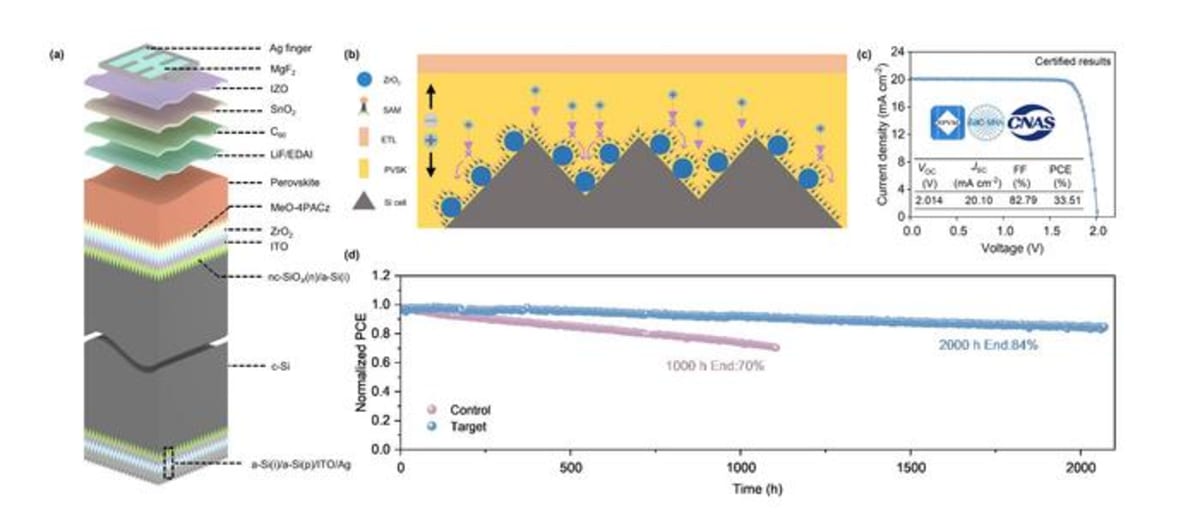
Their solution was surprisingly elegant. They inserted tiny particles of zirconia, a ceramic material, between two layers of the solar cell. These nanoparticles act like microscopic scaffolding, helping the solar material grow more evenly while still allowing electricity to flow freely.
The results speak for themselves. An independent lab confirmed the panels reached 2.014 volts, one of the highest voltages ever recorded for this type of solar cell. The certified version achieved 33.5% efficiency, well above today's commercial panels that typically max out around 20%.
Durability was just as impressive. After running continuously for 2,000 hours under full sunlight conditions, the modified panels still operated at 84% of their original efficiency. That kind of staying power matters when solar installations need to last 25 years or more.
The Ripple Effect
This isn't just a lab curiosity. China produces most of the world's solar panels, and the research team partnered with LONGi, one of the planet's largest solar manufacturers. That connection means these improvements could reach factory floors faster than usual.
Better efficiency translates directly to lower costs per watt of electricity. Homeowners could generate more power from smaller rooftops. Utilities could produce more clean energy from the same amount of land. Countries working to phase out fossil fuels could accelerate their timelines.
The technology combines two types of solar materials: perovskite and silicon. Silicon panels already dominate the market because they're reliable and relatively cheap. Perovskites are newcomers that capture different wavelengths of light. Layer them together properly, and you capture more of the sun's energy spectrum.
Other research teams have been racing toward similar goals, but the zirconia nanoparticle approach solved multiple problems at once without creating new trade-offs. The nanoparticles improved both the material quality and electrical performance simultaneously.
The study appeared in Science Bulletin, marking another step in solar power's steady march toward matching and beating fossil fuel costs worldwide.
More Images
Based on reporting by Google: solar power breakthrough
This story was written by BrightWire based on verified news reports.
Spread the positivity!
Share this good news with someone who needs it