%2Ffile%2Fattachments%2F2994%2FBW_SD3_113_589531.jpg)
South Africa Tackles Math Anxiety at Its Roots
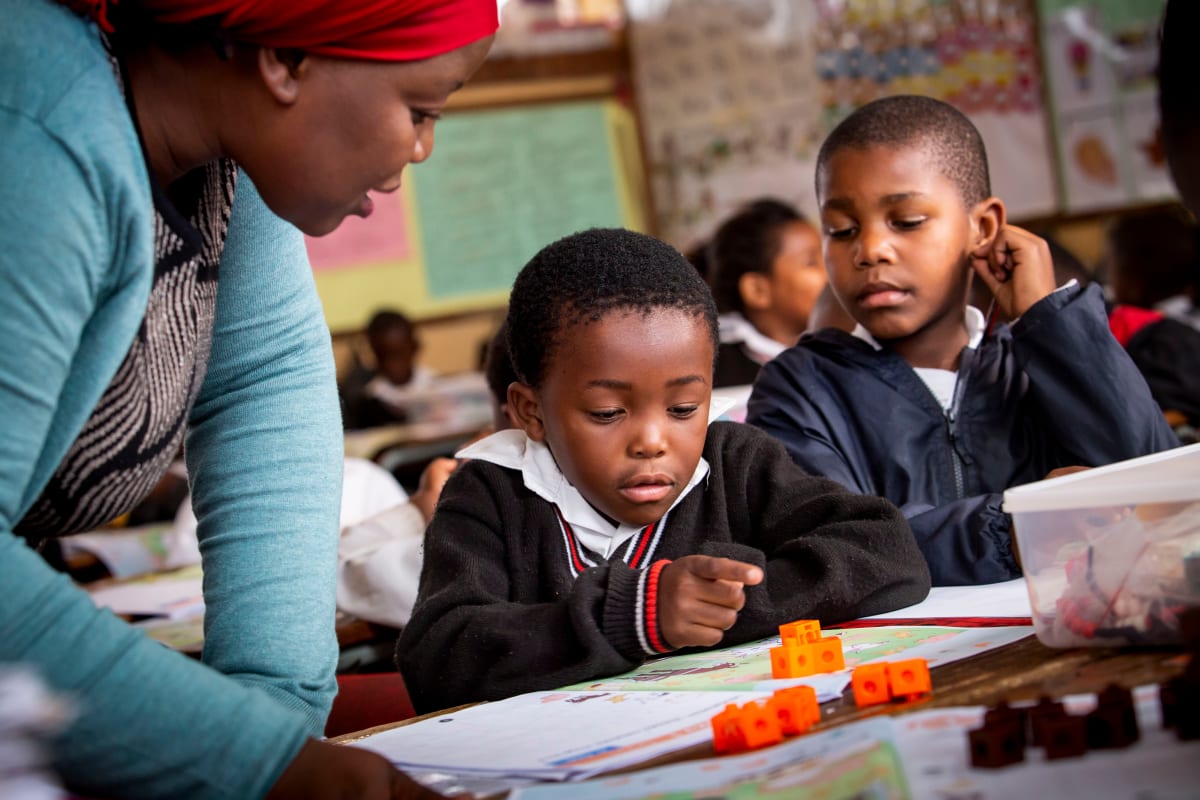
A new program in South African schools is breaking the cycle of math fear by teaching teachers first. Bala Wande focuses on building confidence in young children before they ever think "math isn't for me."
What if the reason so many people hate math started long before algebra class?
In South Africa, a nonprofit called Funda Wande identified the problem. When teachers lack confidence in math, kids pick up on that anxiety and carry it through life. When parents say "I was never good at math," children learn that giving up is acceptable.
The organization launched Bala Wande, a math program designed to stop the fear before it starts. The program trains foundation phase teachers in deep conceptual understanding, not just memorization tricks. Teachers learn to explain why math works, not just how to plug numbers into formulas.
The timing matters more than most people realize. Research shows children develop basic math skills naturally as preschoolers. They understand symmetry through building blocks and fairness by dividing snacks equally. Kids as young as six months can distinguish between different quantities.
But somewhere around ages five or six, when formal math education begins, something shifts. Students who don't grasp whole numbers struggle with integers later. Without solid integer knowledge, rational numbers become impossible. One weak year creates a domino effect that can last a lifetime.
Bala Wande attacks this cycle at multiple points. The program gives teachers high-quality materials that build concepts step by step along learning trajectories. Instead of teaching recipes, teachers learn to help children think analytically about what to solve and how to approach it.
The program also addresses a unique challenge in math education. Unlike science with its visible experiments or language that students use daily, abstract math concepts lack practical examples children can touch. Calculus and number systems feel disconnected from real life, making them harder to remember and easier to abandon.
The Ripple Effect
When teachers gain mathematical confidence, that assurance spreads to entire classrooms of young learners. Children who build strong foundations in primary grades don't hit the wall in later years when algebra and trigonometry arrive. They see math as a subject they can master, not a monster waiting to defeat them.
The shift from "I can't do math" to "I can learn this" changes more than test scores. It opens career paths in science, technology, engineering and finance that seemed impossible before. It breaks generational patterns where parents pass math anxiety to their children.
By catching kids at ages five and six, when they're still open and curious, Bala Wande is rewriting the story that math talent is something you're born with or without.
One confident teacher at a time, South African classrooms are proving that math ability isn't fixed, and giving up doesn't have to be the ending everyone expects.
More Images

%2Ffile%2Fattachments%2F2994%2FBW_SD1_022_572233.jpg)
%2Ffile%2Fattachments%2F2995%2FDM-17072026_449068.jpg)
Based on reporting by Daily Maverick
This story was written by BrightWire based on verified news reports.
Spread the positivity!
Share this good news with someone who needs it

%2Ffile%2Fattachments%2Forphans%2FFeatureimage24Aug_HaberdoedasPhotography_Pexelscopy_135558.jpg)