Space Telescope Finds Soccer-Ball Molecules in Dying Star
Scientists just discovered buckyballs—60-atom carbon molecules shaped like soccer balls—arranged in a giant hollow sphere inside a 10,000-light-year-distant nebula. The James Webb Space Telescope also captured a mysterious question mark structure that has astronomers buzzing with new questions about how dying stars shape the universe.
Scientists peering into a dying star 10,000 light years away just found something remarkable: tiny soccer-ball-shaped molecules arranged in the pattern of one giant soccer ball.
The molecules are called buckyballs, and they're made of 60 carbon atoms bonded together into spheres with 20 hexagons and 12 pentagons. Think of a classic black-and-white soccer ball, but microscopic and floating in space.
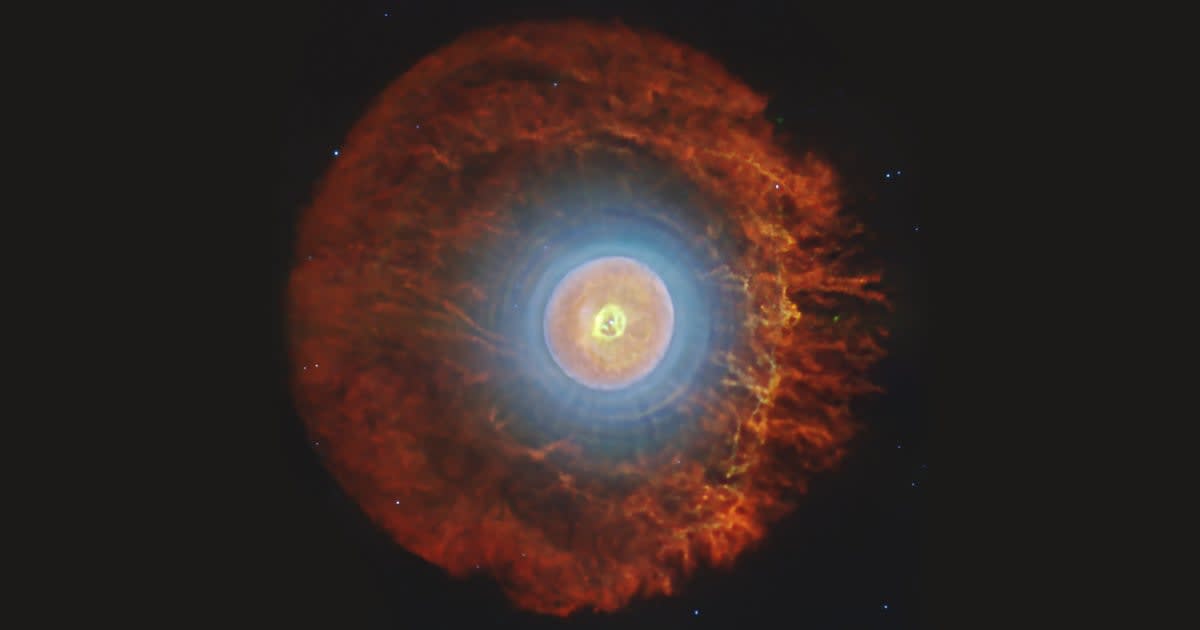
The James Webb Space Telescope captured stunning new images of a planetary nebula called Tc 1 in the Ara constellation. Despite their name, planetary nebulas have nothing to do with planets. They're clouds of gas and dust exploded from dying stars.
Tc 1 already made history in 2010 when astronomers first confirmed buckyballs exist in space. Scientists had theorized these molecules could be out there since 1985, but Tc 1 gave them proof.
Now the same research team is back with images so detailed they reveal structures completely invisible before. Hot gas glows blue in the center, surrounded by cooler red gas. At the heart sits a white dwarf, the dense core of what was once a star.
The new images show something unexpected: a structure shaped like an upside-down question mark. Scientists don't yet know what created it.
"Tc 1 was already extraordinary, but this new image shows us we had only scratched the surface," said Jan Cami, who led both the original 2010 study and this new project. "The structures we're seeing now are breathtaking, and they raise as many questions as they answer."
The team mapped where all the buckyballs are located and discovered they form a spherical shell around the dying star. Morgan Giese, a Ph.D. candidate who led the analysis, described it perfectly: "Buckyballs arranged like one giant buckyball."
Why This Inspires
This discovery shows how much we still have to learn about the universe. A nebula studied for over a decade just revealed entirely new mysteries when viewed with better tools.
The findings will help scientists understand how dying stars evolve and what chemistry fuels the cosmos. Every new detail about buckyballs and their distribution teaches us more about the building blocks scattered throughout space.
Charmi Bhatt, another Ph.D. candidate on the team, emphasized that beyond the beauty, this is groundbreaking data. The telescope's sharpness reveals shells, rays, and fine details never seen before, connecting what they see directly to the chemistry and physics happening throughout the nebula.
These aren't just pretty pictures. They're answers to questions we've been asking for years, and new questions we didn't even know to ask yet.
More Images



Based on reporting by Scientific American
This story was written by BrightWire based on verified news reports.
Spread the positivity!
Share this good news with someone who needs it