Spain's Golden Eclipse Dazzles With Rare Sunset Glow
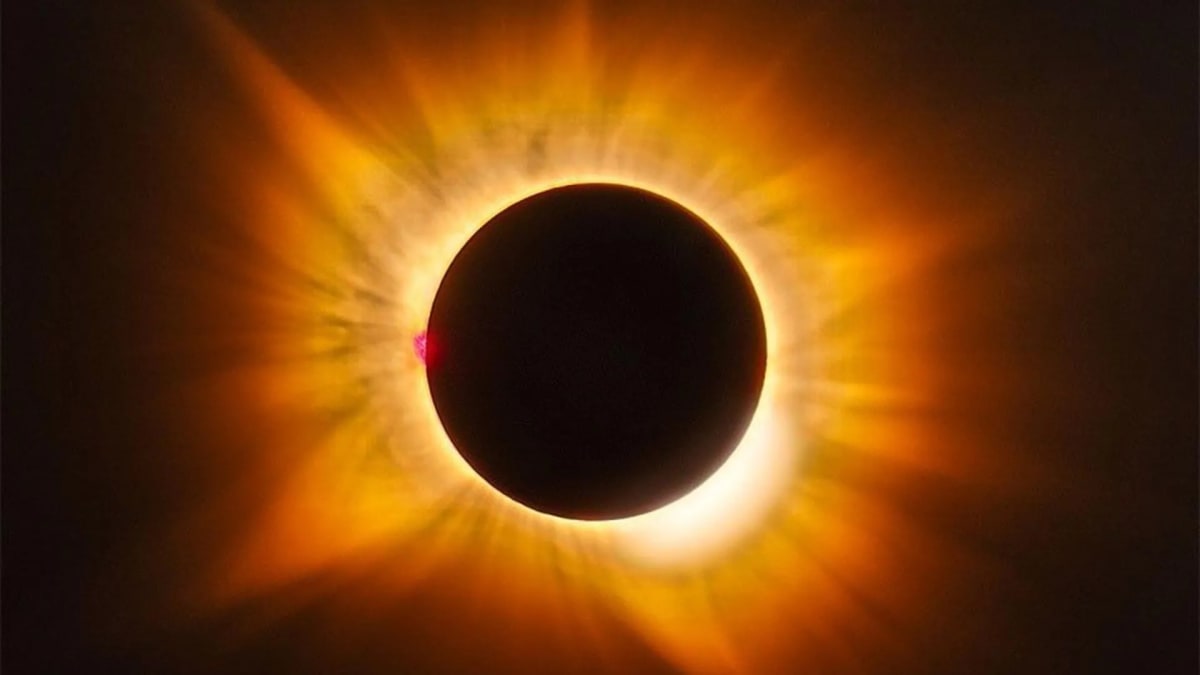
Last week's total solar eclipse over Spain turned an unexpected golden color, thanks to wildfire smoke and a setting sun that filtered out blue light. Photographers captured the stunning phenomenon alongside a brilliant pink solar flare.
Skywatchers in Spain witnessed something most eclipse chasers never see: a total solar eclipse glowing rich gold instead of its usual silvery white.
The rare spectacle happened last week when the moon blocked the sun just as it dipped toward the horizon. Timing made all the difference in creating this celestial light show.
During a typical total eclipse, the sun's outer atmosphere (called the corona) appears pearly white when the moon covers the bright disk. But in Spain, observers saw something remarkably different as the eclipse coincided with sunset.
When the sun sits low on the horizon, its light travels through much more of Earth's atmosphere to reach our eyes. Air molecules along that longer path scatter blue wavelengths of light, the same process that paints our sunsets orange and red.
Nature added an extra filter that day. Smoke from nearby forest fires hung in the air, scattering even more blue light and intensifying the golden tones surrounding the eclipsed sun.
Photographer Rui Santos captured the moment from Benavente, Spain, using multiple exposures combined through HDR imaging. This technique preserved both the faintest and brightest details in a single striking photograph.
Not everything turned gold. A massive pink prominence remained vivid along the sun's left edge, standing out dramatically against the unusual golden corona.
Why This Inspires
Solar prominences are enormous structures of glowing plasma shaped by the sun's magnetic fields. This one emitted light strongly associated with hydrogen, allowing its bright pink color to survive the atmospheric filtering while everything else shifted gold.
The image shows how Earth's atmosphere and unexpected events like wildfires can transform even the most carefully predicted celestial events into once-in-a-lifetime surprises. Scientists knew exactly when and where the eclipse would occur, but nature added its own artistic touch.
Total solar eclipses already rank among the most spectacular natural phenomena visible from Earth. This golden version reminds us that the universe still has new ways to amaze us, even during events humans have observed for thousands of years.
The next total solar eclipse visible from Europe won't occur until 2027, giving plenty of time for sky enthusiasts to wonder what unexpected beauty that one might bring.
Based on reporting by Science Daily
This story was written by BrightWire based on verified news reports.
Spread the positivity!
Share this good news with someone who needs it