Spanish Nano-Coating Makes Satellites Safer, Greener
Spanish researchers created an invisible shield from gold and silver nanoparticles that protects satellites from a destructive electron avalanche, replacing a toxic compound that's been the industry standard for 40 years.
For more than four decades, satellite makers have relied on a chromium-based compound called Alodine to protect their equipment from a potentially catastrophic failure. That compound works well but poses serious risks to workers' health and the environment.
Now a team at Spain's Institute of Materials Science of Madrid has developed a cleaner, more effective alternative. Their innovation uses tiny nanoparticles of gold and silver to create an ultra-thin protective coating that outperforms the old standard.
The problem they solved is called the multipactor effect. Inside satellite components like antennas and waveguides, electrons can trigger an avalanche-like chain reaction in the vacuum of space. This cascade can permanently damage critical communications equipment, crippling satellites that cost millions to launch.
Researcher Lidia Martínez explains that previous attempts to replace Alodine focused on changing materials at the microscopic level. Her team went much smaller, working at the nanoscale with features measured in billionths of a meter.
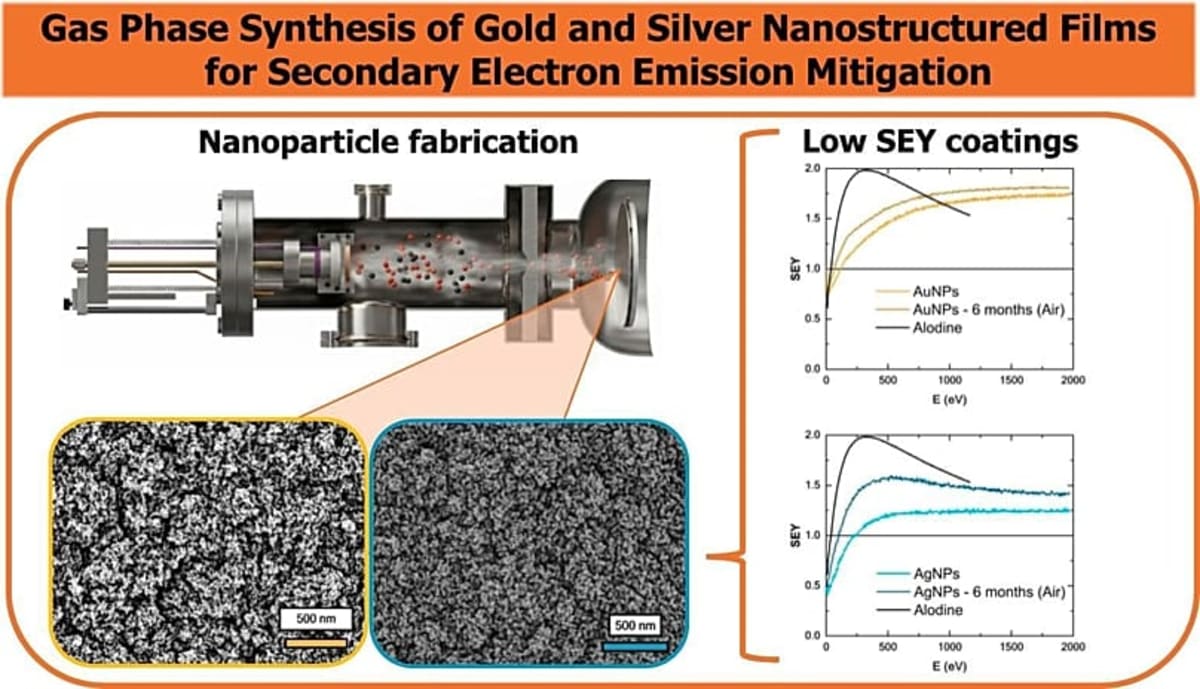
They created gold and silver particles just four to eight nanometers in size using a technique that deposits them without solvents or chemical residues. The result is a porous metallic film that's chemically clean and remarkably effective.
Tests at European Space Agency-accredited labs showed the coating reduces harmful electron emissions by 30% compared to Alodine. Even more impressive, it improves the threshold at which materials start generating excess electrons by up to 300% in some configurations.
The team subjected their coatings to six months of aging tests and temperatures of 150°C, mimicking what satellites endure when exposed to direct sunlight in orbit. While performance declined slightly over time, it still exceeded freshly applied Alodine.
The technology is now covered by a joint European patent filed in July 2025 by CSIC and Nanostine, a spin-off company created to commercialize the coating. The development received funding from the Community of Madrid and support from the ESA Business Innovation Centre.
Why This Inspires
This breakthrough shows how thinking smaller can solve bigger problems. By working at the nanoscale, the Spanish team created a solution that protects both satellites and the people who build them.
The space industry has been searching for an Alodine replacement for years as European authorities pushed to ban the toxic compound. This coating finally delivers the performance leap the sector needed while eliminating health and environmental hazards.
Martínez remains realistic about timelines, noting that getting a new coating approved for actual space use typically takes about a decade. The European Space Agency has expressed satisfaction with the solution, but several validation stages remain before these materials fly on satellites.
Innovation happens when scientists refuse to accept that harmful solutions are the only option.
More Images



Based on reporting by Euronews
This story was written by BrightWire based on verified news reports.
Spread the positivity!
Share this good news with someone who needs it