Spirit Trees Protect Indonesia's Wildlife by Accident
In Indonesian Borneo, Indigenous beliefs about spirits living in fig trees have accidentally created a network of wildlife refuges across farmland. The tradition is fading, but its ecological impact offers lessons for conservation worldwide.
In the forests of Indonesian Borneo, some trees survive not because of laws or fences, but because people believe cutting them down could kill you.
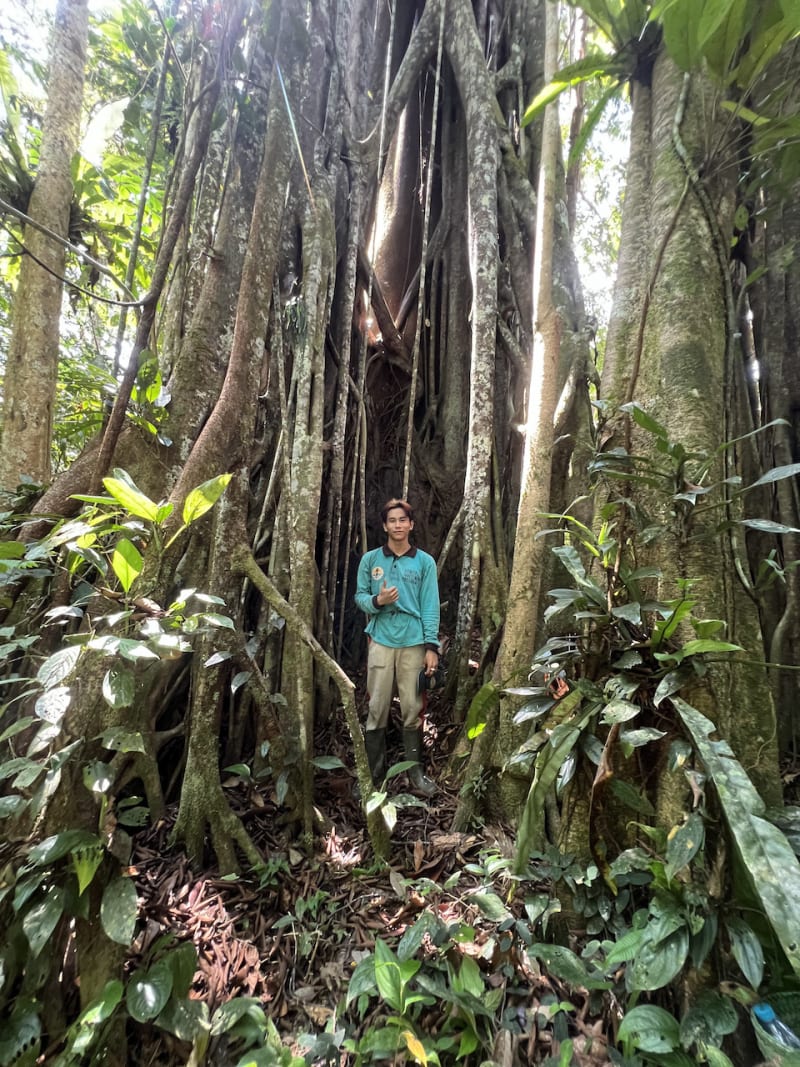
The Indigenous Iban people of Sungai Utik consider large strangler fig trees to be homes for spirits. These spirits, according to local stories, can mislead travelers, cause illness, or worse. One boy vanished near a rice field and was found hours later beside a towering fig, claiming spirits had hidden him in plain sight. His family brought him to a shaman and changed his name to break the spirits' hold.
The tree stayed standing.
When the Iban clear land for farming, they leave these fig trees untouched. They also preserve a ring of forest around each one, creating small islands of vegetation called dipulau scattered through their fields. These islands take up only 1 or 2 percent of farmland, but their impact runs deeper than their size suggests.
Different strangler fig species fruit at different times throughout the year. When other food sources disappear, birds, monkeys, and wild pigs gather at these trees. Wildlife now travels between forest and farmland using these islands as stepping stones across an otherwise cleared landscape.
Researchers measuring the trees found something remarkable. Strangler figs are just as common in Iban farmland as in nearby old-growth forest. The ones in fields often grow even larger, free from competition with other trees. The spiritual tradition has accidentally preserved an agricultural landscape with real ecological value.
The Ripple Effect
This isn't conservation driven by government policy or outside incentives. Scientists call it autonomous conservation, where shared beliefs shape land use without any external enforcement. The Iban weren't trying to protect biodiversity. They were honoring traditions and avoiding spiritual danger. The wildlife benefit came as an unintended gift.
The practice faces an uncertain future. Most villagers now practice Catholicism rather than traditional beliefs. Younger residents increasingly question whether spirits truly punish those who cut down fig trees. A few have tested the taboo and lived without obvious consequences.
Yet the tradition still holds, even if less tightly than before. Researchers see this erosion as significant because the belief system has measurably protected habitat that supports dozens of species. It has preserved trees that seed forest regeneration and maintained corridors for animal movement across generations.
Whether spirits actually live in strangler figs matters less than what the belief has accomplished. For decades, these forests have been spared because cutting certain trees felt like crossing a line people shouldn't cross.
In a world struggling to protect what remains of wild spaces, that line offers unexpected hope.
More Images



Based on reporting by Mongabay
This story was written by BrightWire based on verified news reports.
Spread the positivity!
Share this good news with someone who needs it