Students Build Dark Matter Detector, Shrink Cosmic Mystery
A group of undergrads at the University of Hamburg just proved you don't need a massive lab to hunt for dark matter. Their scrappy, student-funded detector produced real scientific data that helps narrow the search for one of physics' biggest mysteries.
A group of undergraduate students just did something most physicists would say requires millions in funding and years of expertise. They built their own dark matter detector.
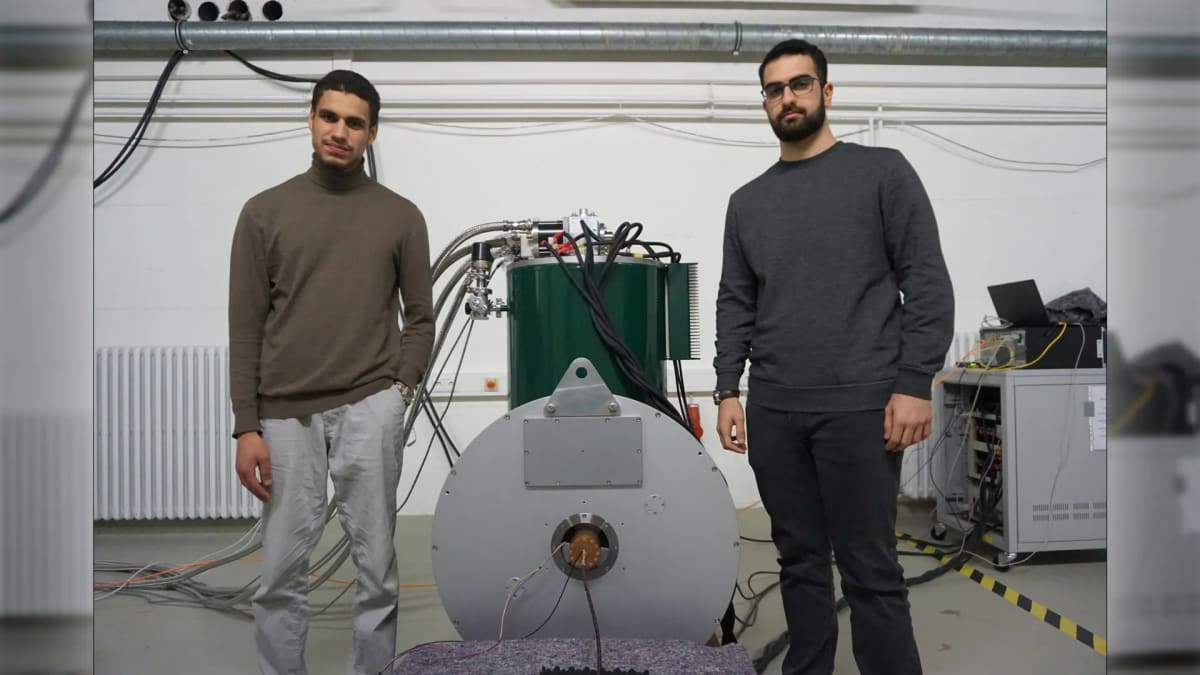
Working out of the University of Hamburg with a student research grant, the team designed a compact cavity detector to hunt for axions, leading candidates for the invisible matter that makes up most of our universe. Their results, published in the Journal of Cosmology and Astroparticle Physics, established new experimental limits on axion properties.
"The detector we built is essentially the simplest version of a cavity detector for dark matter," says Nabil Salama, one of the study's authors. The team stripped complex experiments down to their essential components, creating a less sensitive setup but one still capable of producing new scientific data.
The students had some help. They received support from the MADMAX dark matter experiment research group and access to university equipment like magnets. But the design, construction, and testing were all student-led.
"The benefit of working with dark matter is that we expect it to be present everywhere in our galaxy," explains first author Agit Akgümüs. "So essentially, no matter where you perform the experiment, you have some dark matter on your hand you can do experiments with."
The team didn't detect axions. But that's still progress. Their null result helps rule out axions with certain characteristics in the tested mass range, narrowing the cosmic hiding space for these elusive particles.
Why This Inspires
During peer review, one referee made a striking observation. Once axions are discovered and their properties known, experiments like this could become standard teaching lab setups.
"We were told that setups like ours could one day become standard student lab experiments," says Salama. "In a way, we may have anticipated that future, showing that it is already possible to build and operate such an experiment on a small scale."
The project proves that meaningful scientific contributions don't always require massive observatories and international collaborations. Sometimes all you need is creativity, institutional support, and students willing to tackle one of physics' biggest puzzles with whatever tools they can get their hands on.
Finding dark matter will likely require many experiments probing different regions of possibility. These Hamburg students just showed that the next breakthrough could come from anywhere, even a student research project.
Based on reporting by Science Daily
This story was written by BrightWire based on verified news reports.
Spread the positivity!
Share this good news with someone who needs it