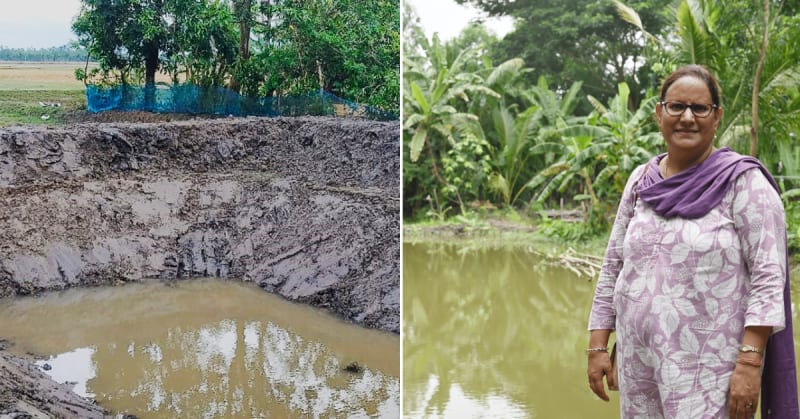
Sundarbans Farmers Store 136M Liters With 319 New Ponds
In a village where water decided everything, 1,950 farmers gave up parts of their fields to dig ponds that now store enough rainwater to irrigate crops all year. What started in weekly meetings became a village-wide solution to vanishing groundwater and salty rivers.
When monsoon rains arrived in Jeliakhali, farmers watched the water disappear almost as quickly as it came, taking their fertile soil with it.
For years, this village in India's Sundarbans struggled with a cruel paradox. Four saltwater rivers surrounded them, but fresh water grew scarcer each season as groundwater levels dropped and wells ran dry.
In May 2024, farmers began making an unexpected choice. They started digging into their own farmland, converting precious growing space into ponds that could capture and hold rainwater.
The decision didn't happen overnight. Gram Samriddhi Foundation had been holding weekly meetings with farmers, discussing ways to reduce costs and improve income. During these conversations, someone noticed that heavy rains were washing nutrient-rich soil down slopes and into canals every monsoon.
Ponds dug along those slopes could stop the erosion and store the water farmers desperately needed. The excavated soil could go back onto fields, and the stored rainwater could irrigate vegetables without draining groundwater meant for drinking.
Between May 2024 and June 2025, about 1,950 farmers across Jeliakhali participated. Together, they created 319 ponds that now store 136 million liters of rainwater annually.
Each pond holds roughly 113,000 liters during monsoon season. That's enough to irrigate crops through the dry months when saltwater rivers offer no help and groundwater pumps used to be the only option.
Giving up farmland required trust. Most families in this village of 5,084 people depend entirely on fishing and farming, so every square foot matters.
Gram Samriddhi Foundation offered training and promised fruit saplings to plant around pond edges. Farmers began seeing how one pond could serve multiple purposes: storing water, raising fish, preserving soil, and growing fruit for extra income.
The ponds took only hours to dig with machinery, but the real work happened in those weekly meetings. Farmers with old, undredged ponds agreed to clean them out. Those without ponds offered portions of their land.
The Ripple Effect
Jeliakhali sits among nearly 1,100 Sundarbans villages facing similar water challenges. Of the village's 489 hectares of farmland, 464 hectares had no irrigation before the ponds arrived.
Now other villages are watching. The solution addresses multiple problems at once: it reduces pressure on drinking water, prevents soil erosion, extends the growing season, and creates opportunities for fish farming.
What worked here wasn't expensive technology or government intervention. It was farmers meeting weekly, sharing observations, and deciding together that giving up a little land now meant keeping their farms alive year-round.
The ponds are filling again this monsoon, storing another year's worth of hope.
More Images
%2Fenglish-betterindia%2Fmedia%2Fmedia_files%2F2026%2F02%2F11%2Ffeatured-img-10-2026-02-11-18-49-37.png)
%2Ffilters%3Aformat(webp)%2Fenglish-betterindia%2Fmedia%2Fmedia_files%2F2026%2F02%2F11%2Ffeatured-img-2026-02-11-19-30-46.png)
%2Ffilters%3Aformat(webp)%2Fenglish-betterindia%2Fmedia%2Fmedia_files%2F2026%2F02%2F11%2Ffeatured-img-2026-02-11-19-35-26.png)
Based on reporting by The Better India
This story was written by BrightWire based on verified news reports.
Spread the positivity!
Share this good news with someone who needs it