Supercomputers Crack 50-Year Mystery About Giant Stars
Scientists finally solved a decades-old puzzle about red giant stars using cutting-edge supercomputers. The secret? Spinning stars mix their insides far better than anyone thought possible.
After 50 years of mystery, astronomers just figured out how red giant stars shuffle material from their deep cores to their surfaces.
The answer came from massive supercomputer simulations that revealed something surprising. Stellar rotation acts like a cosmic blender, mixing elements across barriers inside stars that scientists thought were nearly impenetrable.
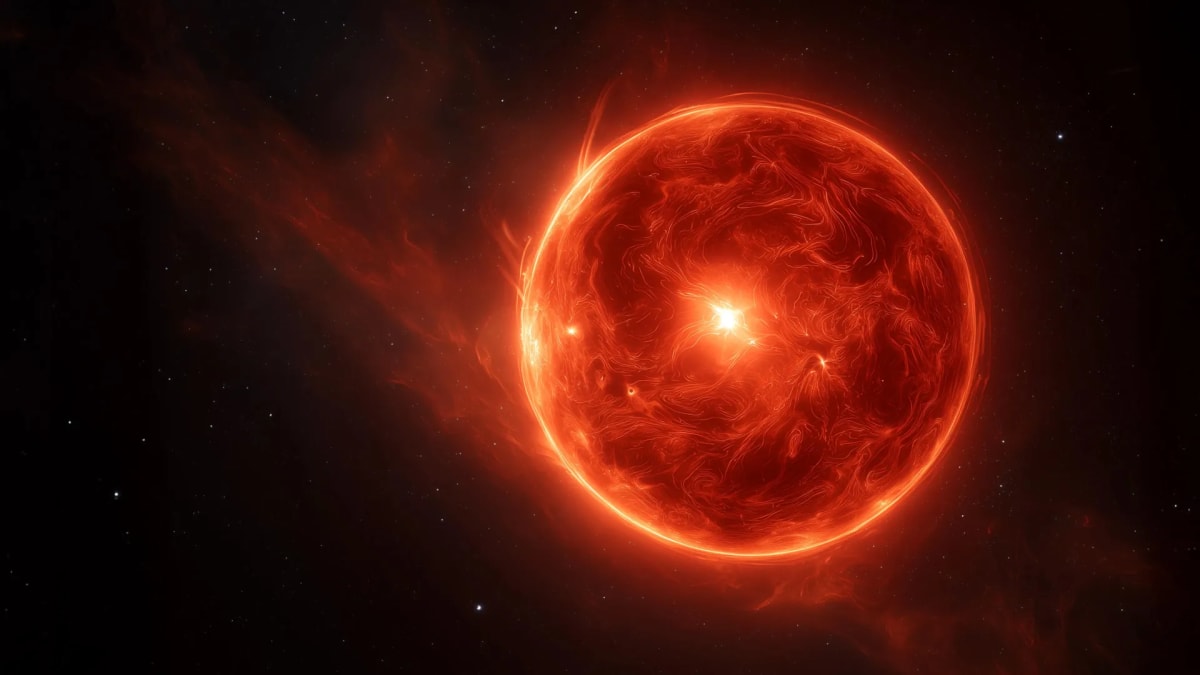
Red giants are what stars like our Sun become when they run out of hydrogen fuel and balloon to 100 times their original size. Since the 1970s, astronomers noticed these giant stars showed weird chemical changes on their surfaces, but nobody could explain how material traveled from the star's core through a stable layer that should have blocked it.
Simon Blouin, a postdoctoral fellow at the University of Victoria, led the team that cracked the case. "Stellar rotation is crucial and provides a natural explanation for the observed chemical signatures in typical red giants," he says.
The researchers discovered that rotation boosts mixing rates by more than 100 times compared to non-rotating stars. Internal waves generated by churning motions in the star get dramatically amplified when the star spins, allowing them to transport material across the barrier layer.
The breakthrough only became possible thanks to recent advances in supercomputing power. The team used systems including Trillium, one of Canada's most powerful academic supercomputers launched in August 2025.
"We were able to discover a new stellar mixing process only because of the immense computing power of the new Trillium machine," says Falk Herwig, principal investigator and director of the Astronomy Research Centre. These simulations represent the most computationally intensive stellar convection studies ever performed.
Why This Inspires
This discovery does more than solve an astronomy riddle. It shows what becomes possible when we give scientists the right tools to tackle big questions.
The computational methods developed for this research can help us understand fluid motion in many systems beyond stars. Researchers are already adapting these approaches to study ocean currents, atmospheric patterns, and even blood flow in the human body.
Since our Sun will eventually become a red giant in about five billion years, this research gives us a window into our own star's future. Understanding how these stars work helps us grasp our place in the cosmos and how stellar evolution shapes the universe.
Blouin plans to continue exploring how rotation affects different types of stars at various evolutionary stages. Each new simulation brings us closer to understanding the full story of how stars live, change, and ultimately die.
A half-century mystery just became our newest cosmic breakthrough.
Based on reporting by Science Daily
This story was written by BrightWire based on verified news reports.
Spread the positivity!
Share this good news with someone who needs it