The Simpsons Hid a Brilliant Math Joke for 26 Years
A 1998 episode of The Simpsons featured a sneaky equation that appears to disprove one of math's most famous theorems. The joke was planted by a writer who studied under the mathematician who helped crack the centuries-old puzzle.
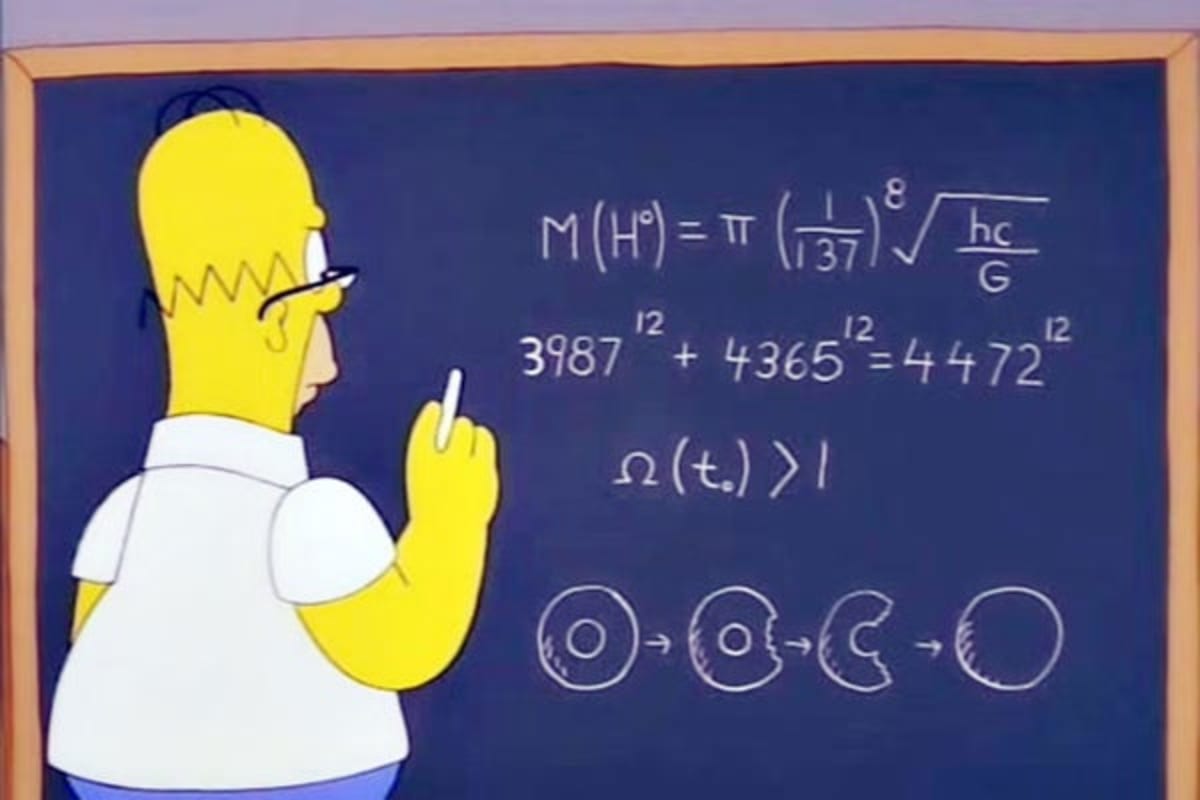
When Homer Simpson stood at a blackboard covered in equations in 1998, most viewers saw just another silly cartoon moment. But math lovers spotted something extraordinary: an equation that seemed to break one of the most celebrated proofs in history.
The equation read 3,987^12 + 4,365^12 = 4,472^12. Punch it into a basic calculator and it looks correct. The problem? It appears to violate Fermat's Last Theorem, a mathematical puzzle that stumped scholars for over 350 years.
Pierre de Fermat, a 17th-century French mathematician, claimed no three positive whole numbers could satisfy the equation x^n + y^n = z^n when n is greater than 2. He scribbled this claim in a book margin but never wrote down his proof. Generations of mathematicians tried and failed to prove him right.
In 1994, mathematician Andrew Wiles finally cracked it using advanced mathematical concepts that took him years to develop. His groundbreaking work earned him the Abel Prize, one of math's highest honors. Nobody seriously doubts his proof is correct.
So did Homer Simpson just disprove centuries of mathematical work? Not quite. The trick lies in your calculator's limitations.
Regular calculators only display about 10 digits, but those numbers in Homer's equation are massive, containing 44 digits each. When you use a more powerful calculator, the equation doesn't actually balance. It just appears to work because of rounding errors.
Why This Inspires
The genius behind this joke was writer David X. Cohen, who has a background in computer science. He wrote a custom computer program specifically to find numbers that would fool a basic calculator while honoring the real mathematical truth.
Even better, Cohen chose this particular theorem for personal reasons. As a student, he attended lectures by Ken Ribet, the mathematician whose preliminary work helped Wiles complete his famous proof. The Easter egg was a clever tribute to his academic roots.
This isn't the only time The Simpsons has hidden advanced math jokes in plain sight. Many of the show's writers hold degrees in mathematics, physics, or computer science, and they've packed episodes with clever references that reward careful viewers.
The blackboard scene proves something wonderful: smart, playful humor can thrive anywhere, even in a cartoon about a bumbling dad who loves doughnuts.
More Images


Based on reporting by Scientific American
This story was written by BrightWire based on verified news reports.
Spread the positivity!
Share this good news with someone who needs it