Tiny Catalyst Makes Green Hydrogen 1.5x More Efficient
Scientists have created microscopic catalysts using just 15 atoms of rare metal that make clean hydrogen production significantly cheaper and more efficient. This breakthrough could accelerate the shift to renewable energy worldwide.
Green hydrogen just got a major boost from some incredibly tiny helpers.
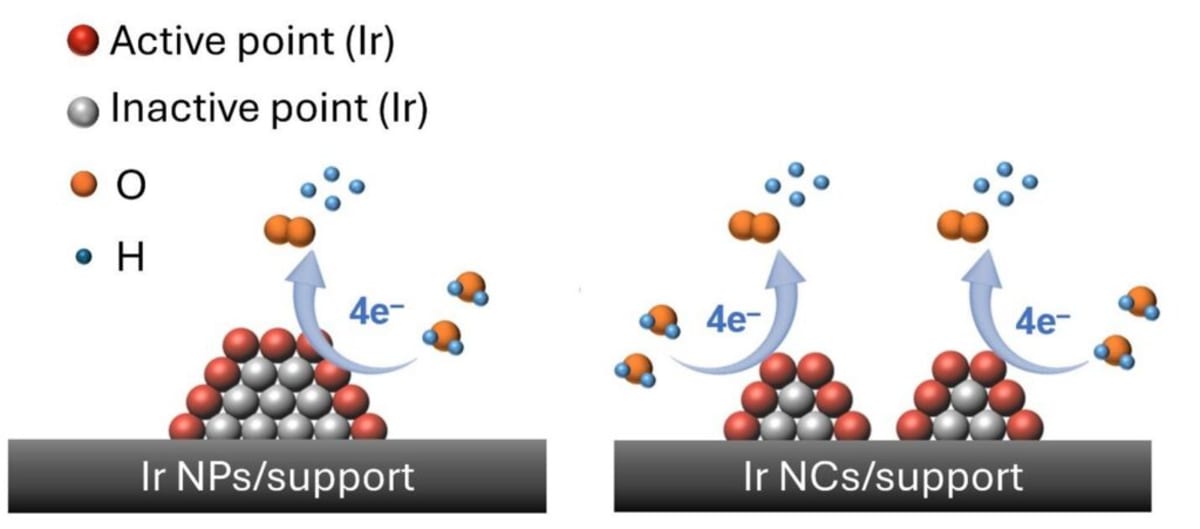
An international team of researchers from the University of Adelaide, Tohoku University, Tokyo University of Science, and Vanderbilt University has developed microscopic catalysts that outperform current technology by 1.5 times. These catalysts use only 15 atoms of iridium, a rare and expensive metal crucial for producing hydrogen from water.
Green hydrogen is made by splitting water into hydrogen and oxygen using renewable electricity. The process could power everything from cars to factories without carbon emissions, but there's been one expensive problem holding it back.
The splitting process happens in a highly acidic, corrosive environment that destroys most materials. Iridium is one of the few metals tough enough to survive, but it's rare and costly, making green hydrogen production expensive at scale.
Scientists have been racing to use less iridium while maintaining performance. The breakthrough came from making the metal particles incredibly small, measuring just 0.9 nanometers (about 100,000 times smaller than a human hair).
The challenge with shrinking metals this small is that they typically become unstable when exposed to air. The research team solved this by wrapping each tiny cluster in protective molecules of carbon monoxide and triphenylphosphine, creating a stable catalyst that could be manufactured in open air.
The miniaturization changed how the iridium atoms behave at the electronic level, making chemical reactions happen more efficiently. In testing, the new catalysts ran continuously for more than 20 hours without losing performance.
The Ripple Effect
This discovery arrives as countries worldwide race to build clean energy infrastructure. Green hydrogen is considered essential for decarbonizing heavy industries like steel and cement production, as well as long-haul transportation where batteries fall short.
Making the production process cheaper and more efficient removes a major barrier to adoption. When one of the rarest, most expensive components can deliver 1.5 times better performance while using far less material, the economics of clean energy shift dramatically.
The research also opens doors for creating other ultra-small metal catalysts. The same protective approach could work with different metals and chemical reactions, potentially improving efficiency across multiple clean energy technologies.
Yuichi Negishi from Tohoku University believes the findings mark a turning point. "We expect these findings to mark a new milestone in metal nanocluster and green hydrogen research, as it may help us create cost-effective, high-performance metal nanoclusters to solve pressing global energy and environmental challenges," he said.
The results were published in the Journal of the American Chemical Society, making the research available to scientists and engineers worldwide who can now build on this foundation.
Sometimes the smallest innovations create the biggest ripples toward a cleaner future.
More Images


Based on reporting by Google News - Australia Breakthrough
This story was written by BrightWire based on verified news reports.
Spread the positivity!
Share this good news with someone who needs it