UCLA Creates Hologram System Without Image Blurring
Scientists at UCLA just solved a major problem that's been holding back realistic holographic displays. Their new system prevents images from bleeding together, bringing us closer to Star Trek-style 3D projections.
Imagine watching a 3D movie without glasses, where the images look solid enough to touch. Scientists at UCLA just made that future feel a lot closer.
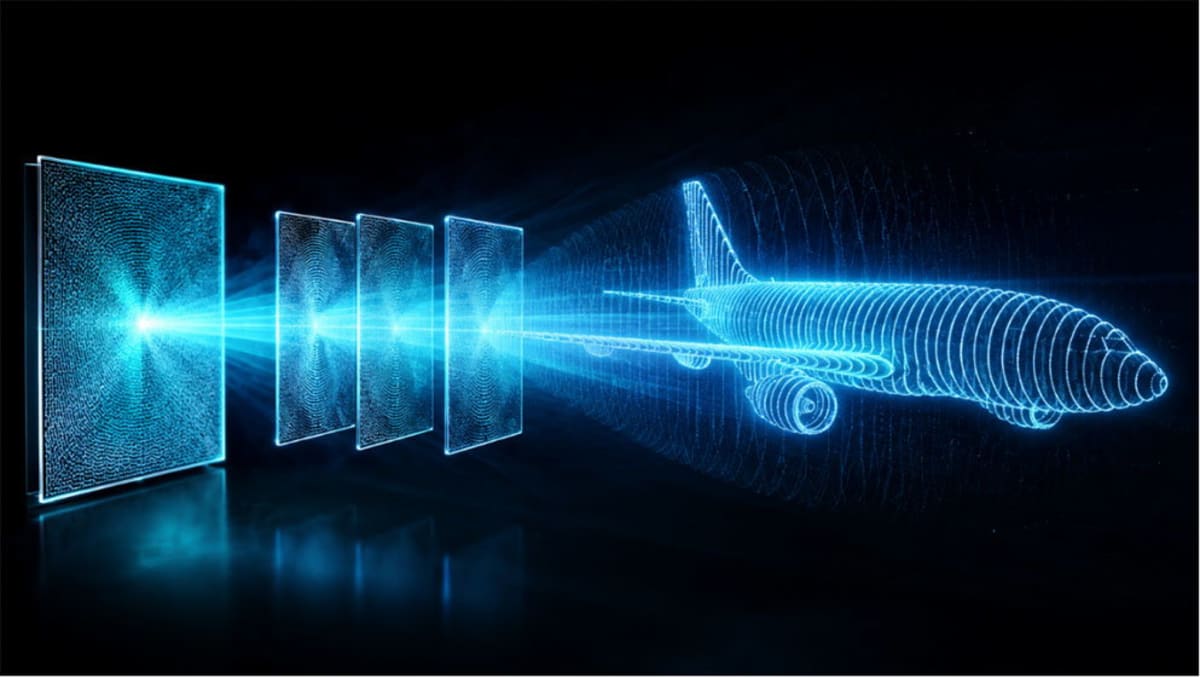
Researchers at the UCLA Samueli School of Engineering solved one of holography's biggest headaches. When projecting 3D objects made from layered images, parts of one layer would leak into another, ruining the illusion of a solid object floating in space.
Professor Aydogan Ozcan and his team created a system that keeps each image slice exactly where it belongs. Their breakthrough combines smart software with specially designed projection surfaces to stop this frustrating bleed-through effect.
Here's how it works. First, an encoder uses artificial intelligence to break down an image into layers. Then those layers get projected onto custom surfaces at different depths, with a deep learning algorithm making sure each slice lands at the right distance without interfering with its neighbors.
The team tested their system with 28 different image layers stacked together. They also built a simpler two-layer version in the lab to prove the concept works in real life, not just on computers.
When they compared their prototype to traditional projection methods, the difference was clear. Their system produced sharper, more realistic 3D images that were easier and more comfortable to watch.
The Ripple Effect
This technology could transform how we experience digital worlds. Virtual reality headsets could display more natural depth, making extended use less tiring on the eyes. Medical researchers using microscopy could see tissue samples in true 3D. Computer systems could process information using light instead of electricity, potentially saving enormous amounts of energy.
The researchers envision their compact system powering everything from augmented reality glasses to next-generation displays. As they refine the technology, applications like multi-angle holography could let different viewers see unique perspectives of the same 3D object simultaneously.
The work represents years of progress in combining machine learning with optical engineering. By solving the cross-talk problem that has stumped researchers for decades, UCLA's team opened doors that seemed firmly locked.
Their findings appeared in Light Science and Applications in June 2026, marking a milestone in making science fiction a bit more real.
The holodeck might still be years away, but thanks to this breakthrough, that future just got a whole lot sharper.
Based on reporting by Google News - Tech Breakthrough
This story was written by BrightWire based on verified news reports.
Spread the positivity!
Share this good news with someone who needs it