Vancouver's New Community Hub Cuts Carbon 41% With Wood
A Vancouver community center achieves a rare triple win: mass timber construction, ultra-efficient energy design, and gold-level sustainability. The building proves public spaces can be both beautiful and kind to the planet.
Vancouver's new Marpole Community Centre is showing neighborhoods everywhere what's possible when cities get serious about green building.
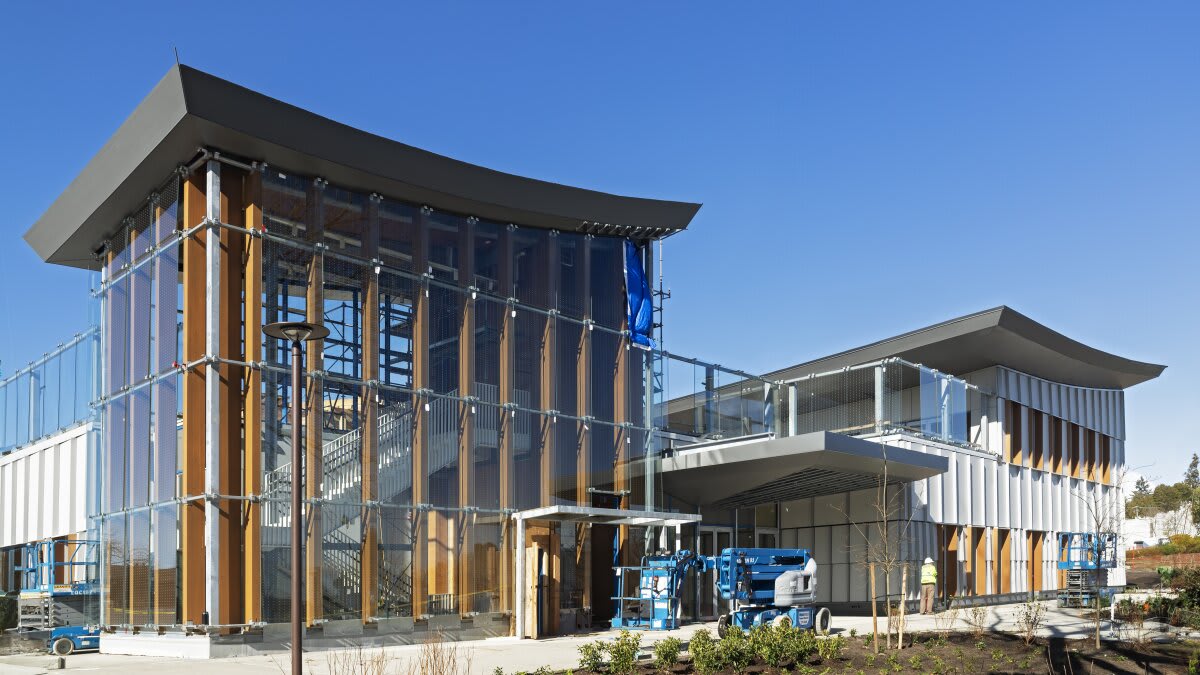
The facility, set to open later this year in Oak Park, has achieved something remarkably rare for a public building. It combines three major environmental achievements: mass timber construction, Passive House standards for energy efficiency, and LEED Gold certification.
The most visible choice is the exposed wood beams throughout the structure. Instead of relying on carbon-heavy steel and concrete, the building uses large engineered timber that cuts embodied carbon by 41% while creating a warm, inviting space that reflects the surrounding trees.
The 40,000-square-foot center replaces a 1949 facility the neighborhood had long outgrown. Inside, residents will find a gymnasium, childcare center, basketball court, and multipurpose rooms, plus outdoor sports courts and an ethnobotanical garden.
But the real magic happens in what you can't see. The building meets strict Passive House standards, meaning it's wrapped in a super-insulated, airtight shell that works like a thermos. Heat stays in during winter and gets pushed out in summer using very little energy.
The entire facility runs on electricity to support Vancouver's climate goals. Architects optimized everything from building orientation to window placement, reducing the need for mechanical heating and cooling systems.
"Our vision was to create an inclusive and welcoming high-performance facility that embodied the City's ambitious sustainability and accessibility targets," said architect Caroline Inglis from Diamond Schmitt, the firm behind the design.
The Ripple Effect
This project matters beyond Vancouver. Public buildings typically lag behind residential and commercial construction in adopting green standards, often due to budget constraints and bureaucratic hesitation. Marpole proves that cities can build spaces for daily community use without compromising on environmental performance.
The exposed timber interior creates something else cities desperately need: warmth in public spaces. Where most community centers feel institutional with their concrete and fluorescent lighting, Marpole feels human-scaled and connected to nature. Similar projects in Sweden and Norway have shown how timber construction can transform the emotional experience of shared civic spaces.
By hitting all three environmental targets at once, Vancouver is giving other cities a roadmap for how to build the community hubs of tomorrow.
When Marpole opens its doors this year, it will welcome a neighborhood while showing what's possible when sustainability meets great design.
More Images


Based on reporting by New Atlas
This story was written by BrightWire based on verified news reports.
Spread the positivity!
Share this good news with someone who needs it