Volcano Accidentally Ate Its Own Methane for 10 Days
A massive 2022 volcanic eruption discovered a way to destroy its own methane pollution, and scientists say we might be able to copy it. The finding could help fight climate change by removing a greenhouse gas 80 times more potent than CO2.
When a submarine volcano erupted in the South Pacific in 2022, it did something unexpected: it started cleaning up after itself.
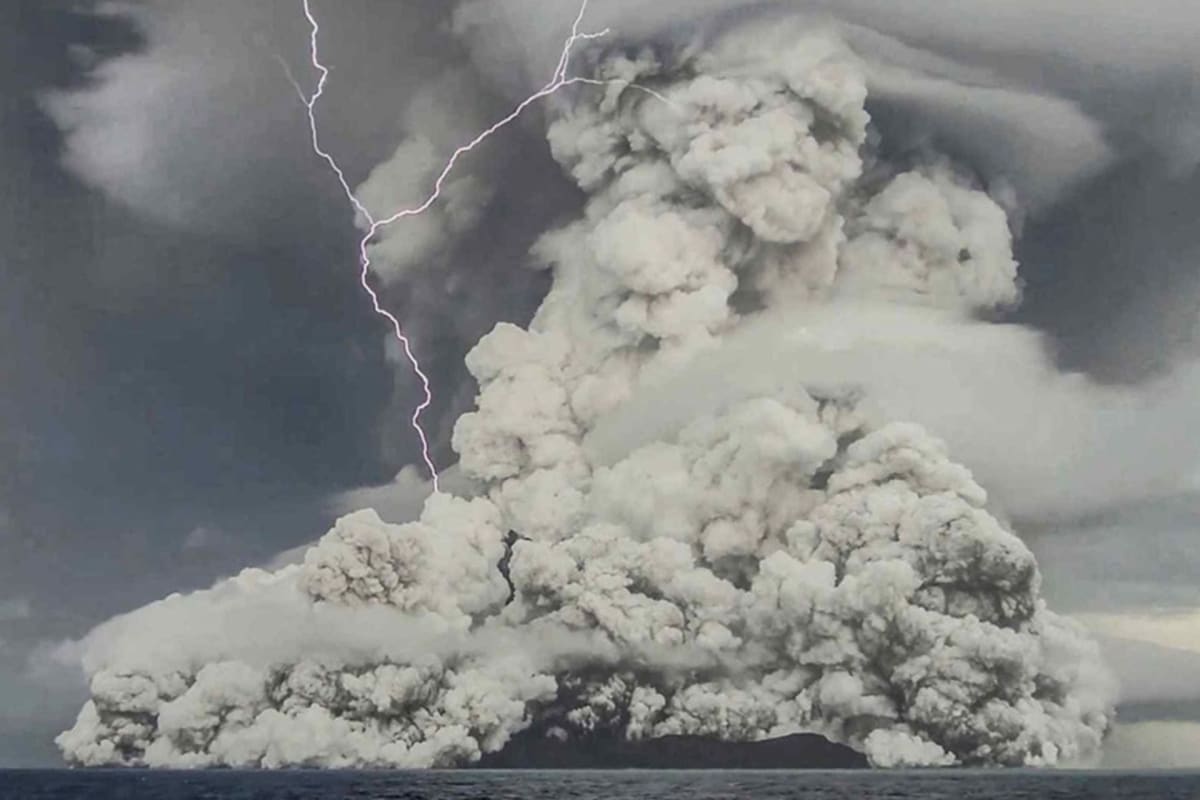
The Hunga Tonga–Hunga Ha'apai eruption spewed 330 gigagrams of methane into the atmosphere, roughly what 2 million cows produce in a year. But according to new research published in Nature Communications, the volcanic plume destroyed about 900 megagrams of its own methane every day for 10 days as it drifted across the ocean.
"It is known that volcanoes emit methane during eruptions, but until now it was not known that volcanic ash is also capable of partially cleaning up this pollution," said lead researcher Maarten van Herpen. The discovery happened when satellite images showed unusually high levels of formaldehyde, a chemical that only appears when methane breaks down.
Scientists pieced together what happened inside that volcanic cloud. Seawater thrown into the air by the eruption mixed with volcanic ash, and when sunlight hit the mixture, it created highly reactive chlorine atoms. Those chlorine atoms acted like tiny methane destroyers, breaking down the greenhouse gas much faster than normal.
This matters because methane is a climate menace. It traps about 80 times more heat than carbon dioxide over a 20-year period and currently drives about 30% of global warming. While methane naturally breaks down in about 10 years, finding ways to speed up that process could help slow warming in the near term.
The volcanic discovery builds on previous research showing that dust from the Sahara Desert creates a similar cleaning effect when it mixes with sea spray over the Atlantic Ocean. Van Herpen had studied that phenomenon before, so the volcanic connection clicked into place.
The Bright Side
Engineers are already exploring ways to recreate this natural methane removal process. Some proposals include building reactors that bubble methane through chlorine-saturated brine or developing controlled release systems. The challenge has always been proving these methods actually work.
That's where satellites come in. "How do you prove that methane has been removed from the atmosphere? It's very difficult," explained co-author Jos de Laat. "But here we address that problem by showing that methane breakdown can in fact be observed using satellites."
The satellite imaging technology used to track the volcanic plume could help engineers measure the effectiveness of any methane removal system they develop. Instead of guessing whether their interventions work, they could watch methane disappear in real time from space.
The researchers hope their findings will inspire more teams to develop safe, effective ways to remove atmospheric methane using chlorine chemistry. Nature just showed us the blueprint.
More Images

Based on reporting by Google News - Science
This story was written by BrightWire based on verified news reports.
Spread the positivity!
Share this good news with someone who needs it