Volcano Accidentally Destroys Methane, Stuns Scientists
A massive underwater volcano in the South Pacific may have accidentally revealed a powerful new climate solution. Scientists discovered the 2022 eruption triggered a chemical reaction that destroyed methane, one of Earth's most potent greenhouse gases.
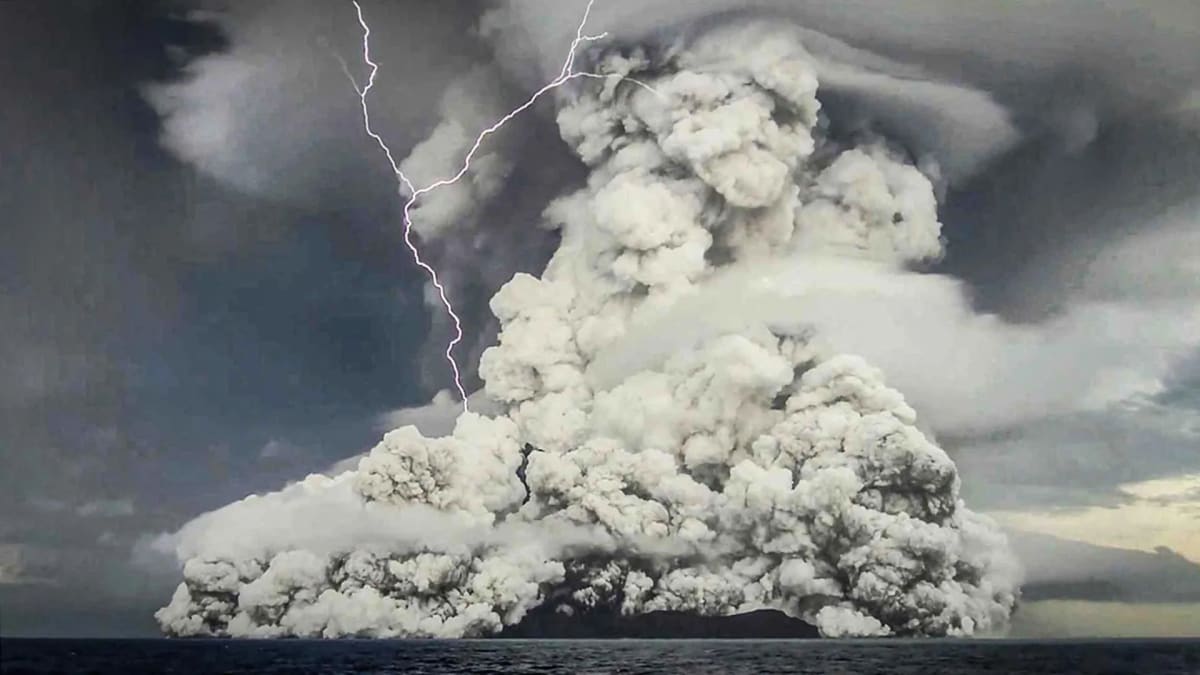
When the underwater volcano Hunga Tonga-Hunga Ha'apai exploded in January 2022, it created one of the most powerful eruptions in modern history. Scientists now say it also accidentally cleaned methane pollution from the atmosphere.
Researchers spotted something unusual in satellite images of the volcanic plume. Formaldehyde levels reached record highs, and that discovery immediately grabbed their attention because formaldehyde only appears when methane breaks down in the air.
The team tracked the cloud for 10 days as it drifted all the way to South America. Because formaldehyde disappears within hours, scientists realized the cloud must have been continuously destroying methane for more than a week.
"It is known that volcanoes emit methane during eruptions, but until now it was not known that volcanic ash is also capable of partially cleaning up this pollution," explains Dr. Maarten van Herpen from Acacia Impact Innovation BV, the study's lead author.
The eruption blasted massive amounts of salty seawater into the stratosphere alongside volcanic ash. When sunlight hit this mixture, it created highly reactive chlorine particles that helped break apart methane molecules.
Scientists had previously discovered a similar process happening when Sahara Desert dust mixes with ocean salt spray. But finding the same mechanism working high in the stratosphere came as a complete surprise.
Why This Inspires
This accidental discovery matters because methane is responsible for about one third of current global warming. Over 20 years, methane traps roughly 80 times more heat than carbon dioxide.
The good news is that methane breaks down much faster than CO2, typically disappearing within 10 years. Scientists call methane reduction an "emergency brake" for climate change because cutting methane could slow warming within the next decade and help avoid dangerous climate tipping points.
The findings could help scientists develop new ways to artificially remove methane from the atmosphere. One major challenge has been proving that methane removal actually works, but this study shows satellites can detect methane breakdown in real time.
"How do you prove that methane has been removed from the atmosphere? How do you know your method works?" asks Dr. Jos de Laat from the Royal Netherlands Meteorological Institute. "But here we address that problem by showing that methane breakdown can in fact be observed using satellites."
The discovery also means scientists need to update the global methane budget, which estimates how much methane enters and leaves Earth's atmosphere. Atmospheric dust has never been included in those calculations before.
While researchers stress that cutting CO2 emissions remains essential for long-term climate stability, this volcanic surprise offers hope that nature might still have climate solutions to teach us.
Based on reporting by Google News - Science
This story was written by BrightWire based on verified news reports.
Spread the positivity!
Share this good news with someone who needs it