Webb and Hubble Reveal Saturn's Secrets in Stunning Detail
NASA's most powerful telescopes just captured Saturn like you've never seen it before, showing electric blue rings and hidden storms that help scientists understand how giant planets work. These images might be our last detailed look at Saturn's mysterious hexagon storm until the 2040s.
Saturn just got its closeup, and the view is absolutely breathtaking.
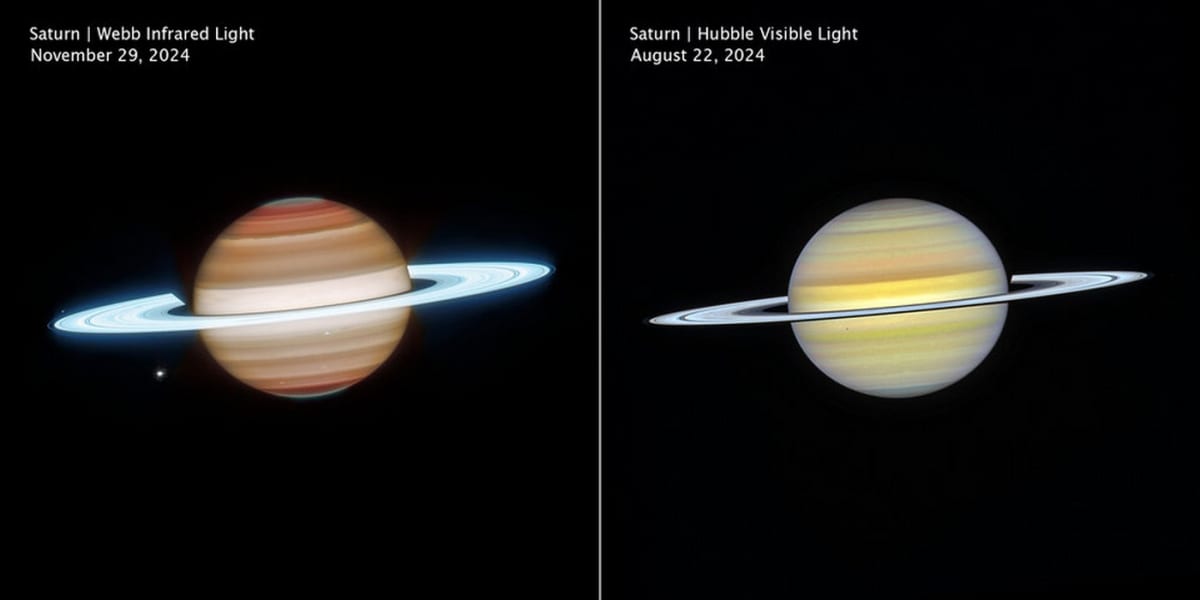
NASA's James Webb and Hubble space telescopes teamed up to photograph the ringed planet in August and late 2024, creating images that reveal both the beauty and science of our solar system's most photogenic world. Webb captured Saturn in infrared light while Hubble used visible light, giving scientists two different windows into the planet's atmosphere.
The result looks nothing like the pale yellow Saturn in textbooks. Webb's infrared view shows the iconic rings in screaming electric blue because they're made of highly reflective water ice. The planet itself appears in shades of grey-green at the poles, possibly from high-altitude aerosols or glowing auroral activity.
Beneath Saturn's beautiful exterior, the images reveal serious science. Webb spotted a long-lived jet stream called the "ribbon wave" meandering across the northern mid-latitudes, shaped by invisible atmospheric waves. A small spot visible in the images is actually a remnant from Saturn's "Great Springtime Storm" that raged from 2011 to 2012.
Both telescopes captured faint glimpses of Saturn's famous hexagon-shaped jet stream at the north pole, first discovered by Voyager in 1981. This six-sided storm has persisted for over 40 years, making it one of the solar system's most intriguing weather mysteries.
The timing matters more than you might think. Saturn's northern pole is entering winter and will shift into darkness for 15 years, meaning these are likely our last high-resolution views of the hexagon until the 2040s.
The Bright Side goes beyond pretty pictures. By combining Hubble's ability to see subtle color variations with Webb's infrared vision that peers deep below storm clouds, scientists can study fluid dynamics under extreme conditions. Saturn essentially becomes a natural laboratory floating in space.
Hubble has monitored Saturn for over a decade through a program called OPAL (Outer Planet Atmospheres Legacy), building a record of the planet's evolving atmosphere, storms, and seasonal shifts. Webb now adds powerful infrared capabilities to this ongoing research, extending what scientists can measure about atmospheric structure and dynamic processes.
As Saturn moves toward its 2025 equinox and later into southern summer in the 2030s, both telescopes will have progressively better views of the southern hemisphere. The planet is tilted on its axis even more than Earth, which means our viewing angle of Saturn's face and rings constantly changes as both planets orbit the Sun.
These observations prove that even familiar worlds still hold secrets worth discovering.
Based on reporting by Good News Network
This story was written by BrightWire based on verified news reports.
Spread the positivity!
Share this good news with someone who needs it