Webb Telescope Captures Galaxy Light from Dinosaur Era
The James Webb Space Telescope photographed a stunning spiral galaxy 65 million light-years away, meaning the light left that galaxy when T. rex walked Earth. Two powerful instruments combined to reveal intricate details scientists are using to understand how stars form and die.
Light that began its journey when dinosaurs still roamed our planet has finally reached us, captured in breathtaking detail by the James Webb Space Telescope.
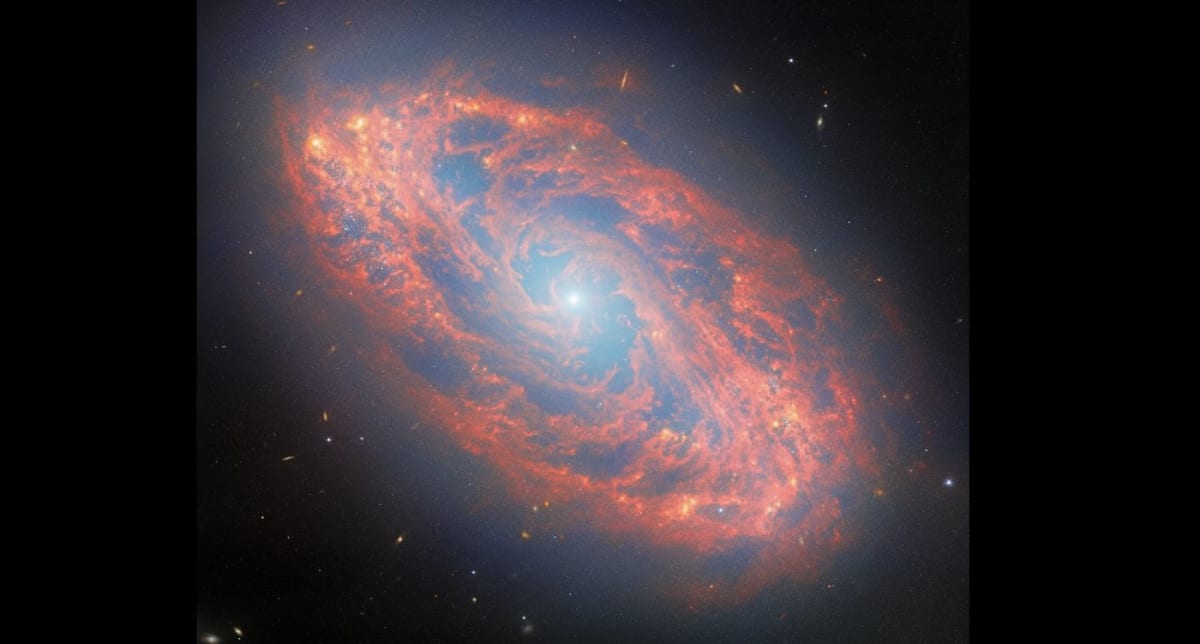
The image shows NGC 5134, a spiral galaxy sitting 65 million light-years away in the Virgo constellation. When the light now reaching our telescopes first departed that distant galaxy, Tyrannosaurus rex had just gone extinct on Earth.
NASA, the European Space Agency, and the Canadian Space Agency released the image in late February. The photo combines data from two of Webb's most powerful instruments working together to reveal details invisible to previous telescopes.
Webb's near-infrared camera highlighted individual stars and star clusters dotting the galaxy's tightly wound spiral arms. Meanwhile, its mid-infrared instrument picked out warm dust clouds and complex molecules swirling through space.
These aren't just pretty pictures. Scientists are using NGC 5134 as a nearby example to understand galaxies much farther away that appear as faint dots even to our best telescopes.
The galaxy, first discovered in 1785 by astronomer William Herschel, may have an active galactic nucleus at its center. This means its core pumps out enormous energy that doesn't come from stars alone.
The billowing gas clouds along NGC 5134's spiral arms are stellar nurseries where new stars are born. Each newborn star consumes some of the galaxy's gas supply, and when stars eventually die, they recycle some material back into space.
Why This Inspires
This image represents one piece of a massive research program studying 55 nearby galaxies actively forming new stars. Scientists are tracking how gas transforms into stars, how those stars reshape their surroundings, and how the whole cycle repeats across cosmic time.
The Webb data has already helped researchers understand how tiny dust grains behave in space, what shapes star-forming clouds take, and how newborn stars alter their environments. Each discovery builds our understanding of how galaxies like our own Milky Way evolve over billions of years.
Looking at light from 65 million years ago reminds us that astronomy is time travel. We're not just seeing distant places but distant moments, frozen in the light crossing the vast darkness between galaxies.
Based on reporting by Good News Network
This story was written by BrightWire based on verified news reports.
Spread the positivity!
Share this good news with someone who needs it