Webb Telescope Finds 5 Galaxies Colliding 800M Years Post-Big Bang
The James Webb Space Telescope discovered five galaxies merging just 800 million years after the Big Bang, billions of years earlier than scientists thought possible. The finding rewrites our understanding of how quickly the early universe came together.
Scientists just spotted something in deep space they didn't think could exist: a cosmic pileup of five galaxies forming when the universe was still in its infancy.
The James Webb Space Telescope caught these galaxies colliding roughly 800 million years after the Big Bang. That's remarkable because astronomers expected galaxies to be small and isolated at that time, not crashing together in complex mergers.
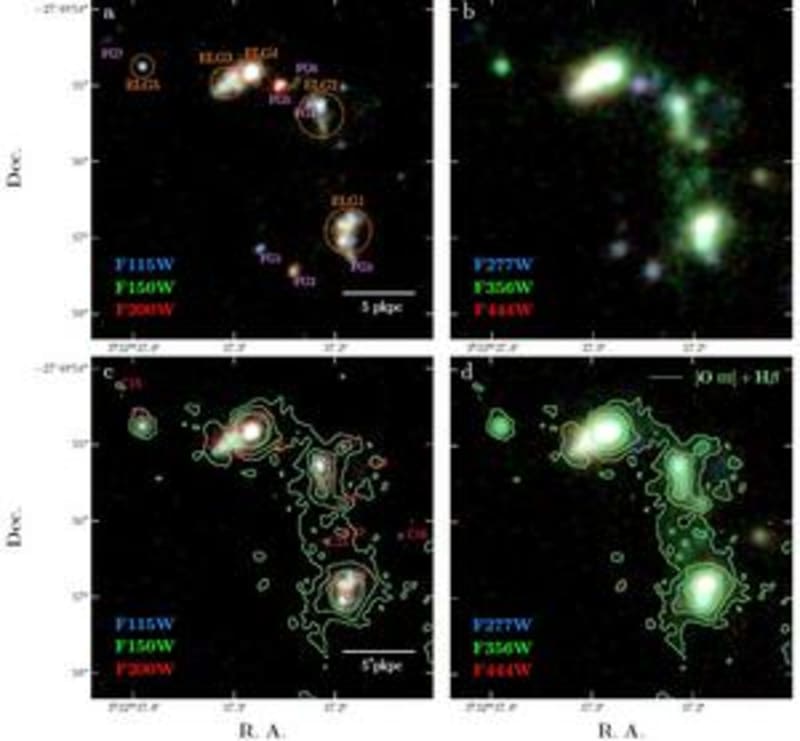
Dr. Weida Hu and Dr. Casey Papovich at Texas A&M University identified the system, nicknamed "JWST's Quintet," while analyzing some of the deepest images ever captured by the telescope. The five galaxies are separated by tens of thousands of light years but packed into an unusually tight region of space.
The collision was creating stars at an incredible pace: about 250 times the mass of our sun every year. That's far faster than typical galaxies at that point in cosmic history.
But the real surprise came when researchers spotted something glowing between the galaxies. A halo of oxygen-rich gas stretched across the space connecting them, evidence that the collision was flinging heavy elements far beyond the galaxies themselves.
Those elements can only form inside stars, meaning the crash was literally reshaping the chemistry of the surrounding universe. Scientists had predicted this kind of widespread enrichment wouldn't happen until well over a billion years after the Big Bang.
Why This Inspires
This discovery arrives at a perfect time. Since it began operations, the Webb telescope has been finding massive, mature galaxies that appear far too early in cosmic history, creating a puzzle for astronomers.
JWST's Quintet might help solve that mystery. If galaxies were colliding and merging this early and this dramatically, they could have grown massive quickly, then exhausted their gas supplies and gone quiet, exactly matching what Webb sees in later eras.
"By showing that a complex, merger-driven system exists so early, it tells us our theories of how galaxies assemble need to be updated to match reality," Papovich explained.
The team plans to use Webb to study how gas and galaxies move within the system, offering even deeper insights into how the universe's first structures took shape. Sometimes the best discoveries are the ones that prove our models wrong and push us to think bigger about what's possible in our cosmos.
Based on reporting by Google: James Webb telescope
This story was written by BrightWire based on verified news reports.
Spread the positivity!
Share this good news with someone who needs it