Webb Telescope Finds 70 Baby Stars Forming Planets
The James Webb Space Telescope just revealed a spectacular cosmic nursery where 70 infant stars are building their own planetary systems inside one of the most intense environments in our galaxy. The discovery gives scientists their first clear look at how planets form in extreme conditions.
Seven thousand five hundred light-years from Earth, inside a cloud shaped like an open treasure chest, 70 baby stars are doing something extraordinary. They're collecting the raw materials needed to build planets, and for the first time ever, we can actually see it happening.
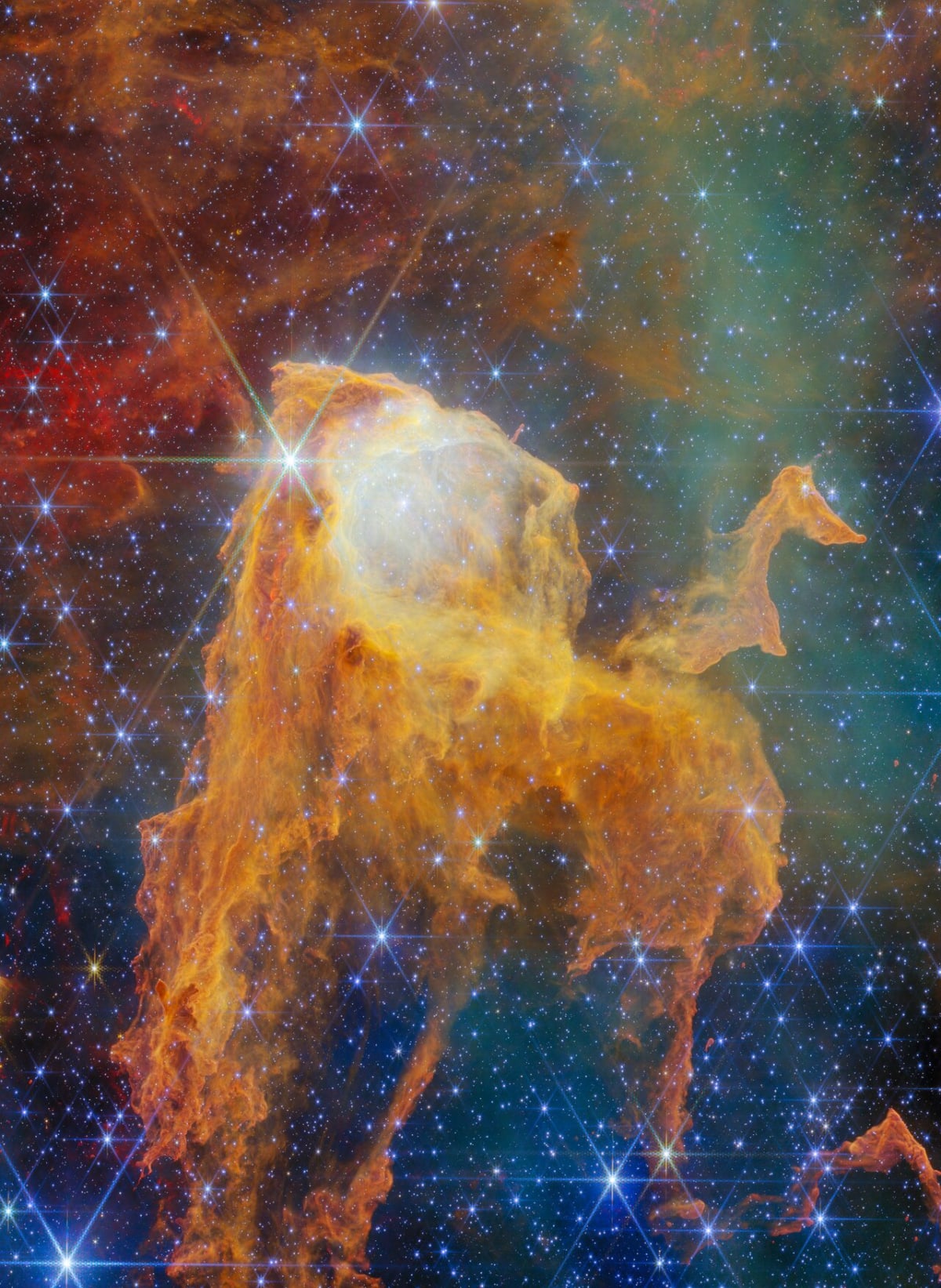
The James Webb Space Telescope released stunning new images this week showing the interior of what astronomers call the Treasure Chest, a dusty cloud tucked inside the Carina Nebula. What makes this discovery special isn't just the number of young stars packed together. It's that each one is wrapped in its own disk of gas and dust, the exact ingredients planets need to form.
No telescope has ever been able to see inside this cloud before. The dust is so thick that for every photon of visible light trying to escape, only one in a quintillion makes it out. But Webb's infrared camera can peer right through it, revealing what's been hidden all along.
The images show something even more fascinating: glowing jets of material shooting out from these infant stars as they grow. These jets, made visible by Webb's special filters, act like cosmic signposts telling scientists exactly how each star is pulling in gas and launching material back into space. It's the full story of star birth, playing out in real time.
The research team, led by Megan Reiter from Rice University, dedicated over 70 hours of Webb's observation time to create the first complete census of how young stars in this region collect and expel material. They expect to discover around 400 new jets throughout the Carina Nebula, each one revealing another chapter in how stars and planets come to be.
The Treasure Chest got its distinctive shape from Eta Carinae, one of the most powerful stars in our galaxy, located just 39 light-years away on the sky. This massive star, along with its neighbors, has been sculpting the cloud for millions of years with intense ultraviolet radiation, carving away the less dense gas and leaving behind the compressed core we see today.
Why This Inspires
This discovery reminds us that creation is happening all around us, even in the most unlikely places. These 70 stars are building their solar systems in one of the harshest neighborhoods imaginable, surrounded by radiation that could destroy their planet-forming disks before worlds ever take shape.
Yet there they are, growing anyway. The same forces that carved their cosmic home into such a beautiful shape are now testing whether those infant planets can survive. Scientists are watching this cosmic drama unfold, learning how resilient the process of planet formation really is.
Every world in our universe, including Earth, started exactly this way: as dust and gas swirling around a newborn star. Seeing it happen elsewhere, in such crisp detail, connects us to something profound. We're witnessing the earliest chapters of planetary systems that might, billions of years from now, host their own stories of life and discovery.
The universe is still creating, still building, still finding ways to make new worlds against all odds.
More Images




Based on reporting by Google: James Webb telescope
This story was written by BrightWire based on verified news reports.
Spread the positivity!
Share this good news with someone who needs it