Webb Telescope Finds Planet With Sand Cloud Mornings
Scientists just mapped weather on a distant world for the first time, and it's nothing like Earth. A giant planet 700 light-years away has mornings filled with mineral clouds and crystal-clear nights, separated by a 170°C temperature swing.
Scientists just did something amazing: they mapped the weather on another world for the very first time.
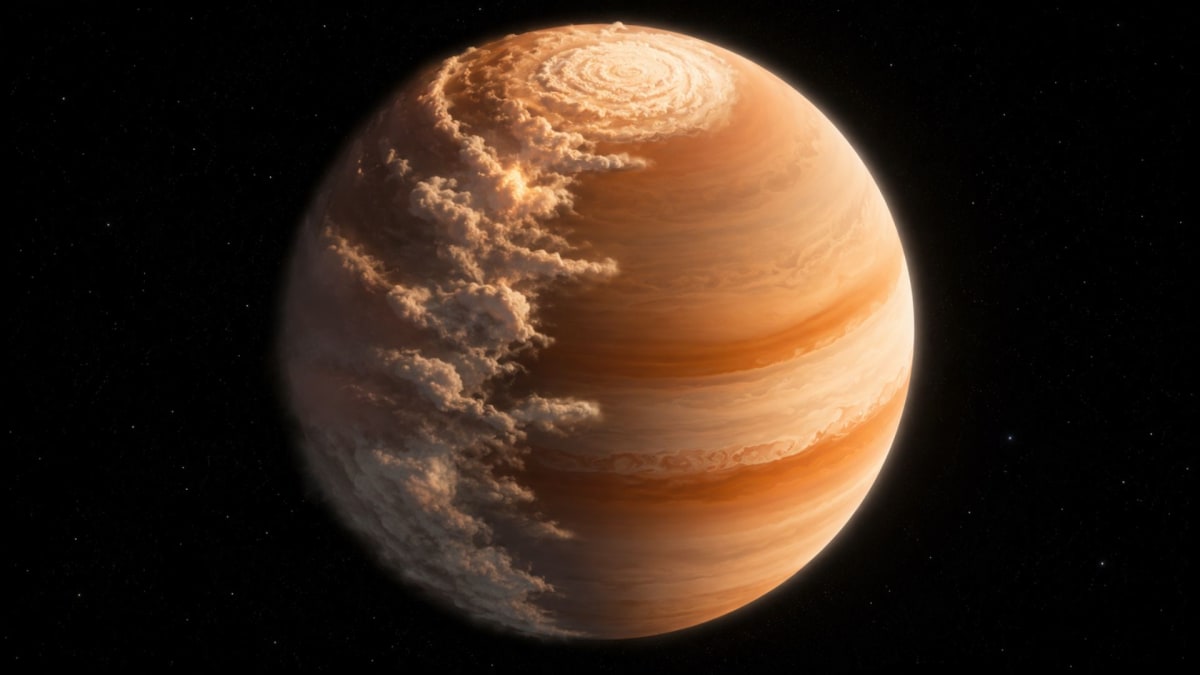
The James Webb Space Telescope discovered that WASP-94A b, a giant gas planet 700 light-years from Earth, has the most extreme daily forecast imaginable. Every morning brings thick clouds packed with mineral aerosols, while every night features perfectly clear skies and intense water vapor.
Researchers from Johns Hopkins University spotted this incredible pattern while studying the planet's atmosphere. The gas giant orbits a star in the constellation Microscopium, and its two hemispheres experience a temperature difference of 170°C.
That massive temperature gap creates a predictable but wild weather cycle. Clouds form on the planet's cold side, then circulate through the atmosphere until morning, where they finally evaporate as the day heats up.
This marks the first time humans have been able to track how weather moves across an entire exoplanet. Scientists analyzed Webb's observations of both the "morning" and "night" phases, watching how aerosols behave differently in each hemisphere.
The planet is classified as a hot Jupiter, meaning it's a massive gas giant that orbits extremely close to its star. These worlds represent some of the most extreme environments we've discovered beyond our solar system.
Why This Inspires
This discovery shows how far our technology has come in understanding distant worlds. Just a few years ago, detecting exoplanets was groundbreaking enough. Now we're mapping their weather patterns and understanding their atmospheric chemistry from 700 light-years away.
The James Webb Space Telescope continues proving it can reveal details about alien worlds that were impossible to see before. Each observation teaches us more about how planets form, evolve, and behave under conditions wildly different from Earth.
These findings help scientists understand the incredible diversity of worlds throughout our galaxy. Every new discovery expands what we know is possible in the universe and brings us closer to understanding our place in it.
The ability to predict weather on a planet nearly a thousand light-years away reminds us that human curiosity and ingenuity have no limits.
Based on reporting by Google: James Webb telescope
This story was written by BrightWire based on verified news reports.
Spread the positivity!
Share this good news with someone who needs it