Webb Telescope Reveals Dying Star's Gift to Future Worlds
The James Webb Space Telescope captured the most detailed view ever of the Helix Nebula, showing how a dying star transforms into the building blocks for new planets. The stunning image reveals what could happen to our own Sun billions of years from now.
A dying star 650 light-years away just showed us the future of our solar system, and it's surprisingly beautiful.
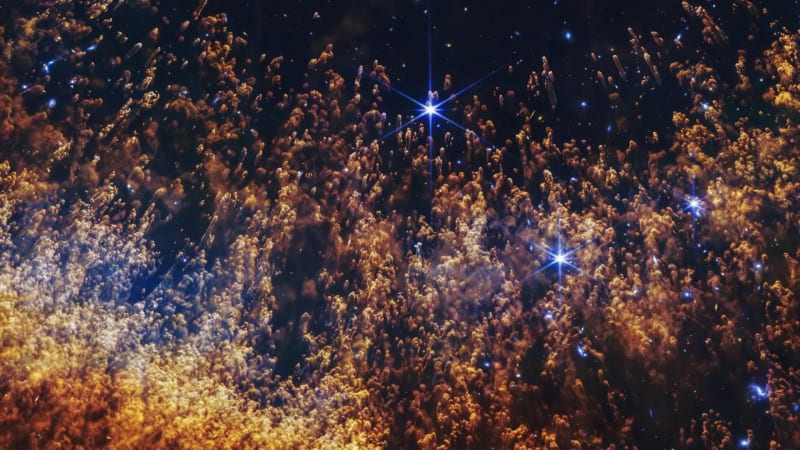
The James Webb Space Telescope has delivered the sharpest view ever captured of the Helix Nebula, a glowing ring of gas and dust created by a star at the end of its life. The telescope's powerful infrared vision reveals intricate structures that look like comets with trailing tails, each one marking where the star's fierce winds collide with material it shed thousands of years earlier.
First spotted in the early 1800s, the Helix Nebula has long fascinated astronomers because it sits so close to Earth. Now Webb's detailed images let scientists study this cosmic transformation like never before.
At the heart of the nebula sits a white dwarf, the exposed core left behind after the star blew off its outer layers. Though the white dwarf itself sits just outside Webb's frame, its influence lights up everything around it. The intense radiation creates a rainbow of environments, from scorching hot gas near the center to cooler regions farther out where complex molecules begin forming.
Those cooler pockets matter more than they might seem. They contain the raw materials that eventually help build new planets in other star systems.
Webb's image uses color to tell the temperature story. Blue shows the hottest gas, energized by ultraviolet radiation. Yellow marks cooler areas where hydrogen atoms bond together. Red traces the coldest material at the edges, where gas thins and dust takes shape.
The Ripple Effect
This isn't just a pretty picture. The Helix Nebula shows astronomers exactly how stellar death becomes stellar birth. When stars like our Sun reach the end of their lives, they don't simply disappear. Instead, they return their material to space, enriching the cosmic soup that forms new stars and planets.
Scientists now have a preview of what could happen to our own solar system in about five billion years. Our Sun will likely follow a similar path, shedding its outer layers and creating its own planetary nebula.
The telescope's ability to zoom deep into these cosmic nurseries helps researchers understand how the chemical elements necessary for life get distributed throughout the galaxy. Each dying star adds its contribution, creating the conditions for future worlds to form.
Webb continues proving its worth as the most powerful space telescope ever launched, revealing details that remained hidden from earlier observatories like Hubble. The sharp focus brings gas knots and dust clouds into crystal clarity, showing the precise moment when one generation of stars passes the torch to the next.
Even in death, stars give the universe an incredible gift.
Based on reporting by Google: James Webb telescope
This story was written by BrightWire based on verified news reports.
Spread the positivity!
Share this good news with someone who needs it