Webb Telescope Reveals Hidden Stars in Centaurus A Galaxy
NASA's James Webb Space Telescope just celebrated four years in space by peering through cosmic dust to reveal millions of stars never seen before in nearby galaxy Centaurus A. The images show not just clearer views, but an entirely different story of a galaxy still recovering from a violent collision two billion years ago.
Scientists just opened a cosmic time capsule 11 million light years away, and what they found inside is rewriting our understanding of how galaxies grow and change.
NASA's James Webb Space Telescope has captured stunning new views of Centaurus A, one of our closest galactic neighbors. For the first time, astronomers can see through the thick dust that has hidden the galaxy's most active regions for decades.
What once looked like fuzzy textures in older telescope images turned out to be millions of individual stars packed tightly together. Previous telescopes like Hubble could only see the outer regions, while Spitzer detected infrared heat but couldn't resolve individual stars through the dust.
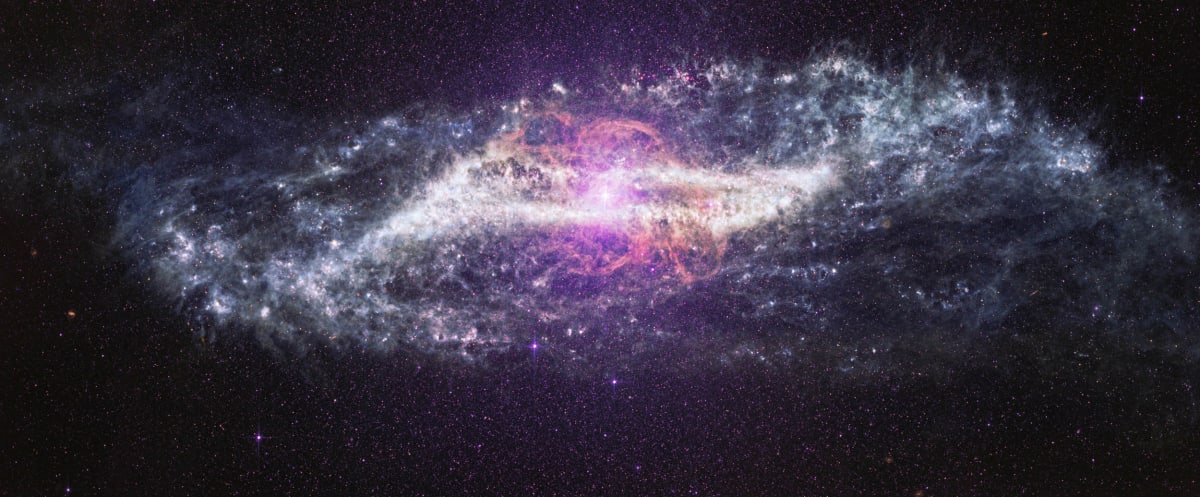
Webb's powerful infrared vision changed everything. The telescope spotted countless stars living close to the galaxy's core, along with twisting clouds of dust and an mysterious S-shaped structure that has scientists puzzled.
Centaurus A carries visible scars from a cosmic crash that happened two billion years ago when it collided with another galaxy. Unlike most galactic mergers that eventually calm down, this one still shows dramatic effects today, with new stars continuing to form from gas thrown around during the ancient impact.
The images reveal a warped band of material slicing across the center like a parallelogram, with thinner streams stretching outward into space. Each glowing red point marks either a dust-wrapped star or a stellar nursery where new stars are being born.
At the heart of it all sits a supermassive black hole that continues shaping the entire galaxy. Webb's instruments detected fast-moving ionized gas racing outward from the center, pushed by enormous energy released as matter falls into the black hole.
Why This Inspires
These stars are more than just beautiful dots of light. They're a historical record written across space, allowing astronomers to reconstruct exactly when major events happened and how the galaxy responded.
Some stars belong to the earliest generations formed billions of years ago. Others appeared during collision-triggered bursts of star formation. Still more emerged from gas left swirling through the galaxy afterward, creating a complete timeline of cosmic events.
By studying different star populations, researchers are practicing what they call galactic archaeology, piecing together history using the stars themselves as evidence. Because Centaurus A sits relatively close to Earth, it offers scientists an extraordinary laboratory for understanding how all galaxies evolve over time.
The black hole's dual role is particularly fascinating. It can squeeze gas tightly enough to trigger new star formation, yet also blow gas away to prevent stars from forming, acting as both creator and destroyer.
Four years into its mission, Webb continues proving that each new technological leap reveals not just sharper pictures, but entirely new chapters in the universe's story that previous generations of telescopes couldn't access.
Based on reporting by Google: James Webb telescope
This story was written by BrightWire based on verified news reports.
Spread the positivity!
Share this good news with someone who needs it