Webb Telescope Sees Mercury-Like Planet 48 Light-Years Away
NASA's James Webb Space Telescope just gave us our first direct look at a rocky exoplanet's surface, and it's a scorching world that resembles Mercury more than Earth. The breakthrough shows scientists can now study distant planets in ways never before possible.
For the first time ever, scientists have directly observed the surface of a rocky planet orbiting another star, revealing a harsh world that looks more like Mercury or our Moon than the Earth we call home.
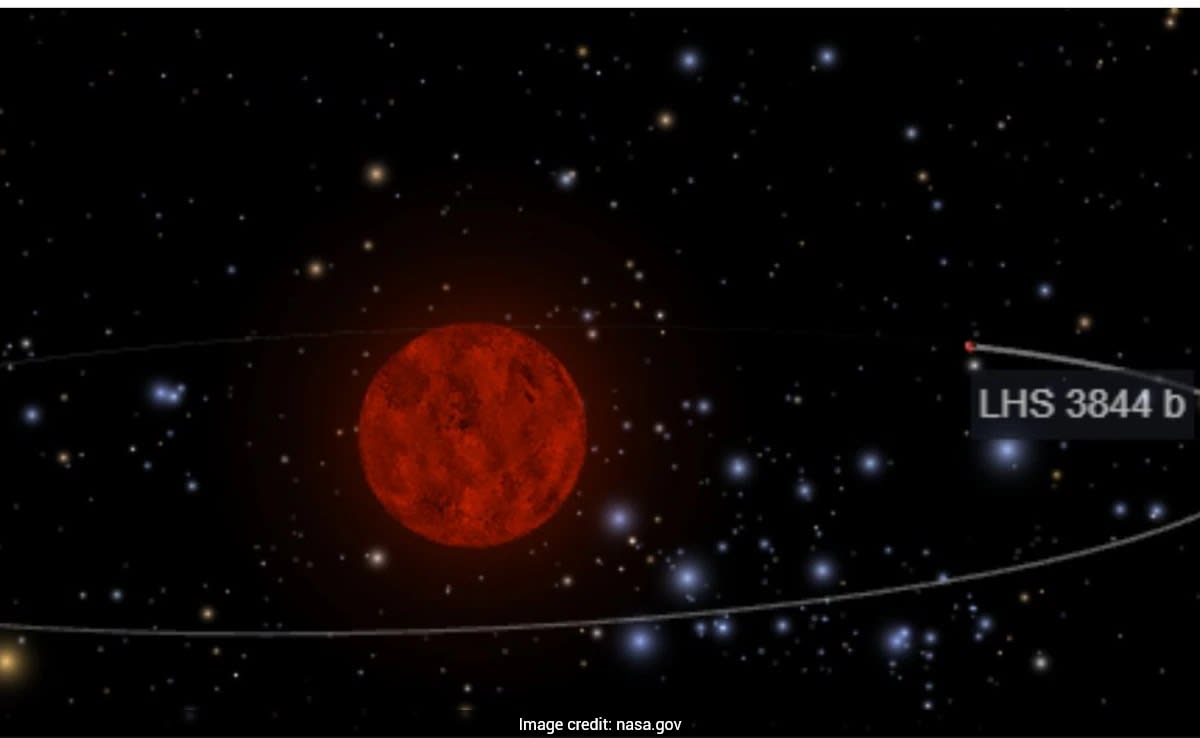
NASA's James Webb Space Telescope captured detailed observations of LHS 3844 b, a rocky super-Earth located just 48.5 light-years from our planet. The world is about 30% larger than Earth but circles its cool red dwarf star in less than 11 hours, racing around at a distance one-fortieth that between Mercury and our Sun.
That extreme closeness has locked the planet in place, with one side permanently facing its star in a scorching embrace. The dayside bakes at an average temperature of 725 degrees Celsius (1,340 degrees Fahrenheit), where night never falls and relief never comes.
Using the telescope's Mid-Infrared Instrument, researchers measured heat radiating directly from the planet's surface. The infrared readings revealed a dark, basaltic landscape similar to Mercury's crust or the lunar maria, made of low-silica rock rather than Earth's silica-rich surface formed by plate tectonics and liquid water.
"This is a brutal place," said Laura Kreidberg, Director at the Max Planck Institute for Astronomy and the study's principal investigator. "We see a dark, hot, barren rock, devoid of any atmosphere."
Without an atmosphere to protect it, the planet endures constant bombardment from stellar radiation and micrometeorites. This relentless exposure breaks surface rock into fine dust and darkens the terrain through a process called space weathering, creating a landscape that would feel familiar to anyone who's studied Mercury or the Moon.
The team found no signs of volcanic gases like carbon dioxide or sulfur dioxide. Even if volcanoes exist on this distant world, they're not producing enough atmospheric gases to create a protective blanket.
Scientists didn't photograph the planet directly. Instead, they tracked how the combined light from the star and planet changed as LHS 3844 b completed its rapid orbit, watching the infrared signature brighten when the hot dayside faced Earth and dim when the cold nightside turned toward us.
Why This Inspires
This observation marks a turning point in our ability to study worlds beyond our solar system. For years, scientists could only detect exoplanets indirectly or study their atmospheres as they passed in front of their stars.
Now, the James Webb Space Telescope has proven we can examine the actual surfaces of rocky planets dozens of light-years away. That capability opens doors to finding worlds with conditions more suitable for life and understanding how planetary systems form and evolve across the galaxy.
The findings, published in Nature Astronomy on May 4, 2025, represent just the beginning of what promises to be a new era in planetary science.
Every new world we study teaches us something about the incredible diversity of planets in our universe and helps us better understand what makes Earth so special.
More Images



Based on reporting by Google: James Webb telescope
This story was written by BrightWire based on verified news reports.
Spread the positivity!
Share this good news with someone who needs it