Webb Telescope Solves Black Hole Feeding Mystery
Scientists finally understand how supermassive black holes keep growing despite their own powerful energy blasts that should starve them. The James Webb Space Telescope revealed a cosmic recycling system that's been hiding in plain sight for decades.
For years, astronomers faced a cosmic puzzle that didn't make sense: black holes produce jets so powerful they heat up surrounding gas, yet somehow they keep eating and growing anyway.
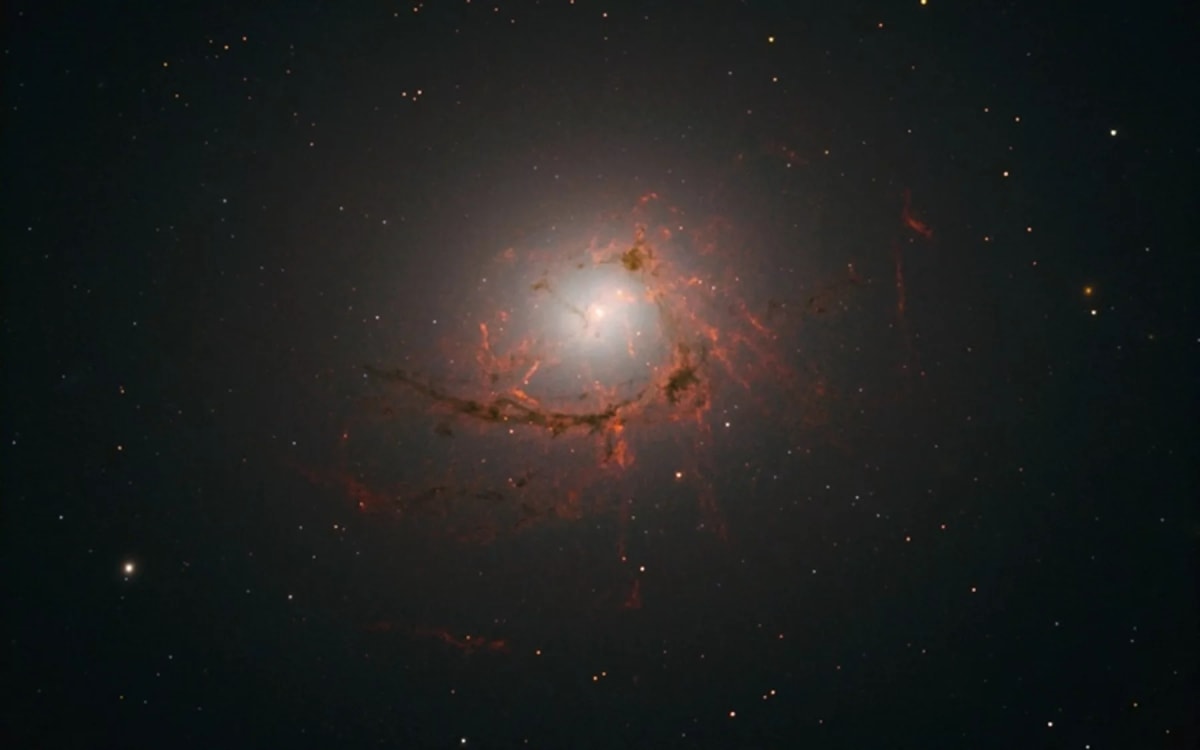
The James Webb Space Telescope just cracked the case. By peering 145 million light-years away at galaxy NGC 4696, scientists watched a supermassive black hole feed itself in stunning detail.
Here's what's actually happening. The black hole blasts out energy jets that heat nearby gas, but that hot gas eventually cools down and forms long, thread-like filaments stretching through space. These cosmic threads act like highways, channeling cool gas back toward the black hole.
Webb's instruments captured something extraordinary: an 800-light-year-wide disk of gas spinning at 600 kilometers per second, directly connected to one of these filaments. Gas flows along the filament like water through a pipe, pours into the spinning disk, and feeds straight into the black hole.
The team from Université de Montréal and Michigan State University spent nearly eight hours mapping the gas movements with incredible precision. They could distinguish features just 30 light-years across, watching the universe's biggest engines refuel in real time.
"JWST observations are offering us thousands of new facts and measurements," said Megan Donahue, Distinguished Professor of physics and astronomy at Michigan State University. The data revealed a self-regulating cycle where magnetic fields slow the gas's rotation and guide it inward.
Computer simulations matched exactly what Webb observed. Jets blast energy outward, gas cools and forms filaments, magnetic forces channel it back, and the black hole reignites its jets to start the whole process over again.
Why This Inspires
This discovery shows the universe operates on cycles of renewal we're only beginning to understand. What looked like destruction is actually creation in disguise, a cosmic recycling program billions of years in the making.
The finding fills a crucial gap in understanding how galaxies evolve and how black holes shape the cosmic structures around them. It proves that even the universe's most violent processes follow elegant patterns of balance.
Webb's unprecedented sharpness lets us see the universe working at scales never before possible, revealing hidden connections between forces that seemed at odds.
The cosmos keeps feeding its hungriest monsters through a system more elegant than anyone imagined.
More Images
Based on reporting by Google: James Webb telescope
This story was written by BrightWire based on verified news reports.
Spread the positivity!
Share this good news with someone who needs it