Webb Telescope Solves Mystery of Fast-Growing Black Holes
The James Webb Space Telescope just watched a supermassive black hole feed itself in a cosmic recycling loop that could explain how these giants grew impossibly fast in the early universe. For the first time, scientists have seen the complete cycle of how black holes stay fed without starving themselves.
Scientists have caught a supermassive black hole in the act of solving one of astronomy's biggest puzzles. The James Webb Space Telescope spent nearly eight hours watching a galaxy 145 million light-years away and discovered something remarkable: black holes run on a self-sustaining recycling system.
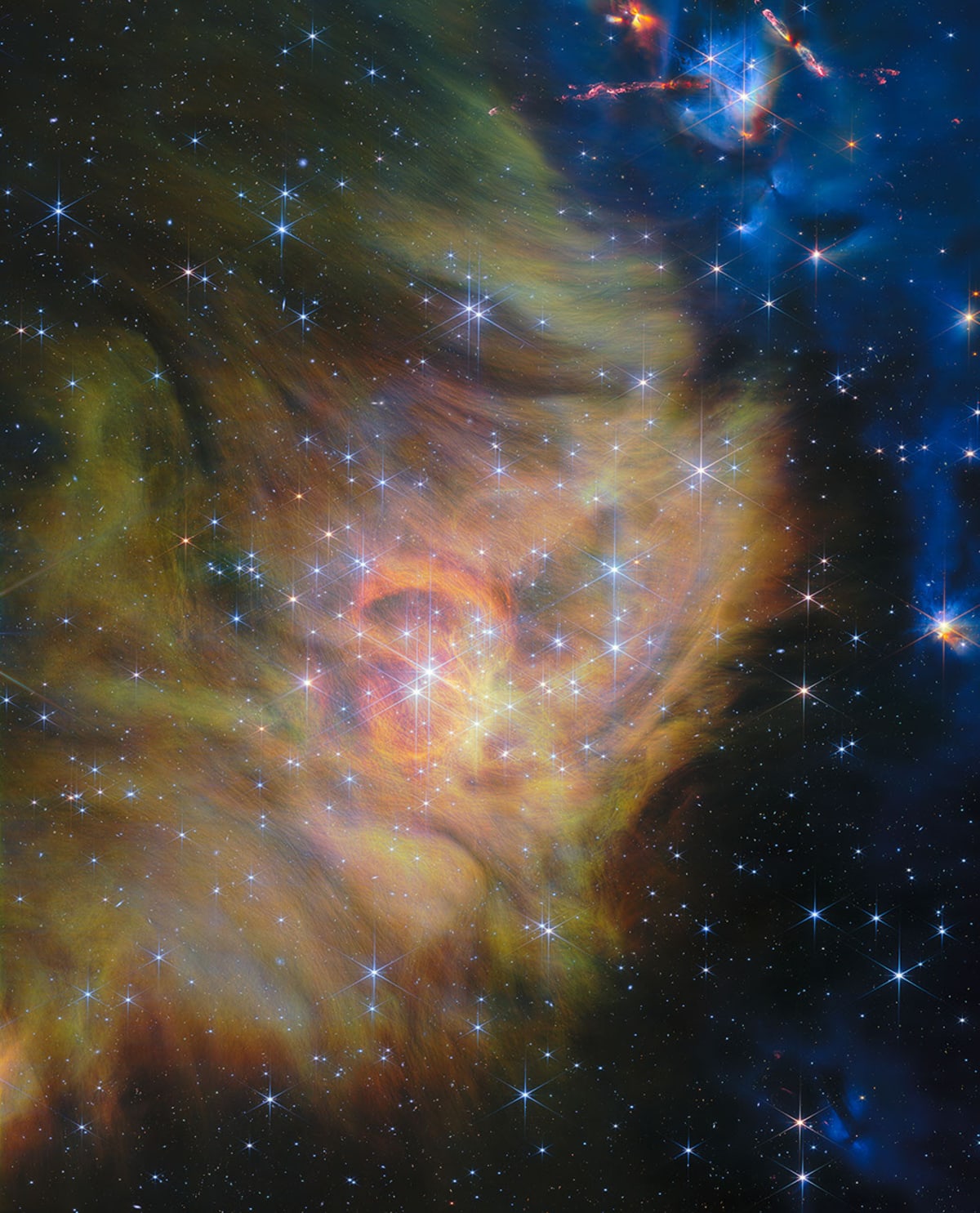
Inside NGC 4696, the largest galaxy in the Centaurus cluster, Webb's powerful infrared instruments captured gas flowing down a long filament directly into a spinning disk surrounding the central black hole. The disk stretches 800 light-years across, with material whipping around at 600 kilometers per second before plunging into the black hole itself.
This discovery matters because it solves a paradox that has puzzled astronomers for decades. When black holes feed, they shoot out powerful jets that heat up surrounding gas and push it away. Hot gas resists gravity, so logically, black holes should eventually starve themselves by heating all their food until it floats away.
But they don't starve. In fact, Webb keeps finding supermassive black holes that existed less than a billion years after the Big Bang, objects so massive they shouldn't have had time to grow that large according to standard physics.
The new observations show exactly how they do it. The jets from the black hole heat the surrounding gas, but over time that gas cools down and becomes unstable. It collapses into narrow filaments, funneled by magnetic forces toward the center where it collects in the spinning disk. The disk feeds the black hole, which powers new jets, which heat the gas again.
It's a cosmic recycling system where the black hole's waste heat eventually becomes its next meal.
Julie Hlavacek-Larrondo from the Université de Montréal, who led the study published in The Astrophysical Journal Letters, described black holes as cosmic recyclers releasing enormous amounts of energy. Helen Russell from the University of Nottingham called the observation the final link in the chain, showing the complete closed loop scientists have been trying to map for years.
Why This Inspires
This breakthrough changes how we understand the growth of the universe's most massive objects. If black holes can maintain their own fuel supply instead of choking on their exhaust, they can grow much faster than anyone thought possible.
The finding doesn't just solve an abstract puzzle. It reveals that even the universe's most destructive forces operate in balanced, sustainable cycles. What looked like chaos turns out to be an elegant feedback loop where nothing goes to waste.
Webb resolved structures as small as 30 light-years across from 145 million light-years away, technology that lets us witness cosmic processes no human has ever seen before.
The universe just got a little less mysterious and a lot more wonderfully organized.
More Images

Based on reporting by Google: James Webb telescope
This story was written by BrightWire based on verified news reports.
Spread the positivity!
Share this good news with someone who needs it