Webb Telescope Spots Galaxy Cluster That Shouldn't Exist Yet
The James Webb Space Telescope discovered a massive galaxy cluster 10 billion light years away that formed way faster than scientists thought possible. This cosmic oddity is rewriting what we know about how the universe grew up.
Scientists just found a galaxy cluster that broke the rules of cosmic development, and it's forcing them to rethink how the early universe worked.
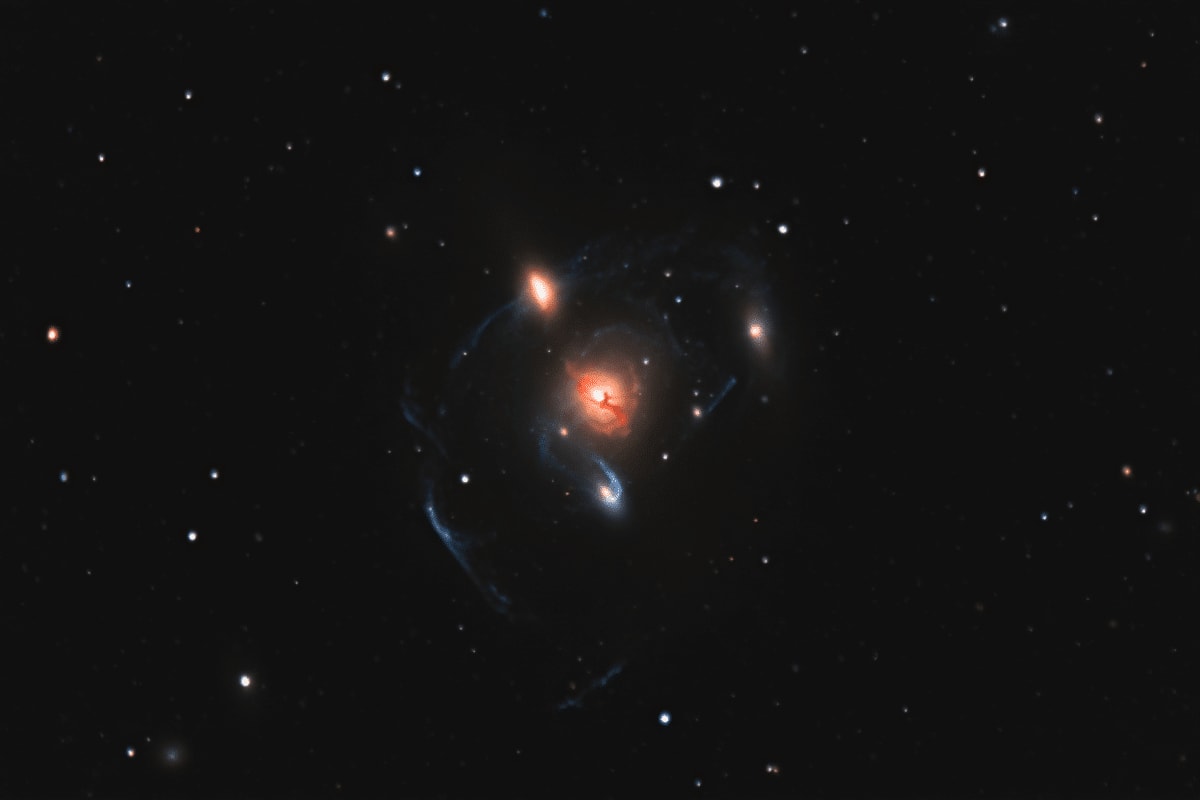
The James Webb Space Telescope spotted XLSSC 122, a massive cluster of galaxies sitting over 10 billion light years away. What makes this discovery extraordinary isn't just the distance—it's that this cluster appears fully mature and organized when it should still be in its awkward teenage phase.
"When we got those first images back from JWST, we said, 'Wow, look at this, there's strong lensing coming from this cluster!'" said Kyle Finner, lead scientist at Caltech's Infrared Processing and Analysis Center. The cluster set a record as the most distant one ever observed displaying strong gravitational lensing, a rare phenomenon where a cluster's gravity bends and magnifies light from even more distant galaxies behind it.
Think of gravitational lensing like a cosmic magnifying glass. The cluster's immense gravity warps space itself, creating visible arcs of light around its center that help astronomers map the invisible dark matter holding everything together.
But here's where things get interesting. XLSSC 122 has an extraordinarily concentrated core, packed with mass in a way that current cosmological models say shouldn't happen this early in cosmic history. The cluster exists during "cosmic noon," when the universe was cranking out stars roughly 100 times faster than today, yet it looks as developed as modern clusters in our neighborhood.
The discovery challenges fundamental assumptions about how quickly massive structures can assemble. Current theories predict that building such a dense, organized cluster should take much longer than the universe had at that point.
The Bright Side
This cosmic puzzle actually represents progress in our understanding of the universe. Every time scientists find something that doesn't fit existing models, it opens doors to deeper knowledge about how reality works.
The team detected the earliest known "intracluster light," a glow from stars drifting freely between galaxies, confirming that XLSSC 122 is still actively merging and growing. These observations give researchers new tools to test and refine their models of cosmic evolution.
Looking ahead, Finner's team hopes to study dozens more ultra-distant clusters. If more early-universe clusters show similar properties, cosmologists may need to fundamentally revise their understanding of how the universe developed its grand structure.
The finding proves we're still in the early days of cosmic discovery, with each observation from Webb revealing surprises that push science forward.
Based on reporting by Google: James Webb telescope
This story was written by BrightWire based on verified news reports.
Spread the positivity!
Share this good news with someone who needs it