Wild Costa Rican Monkeys Learn to Use AI Touchscreens
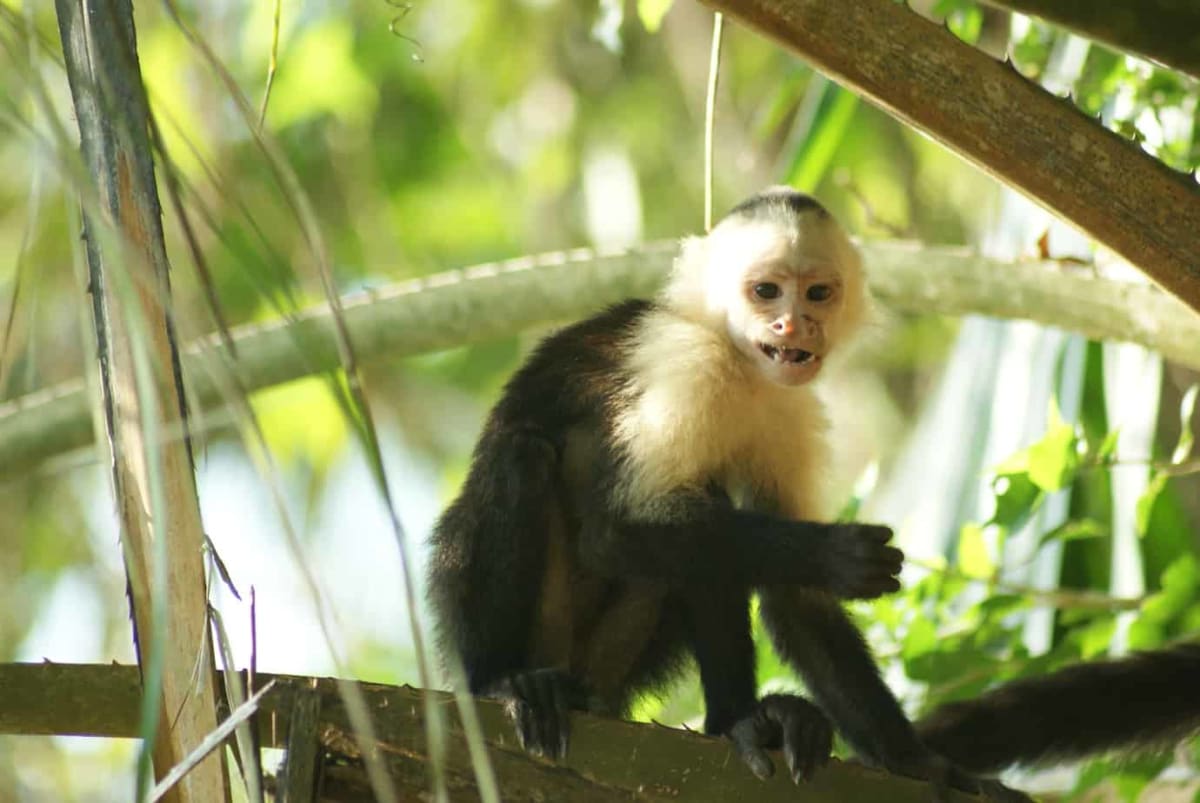
White-faced capuchin monkeys in Costa Rica are voluntarily using AI-powered touchscreens in the jungle, opening new frontiers in studying animal intelligence in the wild. Some monkeys even figured out they could "kiss" the screen to earn banana rewards.
Wild capuchin monkeys in Costa Rica are teaching themselves to use touchscreen technology in the middle of the rainforest, proving that cutting-edge science and wild animals can work together in surprising ways.
At the Taboga Forest Reserve in Guanacaste, researchers set up a station called CapuchinAI that combines artificial intelligence, cameras, a touchscreen, and an automatic food dispenser. When a monkey approaches, the system recognizes the animal and presents a simple task on the screen.
During a two-week test, 16 wild monkeys voluntarily interacted with the device. Ten figured out how to trigger food rewards by touching the screen, while eight clearly learned the connection between their touch and receiving a slice of dried banana.
The first monkey to crack the code was a large male named Trompudo. After exploring the device, he touched the screen and immediately received his reward. He quickly repeated the action, and other curious monkeys followed his lead.
The most charming discovery? Some monkeys realized the touchscreen responded not just to their hands but also to their mouths. A few learned to effectively kiss the screen to get their treats.
The technology solves a problem scientists have struggled with for years. Laboratory experiments offer control but can't replicate the social dynamics and environmental challenges animals face in the wild. CapuchinAI brings rigorous testing into the forest where the monkeys actually live.
The system's facial recognition software can identify individual monkeys with over 97% accuracy. This means researchers can eventually track each monkey's progress over time and tailor cognitive tests to their skill level.
Why This Inspires
This breakthrough opens doors for understanding animal intelligence in entirely new ways. Instead of removing animals from their homes to study them, scientists can now observe how wild monkeys solve problems while they continue their normal lives with their families and friends.
The portable unit runs on a Raspberry Pi computer and operates for about eight hours on battery power. It's practical, affordable, and could eventually be adapted for studying other wild primates around the world.
Researchers are developing experiments to test learning, impulse control, memory, and cognitive flexibility. Combined with years of observations about these monkeys' social relationships and behaviors, the data could reveal why some capuchins learn faster than others and how their experiences shape their intelligence.
The technology doesn't replace traditional field research. Instead, it gives scientists another tool to collect standardized information while the animals roam freely through their habitat.
If the approach succeeds at Taboga, similar systems could help researchers compare cognition across different species and environments without relying on captive populations.
Costa Rica's familiar white-faced capuchins are now at the center of an exciting intersection between conservation, artificial intelligence, and behavioral science, proving that the future of wildlife research might be more collaborative than we ever imagined.
More Images




Based on reporting by Tico Times Costa Rica
This story was written by BrightWire based on verified news reports.
Spread the positivity!
Share this good news with someone who needs it