World's First Kelp Farm Thrives Inside Wind Farm
A Dutch crew just harvested the first commercial seaweed crop ever grown between working offshore wind turbines, proving the same ocean space can produce both clean energy and sustainable food. The five-hectare farm turned what was once restricted dead space into double-duty ocean real estate.
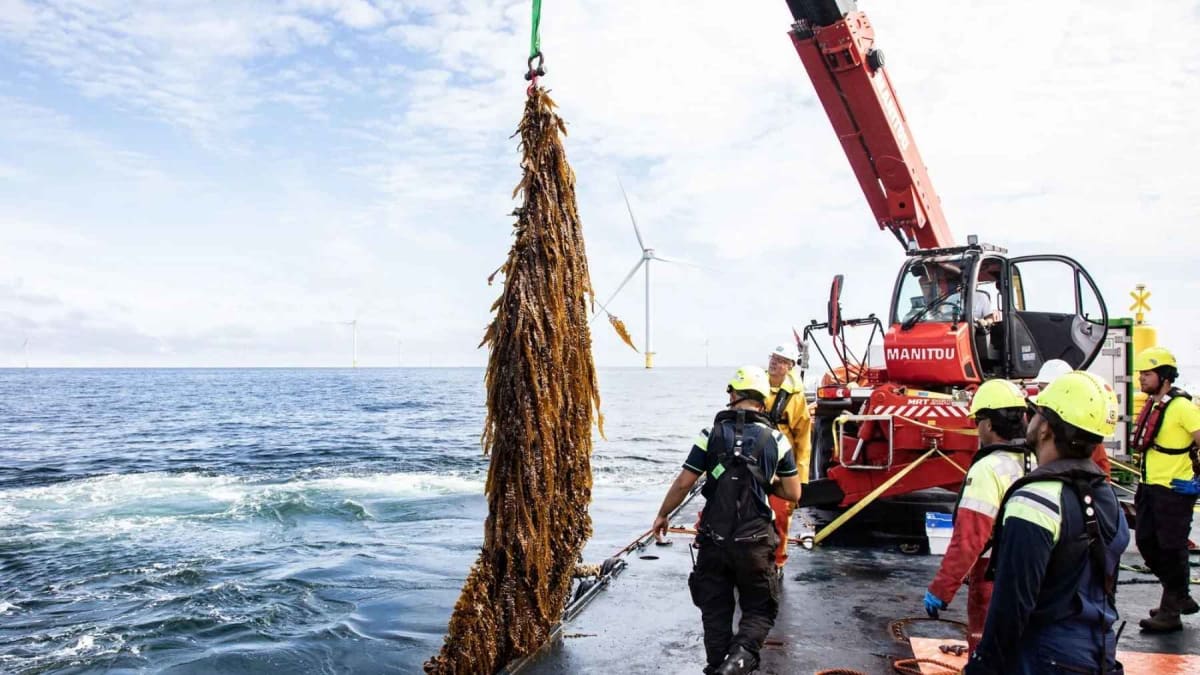
Eleven miles off the coast of The Hague, a crew carefully navigated between 139 spinning wind turbines to pull up something no one had harvested before: the world's first commercial kelp crop grown inside a working wind farm.
North Sea Farm 1 just proved that the same patch of ocean can do two jobs at once. The Hollandse Kust Zuid wind farm already powers 1.5 million Dutch homes with its massive turbines, each standing as tall as a skyscraper with blades stretching 660 feet across.
Now the water between those towers is growing food too. Four massive nets, each 164 feet long, were anchored to the seabed last October with sugar kelp seedlings. In July 2025, crews hauled up the first harvest using a specially designed vessel that threaded through the turbine maze.
The breakthrough solves a problem that has stumped seaweed farmers for years: where to grow. The North Sea is one of the planet's busiest waterways, packed with shipping lanes, fishing zones, military areas, and undersea cables. Finding open space for farming seemed impossible.
Then someone realized the wind farm had already solved that problem. The restricted zones that keep cargo ships away from the turbines create a perfect protected area for kelp nets. No one accidentally plows through your crop at 15 knots when the space is already off limits.
Amazon's Right Now Climate Fund invested €2 million to make it happen. The Irish company Simply Blue Group led the farming work alongside maritime contractor Van Oord and seaweed specialists from Algaia. "When I joined the company, I was asked a straightforward question: can we utilise the space between offshore wind turbines for seaweed cultivation?" said project manager Gareth Murphy. "We now know the answer is yes."
The Ripple Effect
This five-hectare farm is just the beginning of rethinking ocean space. Dutch researchers are already testing floating solar panels at another offshore site, and some wind farms are experimenting with red turbine blades to see if birds avoid them better. The same instinct drives all these projects: our oceans are crowded, so every square mile needs to work harder.
The harvest also launched a major research program led by Plymouth Marine Laboratory. Scientists are tracking exactly how much carbon the kelp pulls from seawater and what happens to that carbon as it moves through the ecosystem. They're using everything from seabed core samples to eDNA analysis to understand which species move in around the nets and how the whole system changes.
Sugar kelp has dozens of uses, from food ingredients to bioplastics to animal feed. But the real win here isn't just the crop. It's proving that humans can stack ocean uses on top of each other instead of fighting over every inch of coastline.
The North Sea just got a little more productive, one kelp net at a time.
More Images

Based on reporting by Google News - Wind Energy
This story was written by BrightWire based on verified news reports.
Spread the positivity!
Share this good news with someone who needs it