Cat-Clawed Drone Lands on 60-Degree Ice Walls
Scientists in Quebec built a drone with retractable claws that can perch on near-vertical glaciers, solving a problem that's limited Arctic research for years. The Ice Dart could transform how we monitor melting icebergs and keep shipping routes safe in the frozen north.
📺 Watch the full story above
Drones have conquered the skies, but they've never been able to rest on one of Earth's most challenging surfaces: steep glacier ice.
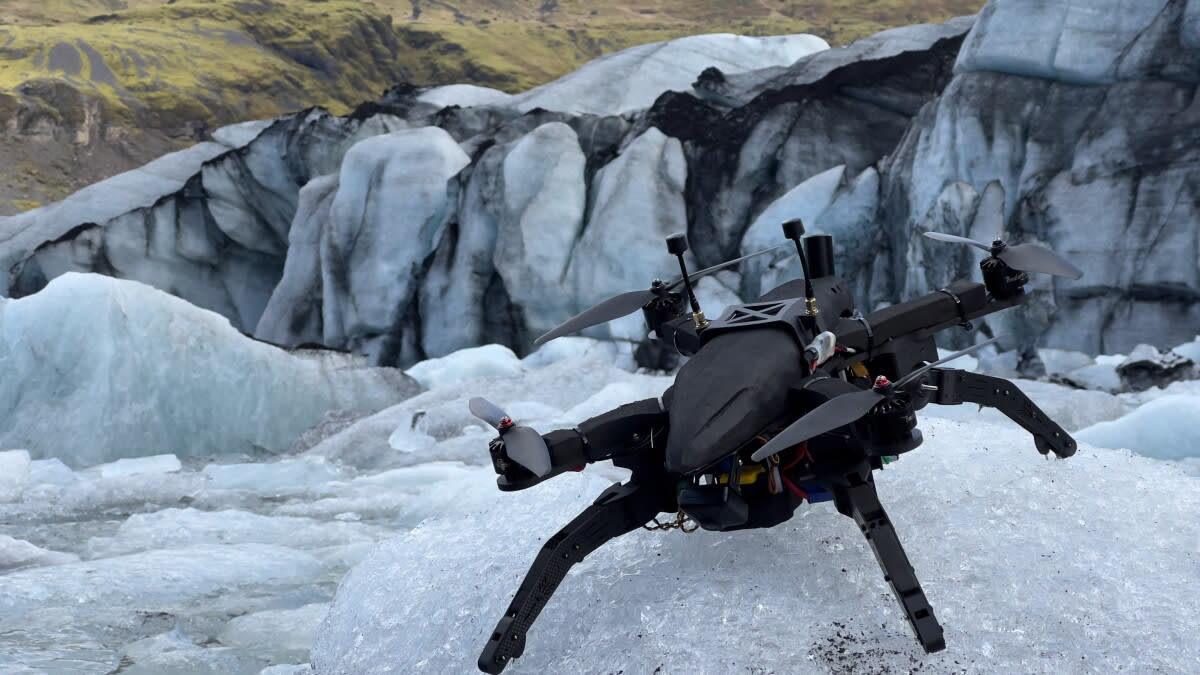
A team at the Université de Sherbrooke in Quebec just changed that. They created the Ice Dart, a drone with cat-inspired retractable claws that can land on ice slopes up to 60 degrees and stay put for hours instead of burning through its battery in minutes.
The problem sounds simple but has stumped robotics researchers for years. Regular drones with rubber feet start sliding off ice at slopes as gentle as 9 degrees. On a 60-degree wall, gravity only pushes down with half its usual force, making grip nearly impossible.
Isaac Tunney, the postdoctoral researcher who led the project, took inspiration from an unexpected source. "I wanted to create feet that would naturally and passively engage their spines in the ice at the right moment, regardless of the drone's orientation, the surface geometry, or the ice conditions," he says.
The solution combines three clever technologies. Each of the drone's four carbon fiber legs ends in a foot with two spring-loaded spines pointing opposite directions, so one always bites into the ice whether the aircraft lands facing uphill or downhill. Shock-absorbing friction disks prevent bouncing on impact, keeping the spines locked in place.
The third trick is pure genius. For a split second after landing, the motors reverse thrust and shove the drone into the wall, helping the claws dig deeper when gravity alone won't cut it.
The team tested their creation on Iceland's Fjallsjökull glacier in winds gusting past 30 km/h. The Ice Dart stuck 24 perfect landings on slopes up to 58 degrees with a 100% success rate.
The Ripple Effect
A hovering drone dies in minutes, but a perched one becomes a silent, low-energy sentinel that can watch for hours or even days. That capability could transform Arctic monitoring just as the region becomes more critical and more fragile.
Drifting icebergs threaten oil platforms and shipping routes as maritime traffic pushes further north. Right now, tracking them means expensive helicopter drops or boat deployments with limited placement options. The Ice Dart offers a cheaper, more flexible alternative that can land exactly where scientists need eyes.
Once landed, the drone can shut down its noisiest systems and disappear from thermal and radio detection. It becomes a fixed sensor station powered by a fraction of its flying energy, perfect for long-term environmental research in a region where every data point matters.
The Ice Dart hasn't yet landed on a genuinely drifting iceberg in open water, and it still needs a human pilot rather than full autonomy. Those are the team's next steps before this promising prototype becomes a working Arctic monitoring tool.
But for the first time, we have a drone that can stick to one of the planet's most unforgiving surfaces and stay there as long as we need it to.
More Images


Based on reporting by New Atlas
This story was written by BrightWire based on verified news reports.
Spread the positivity!
Share this good news with someone who needs it