Hubble Spots Hidden Galaxy Made of 99% Dark Matter
Astronomers discovered a nearly invisible galaxy 300 million light-years away that's almost entirely dark matter, offering a rare glimpse into the universe's most mysterious substance. The breakthrough shows how new technology is revealing cosmic secrets once thought impossible to find.
📺 Watch the full story above
Scientists just found a galaxy so dominated by dark matter that it's practically invisible, opening a new window into understanding the universe's greatest mystery.
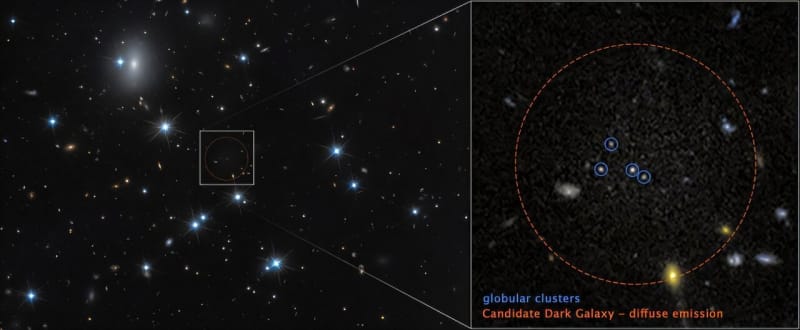
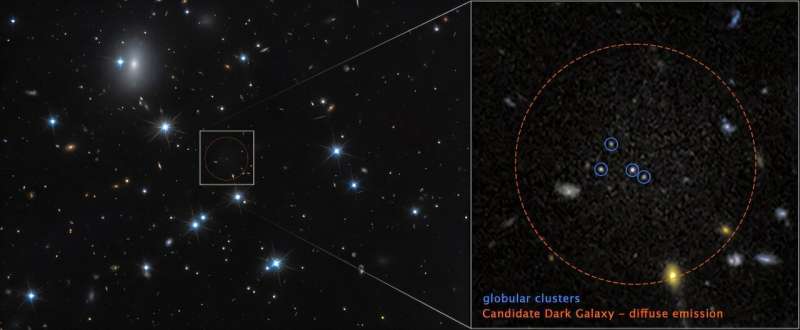
The galaxy, called CDG-2, sits in the Perseus cluster 300 million light-years from Earth. Researchers at the University of Toronto spotted it using an innovative approach: hunting for clusters of tightly packed stars that usually orbit normal galaxies, then using those clusters as cosmic breadcrumbs to find the faint galaxy hiding behind them.
Three powerful telescopes confirmed what seemed impossible. NASA's Hubble Space Telescope, the European Space Agency's Euclid observatory, and Hawaii's Subaru Telescope all detected a faint glow surrounding four star clusters, proving a ghost galaxy existed there all along.
"This is the first galaxy detected solely through its globular cluster population," said David Li, who led the discovery team. The finding represents a completely new way of seeing the invisible.
CDG-2 contains roughly 6 million sun-like stars worth of light, but 99% of its total mass is dark matter. That invisible substance neither reflects, emits, nor absorbs light, making it extraordinarily difficult to study. Scientists believe gravitational interactions with neighboring galaxies stripped away most of CDG-2's normal matter over time, leaving behind this dark matter skeleton with just a handful of stars.
The discovery matters because dark matter makes up about 85% of all matter in the universe, yet remains deeply mysterious to science. Finding galaxies like CDG-2 helps researchers understand how dark matter behaves and shapes cosmic structures.
Why This Inspires
This breakthrough shows how combining human creativity with cutting-edge technology reveals wonders once thought forever hidden. The research team used machine learning and statistical methods to analyze vast amounts of telescope data, essentially teaching computers to spot patterns human eyes would miss.
Even better, more discoveries are coming. Upcoming missions like NASA's Nancy Grace Roman Space Telescope and the Vera C. Rubin Observatory will scan enormous portions of the sky, likely revealing dozens more dark galaxies. Each discovery brings us closer to solving one of the universe's biggest puzzles.
The fact that we can now detect objects that are 99% invisible shows just how far human knowledge and technology have advanced. What seemed like science fiction a generation ago is now routine astronomy, proving that persistence and innovation can illuminate even the darkest corners of existence.
We're living in a golden age of cosmic discovery, where the invisible becomes visible and mysteries become knowledge.
More Images
Based on reporting by Google News - Science
This story was written by BrightWire based on verified news reports.
Spread the positivity!
Share this good news with someone who needs it