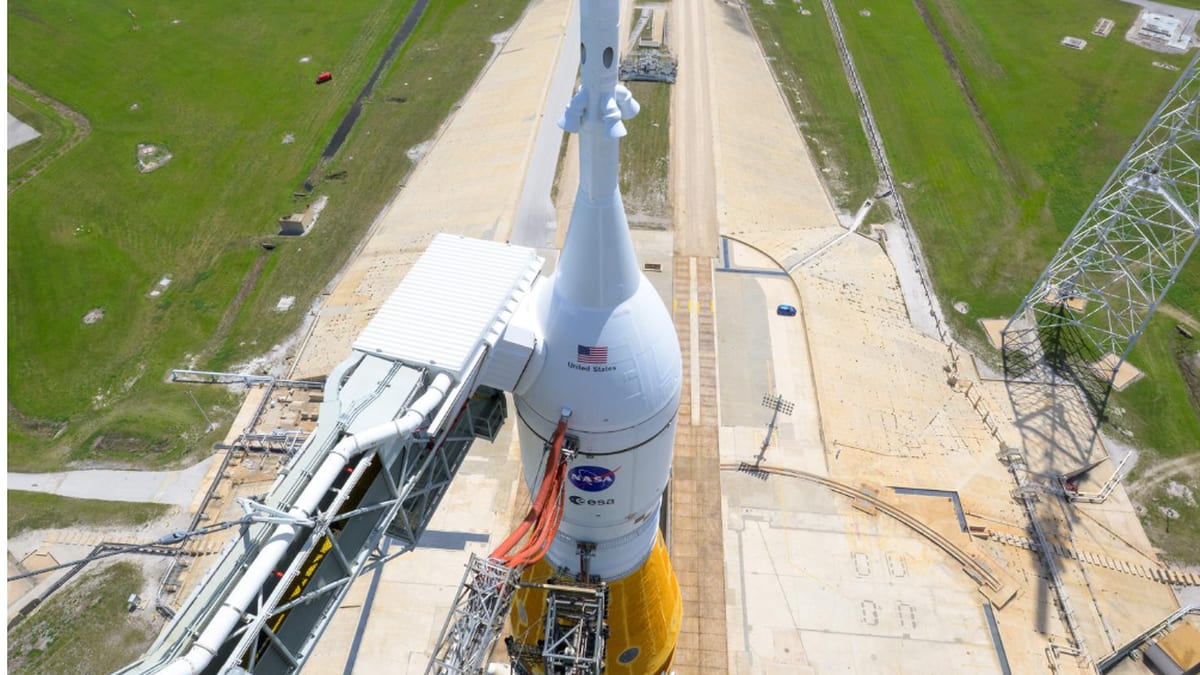
NASA Sends 4 Astronauts to Moon for First Time in 50 Years
Four astronauts launched toward the Moon on Wednesday, marking humanity's return to lunar exploration after half a century. The historic Artemis II mission represents a giant leap forward for space exploration and international cooperation.
📺 Watch the full story above
After more than 50 years, humans are headed back to the Moon, and the world watched as four brave astronauts began their journey into history.
NASA astronauts Reid Wiseman, Victor Glover, Christina Koch, and Canadian Space Agency astronaut Jeremy Hansen lifted off from Kennedy Space Center in Florida on Wednesday evening. Their 10-day mission around the Moon marks the first crewed lunar flight since the Apollo era ended in 1972.
The crew rode atop NASA's powerful Space Launch System rocket inside the Orion spacecraft. The mission won't land on the lunar surface, but it will take the astronauts within 4,700 miles of the Moon before Earth's gravity pulls them back for a Pacific Ocean splashdown.
This flight proves that all the systems needed for future Moon landings work exactly as designed. From ground crews to rocket hardware to the astronauts themselves, Artemis II tests everything NASA needs to return humans to the lunar surface on future missions.
Before boarding, all four crew members signed the inside of the White Room, continuing a tradition dating back to NASA's Gemini program in the 1960s. The closeout crew then sealed them inside with custom-fitted bright orange spacesuits, redesigned with stronger materials and better mobility than the shuttle era suits.
The mission represents true international collaboration. Hansen becomes the first Canadian to travel beyond low Earth orbit, and the crew will deploy ATENEA, a microsatellite built by Argentina to test navigation systems in deep space.
The Ripple Effect
This mission ignites more than rocket engines. Argentina's ATENEA satellite, the only Latin American payload selected from nearly 50 countries, shows how space exploration now includes voices from around the world. Germany, Saudi Arabia, and South Korea also contributed experiments for the journey.
Victor Glover's presence aboard marks another milestone as the first person of color to travel to the Moon. His journey opens doors for future generations who can now see themselves among the stars.
The renewed focus on lunar exploration has energized the entire aerospace industry. As SpaceX prepares for its own historic IPO, investor excitement about space exploration is reaching new heights, promising more innovation and opportunities ahead.
This mission proves that the dreams we thought belonged to history books are becoming our future again. When Orion splashes down next week, NASA will have proven we're ready to return humans to the Moon and eventually push onward to Mars.
The countdown to humanity's next chapter has begun, and millions around the world are watching with wonder.
Based on reporting by The Hindu
This story was written by BrightWire based on verified news reports.
Spread the positivity!
Share this good news with someone who needs it


