Teacher Discovers First-Ever T. Rex Trackway in North Dakota
A high school science teacher recovering from knee surgery made a discovery that rewrote paleontology history: the world's first confirmed trail of T. rex footprints. His hobbled pace turned out to be the perfect speed for spotting what decades of scientists had missed.
📺 Watch the full story above
Kent Hups couldn't climb the steep hills of North Dakota's fossil fields like he normally would. Fresh from knee replacement surgery, the Colorado high school science teacher had to take things slow during a 2025 paleontology dig near Marmarth.
That slower pace led him to notice something 23 feet away that changed everything scientists knew about T. rex movement. What looked like odd rock formations turned out to be four enormous, three-toed footprints stretching across ancient stone.
Hups, who teaches at Northglenn High School and volunteers with the Denver Museum of Nature & Science, immediately started asking himself the questions he teaches his students to ask. How do you prove it's a track? What animal left it?
The answer made history. Each footprint measures roughly three feet long, and together they form the world's first confirmed trackway of a full-grown Tyrannosaurus rex.
Before Hups' discovery, scientists had confirmed only two isolated T. rex footprints worldwide. Neither one could show researchers how the massive predator actually moved through its world.
Now, for the first time ever, paleontologists can follow an adult T. rex's actual path. The spacing between prints reveals the dinosaur was walking between 3.5 and 4.5 miles per hour, about as fast as a human's brisk walk.
Dr. Tyler Lyson, senior curator at the Denver Museum of Nature & Science, explained why this matters so much. "Bones tell us an enormous amount about these animals, but footprints capture a moment of behavior," he said. "With a trackway, we can actually follow an animal as it moved across the landscape."
Why This Inspires
Hups has spent his teaching career encouraging students to stay curious and observe carefully. He never imagined his own advice would lead him to rewrite scientific history.
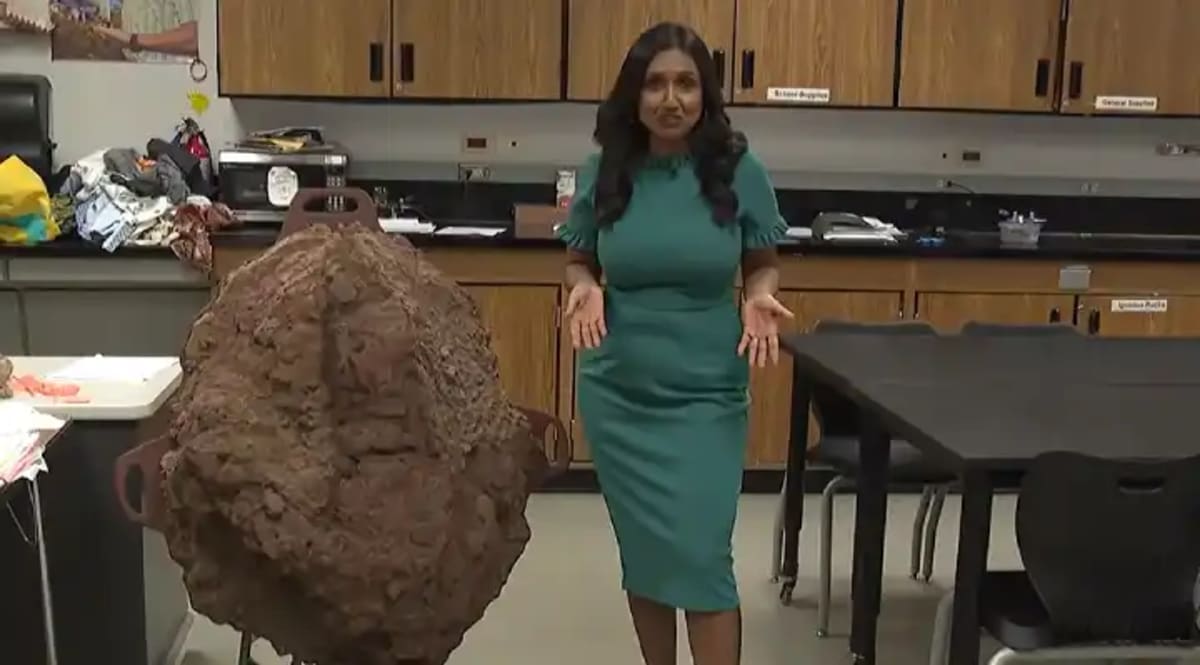
His students are now living that lesson firsthand. During a paleontology club meeting, they painted a 3D model of one of the massive footprints their teacher discovered.
Tenth-grader Alexandra Acosta couldn't contain her excitement about being part of the discovery process. "Having the privilege now to have a part in this because of Mr. Hups and because I wanted to join the paleontology club is just, it fills my soul with so much joy," she said.
The discovery also gave Acosta a profound perspective on humanity's place in Earth's timeline. "Life continues even after things go extinct," she reflected. "Humans are such a small part of it, and this really puts it into perspective."
Three of the four footprints will be airlifted by helicopter this fall to the Denver Museum of Nature & Science. There, researchers can study them further before sharing them with the public.
For Hups, the magic lies in what those 66-million-year-old tracks let us imagine: a living, breathing T. rex walking across ground that would one day become North Dakota badlands, leaving behind frozen moments that waited millions of years for a science teacher with a bad knee to notice them.
Based on reporting by Sunny Skyz
This story was written by BrightWire based on verified news reports.
Spread the positivity!
Share this good news with someone who needs it