10-Billion-Year-Old Supernova May Unlock Dark Energy Secret
Astronomers discovered a rare supernova from 10 billion years ago whose light was bent into multiple images by a galaxy's gravity, creating a cosmic time machine that could solve one of science's biggest mysteries. This discovery might finally explain dark energy, the mysterious force pushing our universe to expand faster and faster.
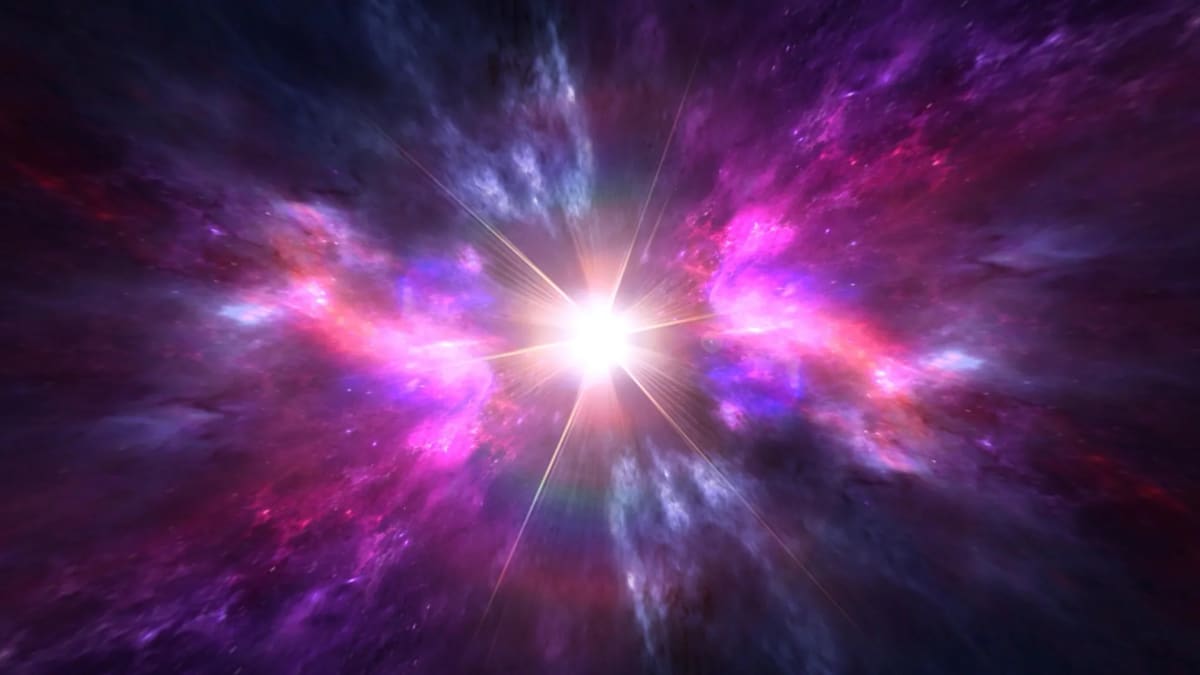
A cosmic explosion from when the universe was just a quarter of its current age is giving scientists an unprecedented tool to understand the invisible force shaping our cosmos.
Astronomers at Liverpool John Moores University spotted something extraordinary: a supernova so distant that its light has been traveling toward Earth for more than 10 billion years. But what makes this discovery special isn't just its age. A galaxy positioned perfectly between Earth and the explosion bent the supernova's light like a cosmic magnifying glass, splitting it into multiple images.
"No one has found a supernova like this before," explains Dr. Daniel Perley, a reader in astrophysics at the university. The discovery could help solve mysteries about dark energy, the unknown force believed to drive the accelerating expansion of the universe.
Here's where it gets exciting. Because each image of the supernova traveled a different path length to reach us, scientists are essentially watching different moments of the same explosion simultaneously. It's like having a cosmic DVR that lets you watch yesterday's show and last week's episode at the same time.
PhD student Jacob Wise first recognized the importance of what they were seeing. "We are seeing the light from this distant supernova split into multiple images, what we call gravitationally lensed," he explains.
The time difference between these images depends directly on how fast the universe is expanding. By measuring these delays with high precision, astronomers can calculate the expansion rate and learn more about the dark energy accelerating it.
Why This Inspires
This discovery arrives at a perfect moment for cosmology. Scientists currently face a frustrating puzzle called the Hubble Tension. Different measurement methods produce conflicting values for how fast the universe is expanding, and no one knows which answer to trust.
Studies of the Big Bang's afterglow give one number for the expansion speed. Studies of nearby galaxies give a different number. These lensed supernova observations could finally reveal which measurement is correct.
The discovery showcases the power of teamwork across the globe. While California's Zwicky Transient Facility first detected the supernova, the Liverpool Telescope was first to spot the multiple images proving it was gravitationally lensed. Later, the world's most powerful observatories joined in, including the Keck Telescopes, Hubble Space Telescope, and James Webb Space Telescope.
"All the major observatories in the Northern Hemisphere plus the space-based telescopes have been looking at this, but it was the Liverpool Telescope, run from LJMU, that got there first," beamed Wise.
Dark energy makes up about 68% of everything in the universe, yet scientists still don't know what it is or exactly how it works. This rare supernova is offering humanity a new window into understanding the invisible architecture of reality itself.
Based on reporting by Science Daily
This story was written by BrightWire based on verified news reports.
Spread the positivity!
Share this good news with someone who needs it