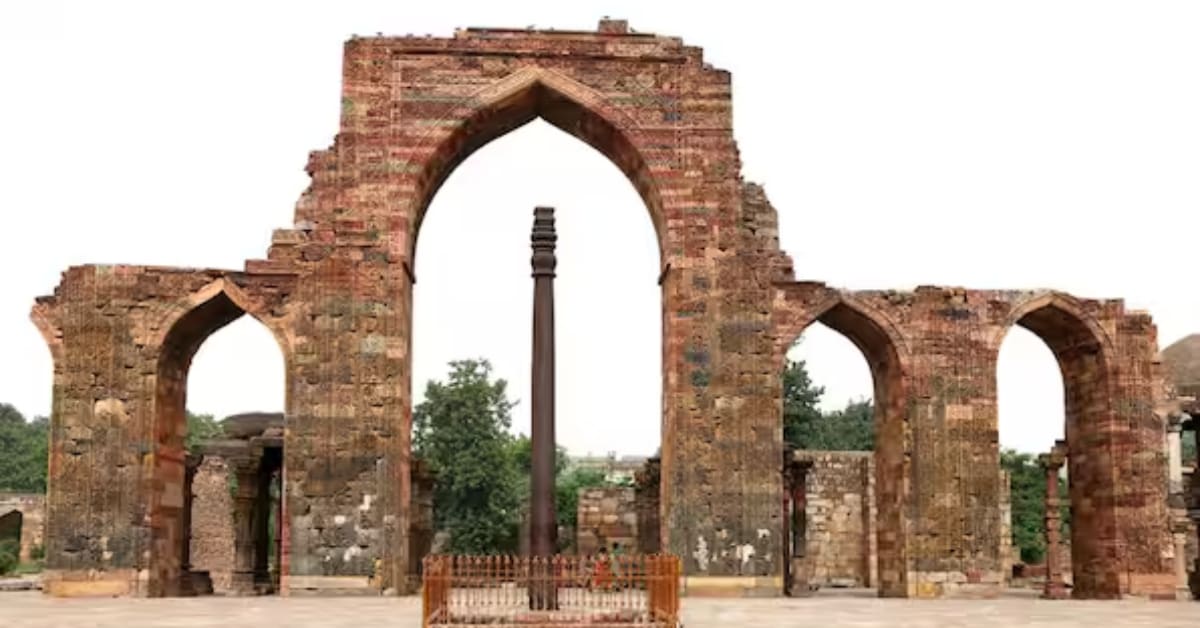
1,600-Year-Old Iron Pillar Reveals Ancient India's Genius
A massive iron pillar in Delhi has stood in the open for nearly 1,600 years without rusting away, and scientists finally understand why. Ancient Indian metalworkers accidentally discovered a technique that modern engineers are still studying today.
A six-ton iron pillar has stood exposed to monsoons, heat, and pollution in Delhi for 1,600 years, and it barely shows its age.
Anyone who has left an iron gate or tool outside knows what happens next. The metal turns orange, flakes away, and slowly crumbles under rust's relentless attack.
The Iron Pillar at Delhi's Qutub Complex should have met the same fate centuries ago. Instead, the 7.2-meter monument from the Gupta period remains remarkably intact, puzzling scientists for over a century.
The pillar dates back to the 4th or 5th century CE, likely commissioned by King Chandragupta II Vikramaditya. While its historical importance was clear, the real mystery lived on its surface.
Under normal conditions, iron reacts with moisture and oxygen to form rust that eats through metal. Even the Eiffel Tower needs constant repainting to survive.
But this ancient pillar seemed to play by different rules.
Scientists studied the pillar for decades before R Balasubramaniam, an archaeometallurgist at IIT Kanpur, helped crack the code. The secret was hiding in plain sight, written in the metal's chemistry.
Ancient Indian ironworkers left about 0.25 percent phosphorus in their iron, while modern methods remove most of it. That tiny difference changed everything.
Over centuries, the phosphorus helped create a protective layer on the pillar's surface. The pillar did rust, but in a way that saved it rather than destroyed it.
The outer layer formed a shield that actually protected the metal underneath. Every time rain fell and dried, the protective coating grew stronger instead of weaker.
Why This Inspires
The pillar's survival tells a powerful story about knowledge that existed long before modern chemistry. Ancient craftsmen used forge welding, heating and hammering separate iron pieces together until they became one massive structure.
Creating a six-ton pillar this way required extraordinary skill and patience. The iron also contained very low levels of sulfur and manganese, which combined with the phosphorus to create ideal conditions for protection.
These metalworkers may not have used scientific terms to describe their process. But through experience and craft, they built something that continues to teach modern scientists about corrosion resistance.
The pillar stands as proof that innovation and expertise flourished in ancient India. Researchers today study its composition to understand how we might protect modern structures better.
What began as a practical monument has become a lesson in sustainable engineering, one that has literally stood the test of time in Delhi's demanding climate for sixteen centuries.
More Images
%2Fenglish-betterindia%2Fmedia%2Fmedia_files%2F2026%2F06%2F15%2Fdelhi-iron-pillar-2026-06-15-13-10-27.png)
%2Ffilters%3Aformat(webp)%2Fenglish-betterindia%2Fmedia%2Fmedia_files%2F2026%2F06%2F15%2Fdelhi-iron-pillar-1-2026-06-15-13-24-47.png)
%2Fenglish-betterindia%2Fmedia%2Fpost_attachments%2Fuploads%2F2022%2F07%2Fhistory-4-1657543525.jpg)
Based on reporting by The Better India
This story was written by BrightWire based on verified news reports.
Spread the positivity!
Share this good news with someone who needs it