1980s Hobbyists Built Walking Robot in an Attic
A British photographer with no robotics training rallied friends to build a life-size walking robot using "air muscles" instead of motors. Their weekly spaghetti dinners and scrap-yard finds launched a company that's still pioneering robotics today.
In 1987, photographer Richard Greenhill had zero robotics training but a wild dream: build a humanoid robot that could carry luggage. When his startup colleagues wouldn't help, he turned his attic into a workshop and invited friends over every Wednesday night.
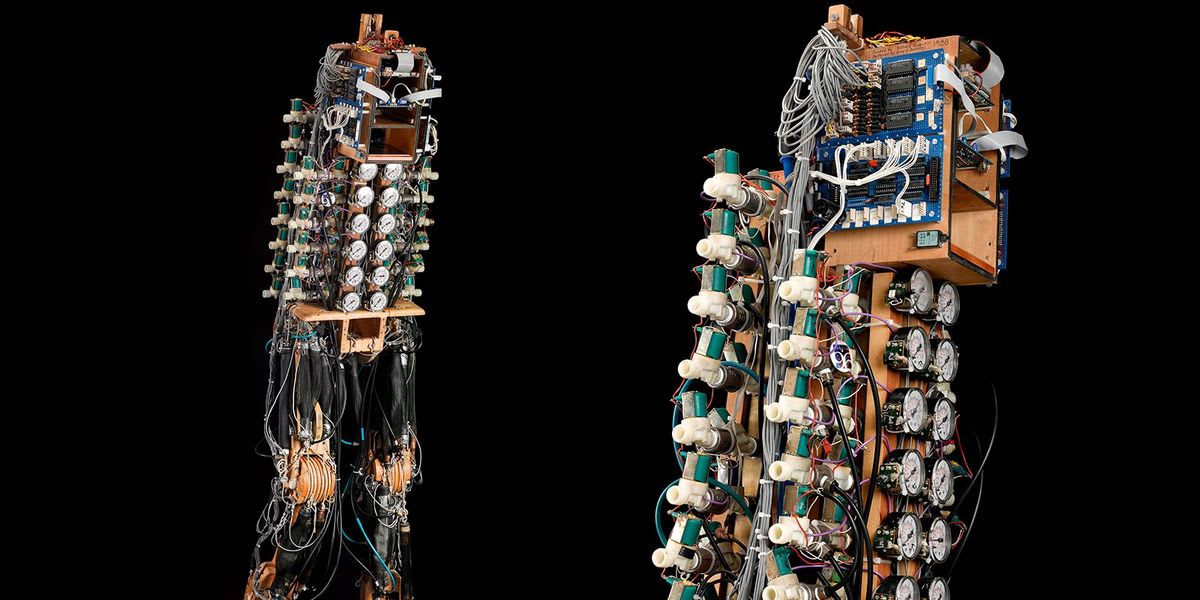
His wife Sally cooked massive pots of spaghetti while a dozen tinkerers gathered around printer parts and junkyard treasures. They called themselves the Shadow Group, and their main creation was Shadow Walker, a headless, armless robot that moved like nothing else at the time.
Instead of motors, Greenhill insisted on using compressed air. The team crafted 28 "air muscles" that expanded and contracted like real human tissue, controlling movement across eight joints. These pneumatic muscles, based on 1950s McKibben technology, gave the robot 12 degrees of freedom.
Robotics expert David Buckley sketched the design from medical textbooks, creating a simplified skeleton from maple wood. The robot stood 168 centimeters tall with double-axis ankles that moved in two directions, knees without kneecaps, and single wide toes on each foot.
A teenage programmer named Rich Walker joined the group and tackled the hardest problem: making the robot balance. He experimented with neural networks to keep Shadow Walker upright, even when pushed. The robot learned to stand reliably, though walking remained elusive due to fragile sensors and unreliable valves.
The Ripple Effect
The Shadow Group's late-night experiments led somewhere remarkable. Rich Walker and the team eventually founded Shadow Robot Company, which continues pushing robotics boundaries today. What started as amateur enthusiasm in a cramped attic became a legitimate force in the field.
Their timing was perfect. Honda was secretly developing humanoid robots in 1987, and the IEEE had just established its Robotics and Automation Society that same year. While industrial giants worked in high-tech labs, the Shadow Group proved innovation could happen anywhere with passion and pasta.
The robot earned an invitation to the 1st International Robot Olympics in 1990, competing against the world's best machines. For a creation built from scrap parts and powered by friendship, standing among professional robots was already a victory.
Shadow Walker now rests in museum collections, a testament to what curious minds can achieve without formal credentials or fancy equipment. Sometimes the most groundbreaking work happens around a dinner table.
More Images

Based on reporting by IEEE Spectrum
This story was written by BrightWire based on verified news reports.
Spread the positivity!
Share this good news with someone who needs it