500-Million-Year-Old Brain Reveals Arthropod Origins
A fossilized larva smaller than a grain of sand just rewrote our understanding of how insects, spiders, and crabs evolved their incredibly successful body designs. Scientists used cutting-edge X-ray technology to peek inside a brain preserved for half a billion years.
A tiny ancient worm is answering one of evolution's biggest questions: how did arthropods become the most successful animals on Earth?
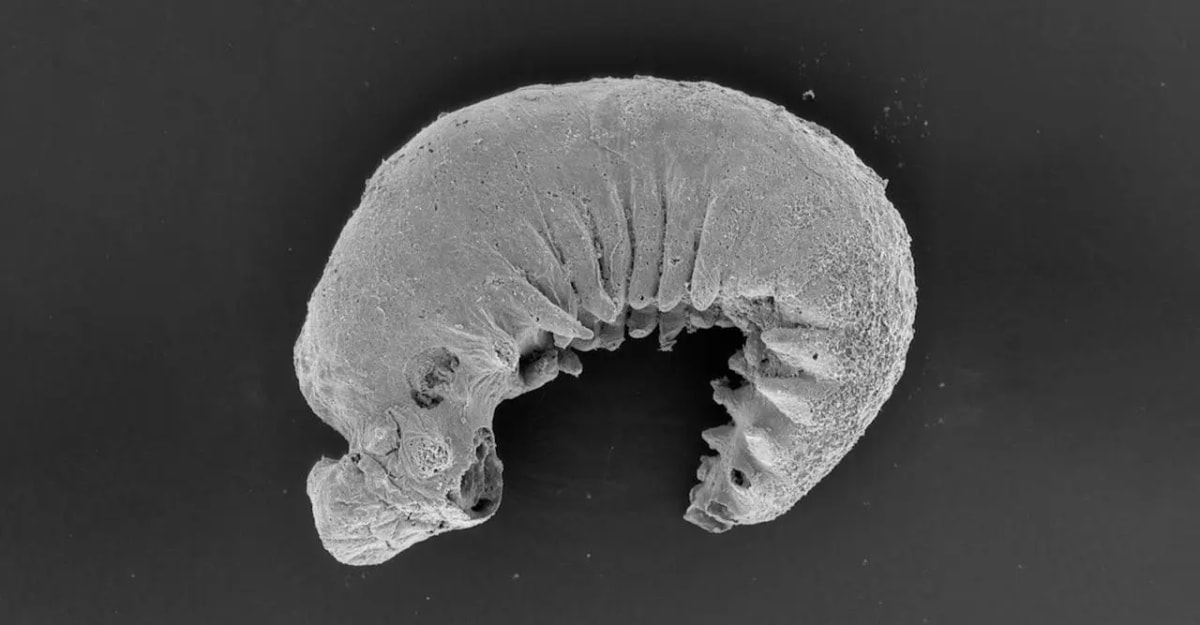
Researchers at Durham University discovered the fossil in China's Yunnan province, and what they found left them stunned. This speck of a larva, barely bigger than a sand grain, preserved its brain, nervous system, digestive tract, and circulatory system in remarkable detail for 500 million years.
The team named the new species Youti yuanshi, meaning "primitive larva" in Chinese. It died during the Cambrian period while still in its early developmental stage, then waited half a billion years to share its secrets with science.
Using advanced X-ray analysis detailed in the journal Nature, scientists could see inside the fossilized body without damaging it. What they discovered was revolutionary: a perfectly preserved window into how arthropod heads and body parts evolved their specialized functions.
Today, arthropods are everywhere. Insects, spiders, crabs, and their relatives now outweigh all humans and livestock combined. They fly through the air, crawl across land, and thrive in the deepest oceans.
Why This Inspires
This discovery fills a critical gap in understanding the Cambrian explosion, when life on Earth diversified faster than ever before. The tiny brain shows exactly how arthropod features like antennae, jaws, and eyes developed from ancestral brain regions and became specialized over millions of years.
Scientists can now trace the evolutionary steps that led to the most successful body plan in animal history. The fossil reveals the crucial stages when simple structures transformed into the complex, adaptable designs that let arthropods conquer nearly every habitat on the planet.
Finding such perfect preservation from this far back in time is incredibly rare. Most soft tissues like brains decompose quickly, leaving no trace for future discovery.
This ancient larva proves that sometimes the smallest creatures hold the biggest answers about life on Earth.
More Images



Based on reporting by Google: fossil discovery
This story was written by BrightWire based on verified news reports.
Spread the positivity!
Share this good news with someone who needs it