70-Million-Year-Old Fossil Rewrites Mammal History
A tiny, nearly complete skeleton from Mongolia's Gobi Desert just solved a 40-year mystery about early mammal evolution. The rabbit-sized creature proves that similar features can evolve separately, changing how scientists understand our ancient relatives.
Scientists just discovered that a group of ancient mammals they thought were our distant cousins actually belonged to a completely different branch of the family tree.
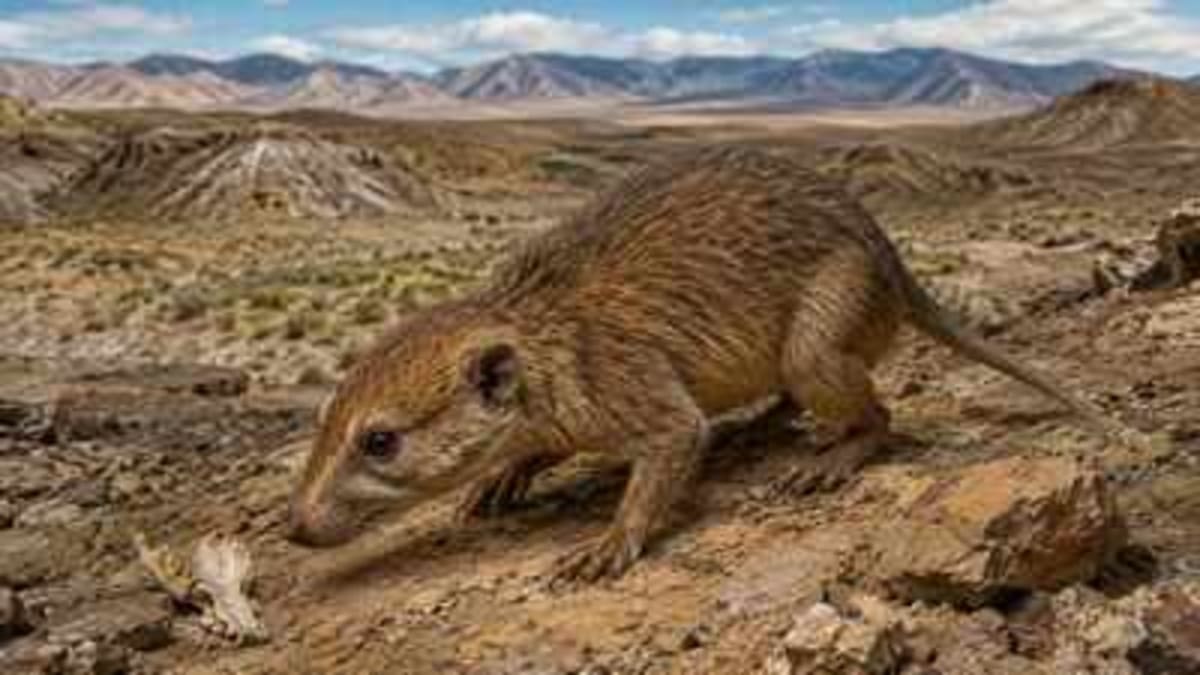
The star of the story is Tamirkhan balcarceli, a six-inch-long creature that scurried across Mongolia 70 million years ago while dinosaurs still ruled the Earth. Unlike most fossil mammals from this period, which usually leave behind only scattered teeth, this specimen preserved its skull, teeth, and hind limbs all together in one remarkable find.
For nearly 40 years, paleontologists have puzzled over a group called zhelestids. Their rounded grinding teeth looked so similar to those of modern plant-eating mammals that scientists assumed they must be early ancestors of horses, cows, and other hoofed animals. The problem was that nobody had enough fossil evidence to be sure.
This new skeleton, described in the journal Nature, finally provided the missing pieces. When researchers examined the complete animal, they found something unexpected. The creature had specialized skull openings, distinctive front teeth, and elongated fused foot bones built for speed, none of which matched early placental mammals.
Instead, all these features pointed to zalambdalestoids, a separate group of small Cretaceous mammals that went extinct long before modern mammals took over. The similar teeth weren't a sign of shared ancestry at all. They evolved independently because both groups faced similar challenges in their environment.
Why This Inspires
This discovery reminds us that nature is far more creative than we often imagine. Two completely unrelated groups of tiny mammals, living millions of years apart, both evolved nearly identical teeth for similar lifestyles. It's a testament to life's ability to find the same clever solutions to the same problems, even when starting from totally different places.
The finding also shows how one well-preserved fossil can rewrite decades of scientific understanding. Every tooth fragment and bone chip that paleontologists have been studying for 40 years suddenly makes sense in a new way. The mammalian family tree just got more branches, more diversity, and more interesting stories to tell.
Tamirkhan balcarceli may have been small enough to fit in your hand, but its impact on science is enormous. It lived in a world dominated by giants, yet its tiny skeleton traveled 70 million years through time to teach us something profound about how evolution actually works.
The researchers named it after the Tamir River near where it was found, honoring both the landscape that preserved it and the scientific collaboration that brought it to light. Sometimes the smallest creatures carry the biggest lessons about life on Earth.
More Images



Based on reporting by Google: fossil discovery
This story was written by BrightWire based on verified news reports.
Spread the positivity!
Share this good news with someone who needs it