A Piece of Mars Just Returned Home After 600,000 Years
A rock blasted off Mars hundreds of thousands of years ago landed in Oman, got catalogued in London, and now rides on a NASA rover back on its home planet doing real science. It's the first Martian meteorite ever returned to Mars.
A dark rock someone picked up from the gravel flats of Oman in 1999 turned out to be a fragment of Mars, and today a slice of it is back home doing an important job.
The rock, catalogued as SaU 008 at London's Natural History Museum, is a shergottite, a type of volcanic rock that scientists can identify as Martian through its unique chemistry and trapped atmospheric gases. An asteroid impact 600,000 to 700,000 years ago hit Mars hard enough to fling debris completely off the planet, and one of those fragments eventually made its way to Earth's Arabian desert.
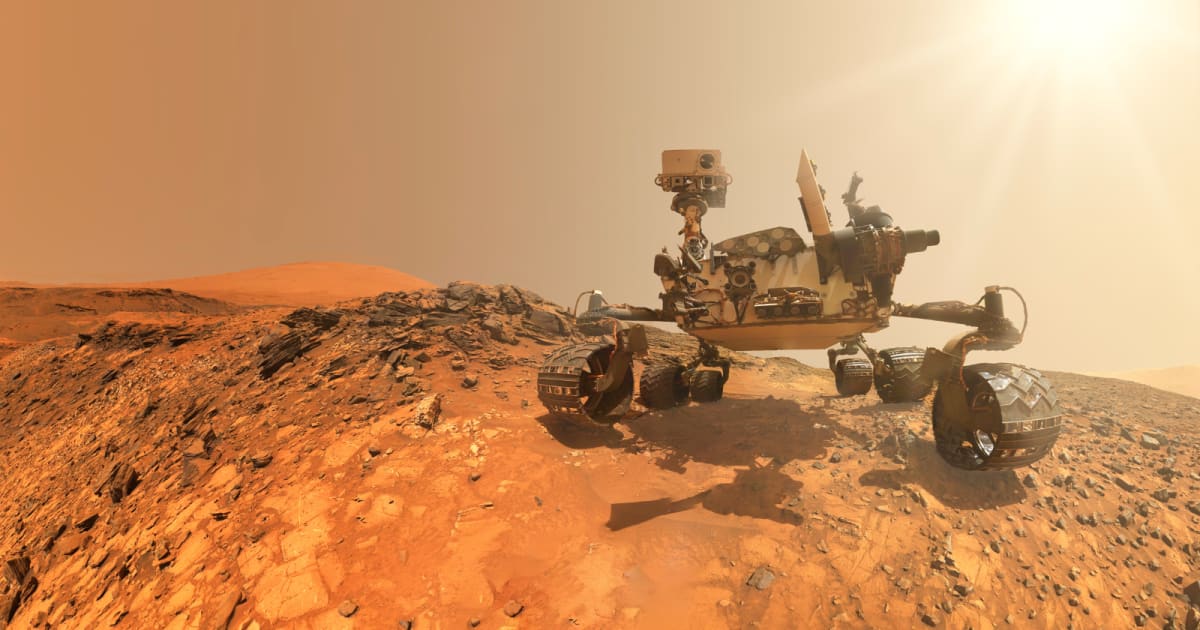
But this isn't just a story about cosmic coincidence. In 2018, NASA's Mars 2020 team selected a slice of SaU 008 for a specific mission, and when the Perseverance rover landed in Jezero crater in February 2021, it carried that fragment back home.
Caroline Smith, the museum's Principal Curator of Meteorites at the time, explained the rock was chosen because it's "as tough as old boots." Anything riding to Mars has to survive a violent launch and landing, and many interesting samples are simply too fragile.
The slice isn't there as a souvenir. It's one of ten calibration targets for SHERLOC, an instrument that uses ultraviolet spectroscopy to map minerals and organic compounds in Martian rocks.
Having a natural Martian sample whose chemistry was fully characterized on Earth before launch gives scientists what they call ground truth. When SHERLOC reads rocks on Mars, the team can check its measurements against this known reference to make sure the instrument is working correctly.
The setup is already paying off. A 2025 analysis showed that SHERLOC repeatedly detected the same chemical signatures in the same spots on SaU 008 across Perseverance's first 1,000 sols on Mars, proving the instrument stays accurate over time.
Why This Inspires
There's something deeply human about this mission within a mission. We didn't just send robots to another planet; we sent a piece of that planet back with instructions to help us understand it better.
The rock spent hundreds of thousands of years wandering through space, landed by accident in a desert, got recognized for what it was, and then got deliberately sent home to do useful work. It's not a monument or a symbol; it's a working tool helping us learn.
Smith captured the quiet significance perfectly when the loan was announced: "This is a first for us, sending one of our samples back home for the benefit of science."
A fragment of Mars is now helping us read Mars more accurately, one measurement at a time.
More Images


Based on reporting by Google News - Science
This story was written by BrightWire based on verified news reports.
Spread the positivity!
Share this good news with someone who needs it