AI Could Save Particle Accelerators Millions Each Year
Scientists at Fermilab are using artificial intelligence to fine-tune particle accelerators, potentially saving millions in operating costs while accelerating breakthrough discoveries about our universe. The project could reshape how scientists conduct cutting-edge physics research.
Scientists just got a powerful new tool to unlock the secrets of the universe, and it could save millions of dollars in the process.
Fermi National Accelerator Laboratory is leading a groundbreaking project to use artificial intelligence to control the massive particle accelerators that help us understand how everything works. The Department of Energy selected the initiative for funding through its Genesis Mission.
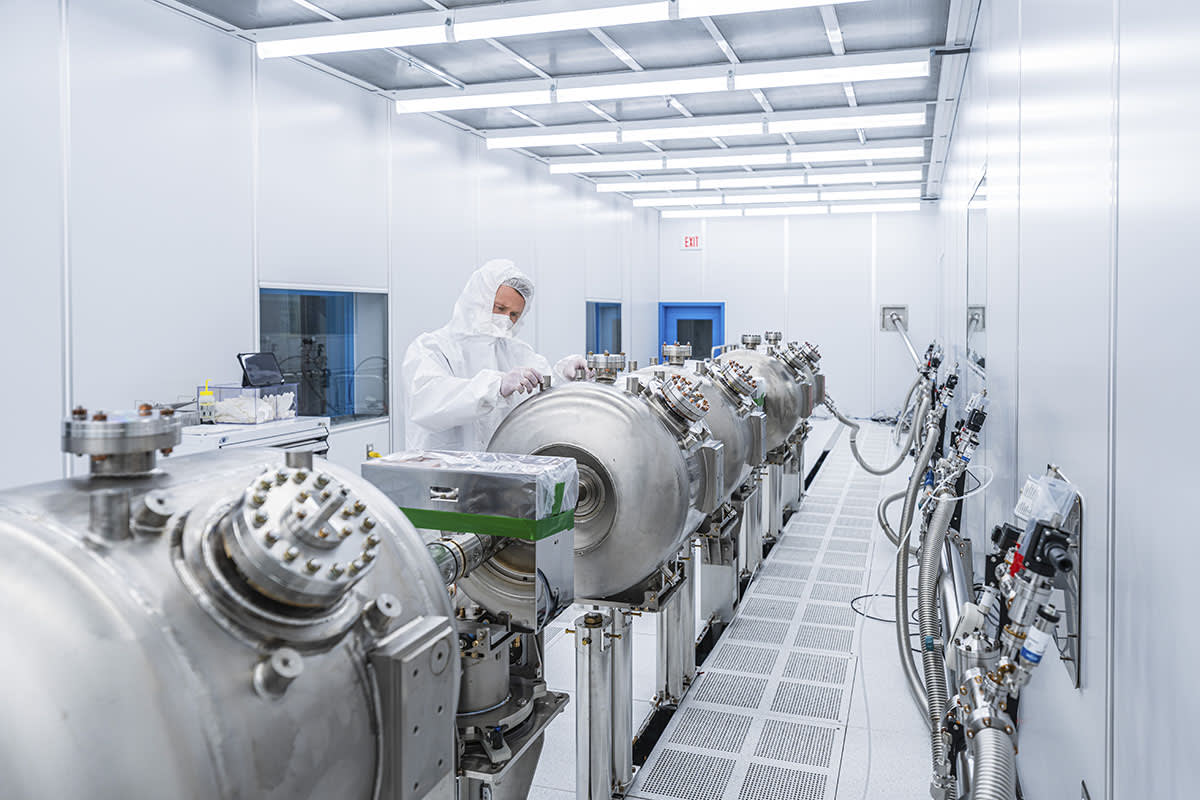
Inside these accelerators, timing is everything. Subatomic particles race through superconducting cavities at nearly the speed of light, getting gentle electromagnetic nudges at precisely the right moments. Think of it like pushing a playground swing: perfect timing sends it soaring, but even a fraction of a second off ruins the rhythm.
The problem is that these cavities can slip out of tune. Pressure changes in the liquid helium coolant, electromagnetic field shifts, and vibrations from nearby equipment all throw off their resonance. When that happens, power gets wasted and experiments can fail.
"Controlling resonance is a critical area of development for particle accelerator facilities, potentially saving millions of dollars a year on operating costs," said Matthias Liepe, a Cornell University professor collaborating on the research. Better control also means more stable particle beams and longer equipment lifespans.
That's where AI comes in. The new machine learning algorithms will monitor and adjust each cavity's frequency in real time, learning from experience and adapting as conditions change. Scientists currently use fast-moving tuners to squeeze cavities back to their ideal frequency, but AI can do this job with far greater precision.
Sam Posen, a senior Fermilab scientist leading the project, sees this as the next frontier. "Today, the lab is at the forefront of an exciting new era to use AI and machine learning to extend our scientific reach even further by improving resonance control in next-generation accelerators," he said.
The project brings together researchers from multiple national laboratories, universities, and industry partners. They're pooling decades of expertise in superconducting technology with cutting-edge AI development.
The Ripple Effect
The benefits extend far beyond just one laboratory. Particle accelerators around the world face the same resonance challenges, meaning this AI breakthrough could improve research facilities globally. More efficient accelerators mean more experiments, faster discoveries, and lower costs for taxpayer-funded science.
When accelerators run more smoothly, scientists can focus on what matters most: smashing particles together to reveal the fundamental building blocks of reality. Every improvement in beam stability brings us closer to answering questions about dark matter, the origins of mass, and the earliest moments after the Big Bang.
The financial savings are equally important. Millions of dollars in annual operating costs can be redirected toward new experiments and upgraded equipment. Better energy efficiency means these massive machines consume less power while delivering better results.
This marriage of AI and particle physics represents exactly the kind of innovation that pushes science forward while making it more sustainable and accessible for future generations.
More Images

Based on reporting by Google: scientific discovery
This story was written by BrightWire based on verified news reports.
Spread the positivity!
Share this good news with someone who needs it