AI Cracks 55 New Alloys Using Cross-Disciplinary Knowledge
Scientists developed an AI system that discovered 55 new high-performance alloys by combining experimental data with expert knowledge extracted from scientific literature. The breakthrough could accelerate the creation of stronger, more durable materials for everything from aircraft engines to clean energy technology.
Discovering new super-strong metal alloys just got dramatically faster thanks to an AI system that thinks more like a scientist than a calculator.
Researchers at Japan Advanced Institute of Science and Technology created a groundbreaking framework that solves one of materials science's biggest headaches. High-entropy alloys, which combine multiple elements in equal amounts to create exceptionally strong and heat-resistant materials, have enormous potential for aircraft engines, industrial equipment, and renewable energy systems. But finding useful combinations has been painfully slow because each additional element creates millions of new possibilities to test.
Traditional AI struggles with truly new materials because it only recognizes patterns from its training data. When researchers explore unfamiliar territory, accuracy plummets. Meanwhile, decades of expert knowledge about how elements interact sits trapped in scientific papers with no way to integrate it into machine learning tools.
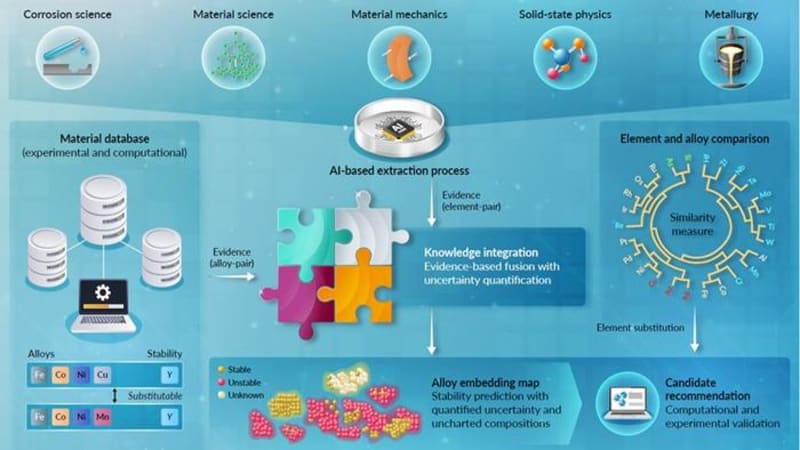
The team, led by Professor Hieu-Chi Dam, built something different. Their system extracts expert judgments from scientific literature across five disciplines using advanced language models like GPT-4, then combines this knowledge with experimental data using a mathematical framework called Dempster-Shafer theory.
What makes this approach special is honesty. "Traditional classifiers force binary 'yes-or-no' predictions even when information is insufficient," Professor Dam explains. "Our approach explicitly quantifies uncertainty, allowing 'we cannot tell' as a legitimate scientific outcome." The system doesn't pretend to know more than it does.
The results exceeded expectations. When tested against 55 experimentally confirmed alloys, the framework achieved 86% to 92% accuracy even for materials containing elements completely absent from its training data. It outperformed both conventional machine learning and computationally expensive modeling methods.
The Ripple Effect goes beyond individual discoveries. The system creates compositional maps showing researchers exactly where predictions are reliable and where more investigation is needed. This means scientists can focus their limited time and budget on the most promising experiments rather than working blind.
With growing demand for materials that can withstand extreme conditions in sustainable energy systems and next-generation electronics, accelerating discovery has become urgent. This breakthrough shows how AI can augment human expertise rather than simply replace it, combining the pattern-recognition power of machine learning with the nuanced judgment found in scientific literature.
The framework is already being used to guide real-world materials research. As scientists explore increasingly complex alloy combinations for everything from corrosion-resistant infrastructure to high-performance batteries, having a tool that can navigate uncertainty while learning from human knowledge could transform how quickly we develop the materials our future depends on.
More Images
Based on reporting by Google: scientific discovery
This story was written by BrightWire based on verified news reports.
Spread the positivity!
Share this good news with someone who needs it