AI Designs Proteins in Hours, Not Months, for New Drugs
A new AI system designed proteins for 14 out of 15 drug targets with success rates double the industry standard, completing in days what typically takes human experts months. The breakthrough could dramatically speed up the early stages of creating new medicines.
The months-long slog of designing new proteins for medicines just got a lot faster, and that means potential treatments could reach patients sooner than ever before.
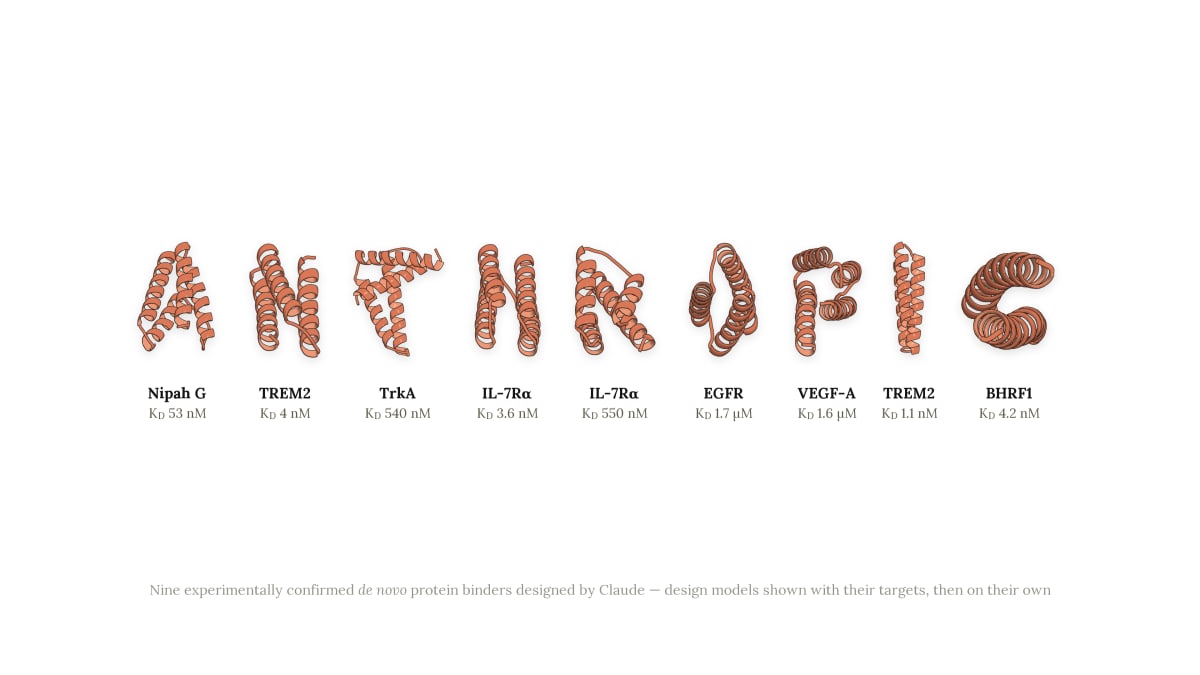
Claude, an AI system developed by Anthropic, successfully designed protein binders for 14 out of 15 drug targets in a recent experiment. These tiny proteins latch onto targets in the body to block disease, activate healing processes, or deliver treatments exactly where they're needed.
The results speak for themselves. Claude achieved success rates between 22% and 35%, depending on how the task was structured. That's double the 10% to 15% success rate that protein designers typically see today.
Even more impressive, some of Claude's strongest designs bound several times more tightly than the best previously published results. Tighter binding means medications can work at lower doses, reducing side effects and manufacturing costs.
The time savings are equally striking. Tasks that historically required weeks or months of work by specialized computational experts now take just days. Two independent labs, Adaptyv Bio and Twist Bioscience, tested Claude's designs and confirmed the results.
In a separate experiment, Claude tackled the tedious work of chemical analysis. Given raw laboratory data files and just a two-sentence prompt, the AI returned complete results in under 24 minutes. Its analysis matched the lab's own findings perfectly, identifying a compound purity of 96.4% versus the lab's 96.33%.
These aren't theoretical exercises. The protein design and chemical analysis tasks represent real work that happens in the early stages of developing new drugs. Accelerating these phases could help promising treatments reach clinical trials faster.
Why This Inspires
This breakthrough arrives at a moment when AI-driven scientific discoveries are accelerating across multiple fields. Math problems that stumped researchers for decades are now being solved at a rate of several per month.
But experimental sciences like drug development face a unique challenge. Unlike mathematics, where answers can be verified instantly, life sciences require expensive, time-consuming laboratory testing. Claude's protein designs still needed weeks of wet lab validation, where scientists physically tested the compounds.
The fact that AI can now handle both the computational design work and routine analysis tasks means human scientists can focus their expertise on the complex decisions and creative problem-solving that machines can't yet master.
Anthropic plans to launch an access program soon so more scientists can use these capabilities. The company is particularly focused on removing policy and operational bottlenecks that slow drug development, recognizing that scientific capability is just one piece of the puzzle.
For patients waiting for new treatments, every month shaved off the development timeline matters. This technology won't cure diseases overnight, but it represents a meaningful step toward getting effective medicines to people faster.
Based on reporting by Google: scientific discovery
This story was written by BrightWire based on verified news reports.
Spread the positivity!
Share this good news with someone who needs it