AI Helps NASA Spot Black Hole Devouring Star 750M Miles Away
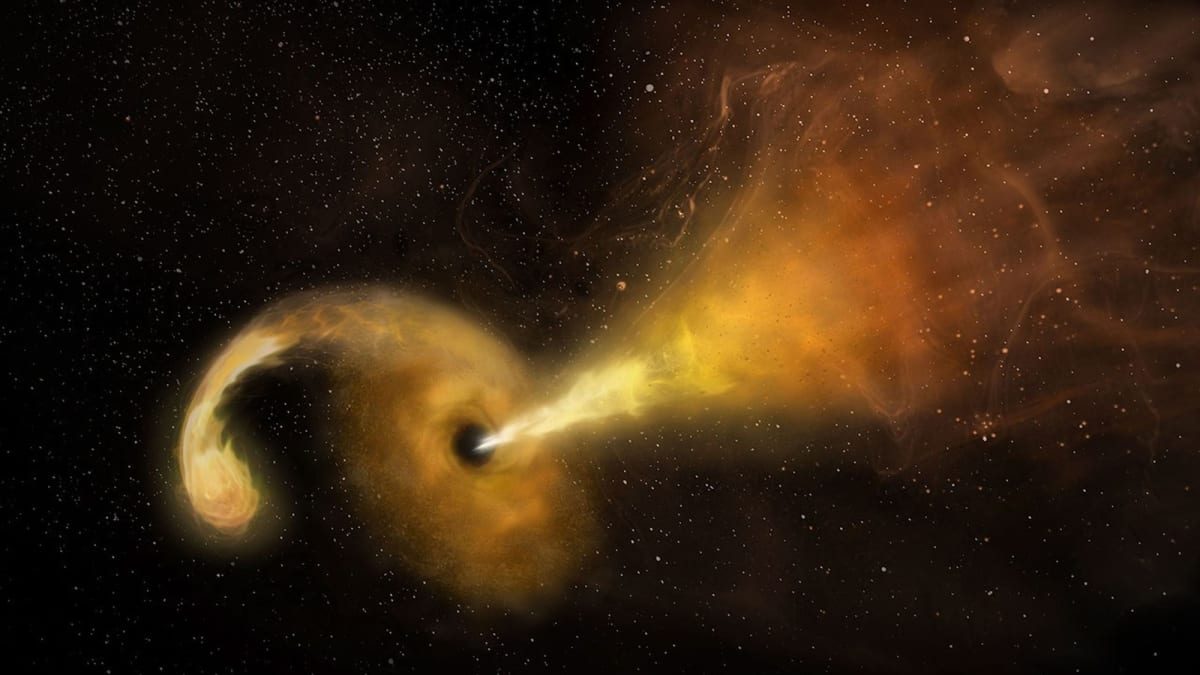
Artificial intelligence helped astronomers witness a rare cosmic event never seen before: a "wandering" black hole on the edge of a distant galaxy tearing apart a star. The discovery validates a new technique that could unlock the universe's hidden giants.
Astronomers just witnessed something extraordinary happening 750 million light years away: a massive black hole devouring a star in a place scientists never expected to find one.
The black hole, weighing about a million times more than our sun, sits on the outskirts of a faraway galaxy rather than at its center. When a star drifted too close, the black hole's intense gravity ripped it apart, creating an ultraviolet flare so bright it outshone its entire host galaxy for months.
This type of event, called a tidal disruption event, only happens about once every 100,000 years per galaxy. What makes this discovery even more special is that it's the first optical TDE ever spotted so far from a galaxy's core.
The breakthrough came from an unlikely helper: artificial intelligence. Every night, the Zwicky Transient Facility in Southern California detects half a million cosmic flashes. In November 2025, a new AI algorithm automatically recognized one flash that looked different from all the rest.
Robert Stein, a research fellow at the University of Maryland and NASA's Goddard Space Flight Center, explained that the AI spotted the telltale signs of a star-shredding event. Astronomers then confirmed the discovery using telescopes in Chile and NASA's Swift Observatory satellite.
These "orphan" or "wandering" black holes are cosmic mysteries. Scientists think this one ended up 30,000 light years from its galaxy's center either because multiple galaxies merged and flung it outward, or because a smaller dwarf galaxy is still merging with a larger one.
Why This Inspires
This discovery opens a new chapter in understanding the universe. Before 2024, scientists had only found these giant black holes in galaxy centers, mainly because that's where they were looking.
Now astronomers have validated a completely new hunting technique. By searching for these spectacular star-shredding events, they can find invisible supermassive black holes hiding in places we never thought to look.
The universe just got a little less mysterious, and our tools for exploring it just got a lot smarter.
More Images



Based on reporting by Google News - Science
This story was written by BrightWire based on verified news reports.
Spread the positivity!
Share this good news with someone who needs it