AI Learns Human Judgment From Just a Few Videos
South Korean researchers have developed technology that teaches robots to understand human preferences using only a handful of videos instead of thousands of data points. This breakthrough could make helpful robots available faster and cheaper than ever before.
Imagine teaching a robot the same way you'd teach a friend: show them a few examples, and they get it.
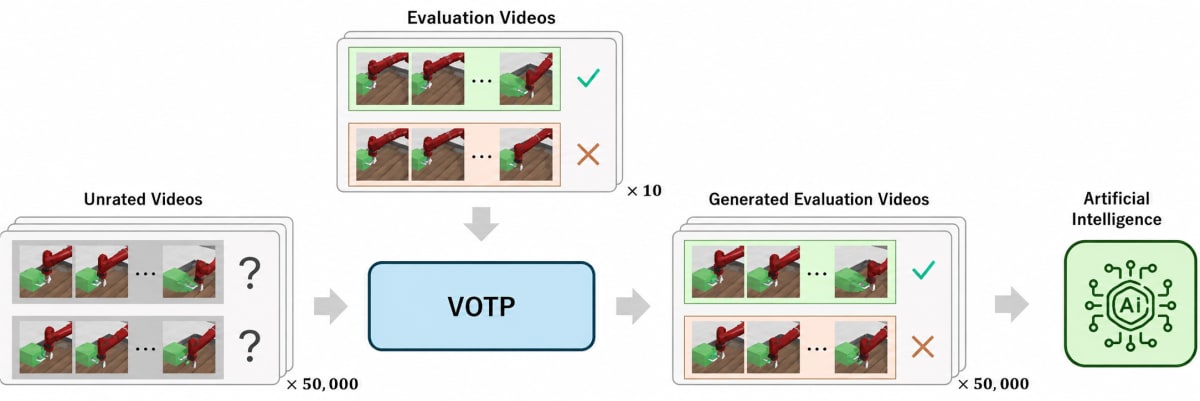
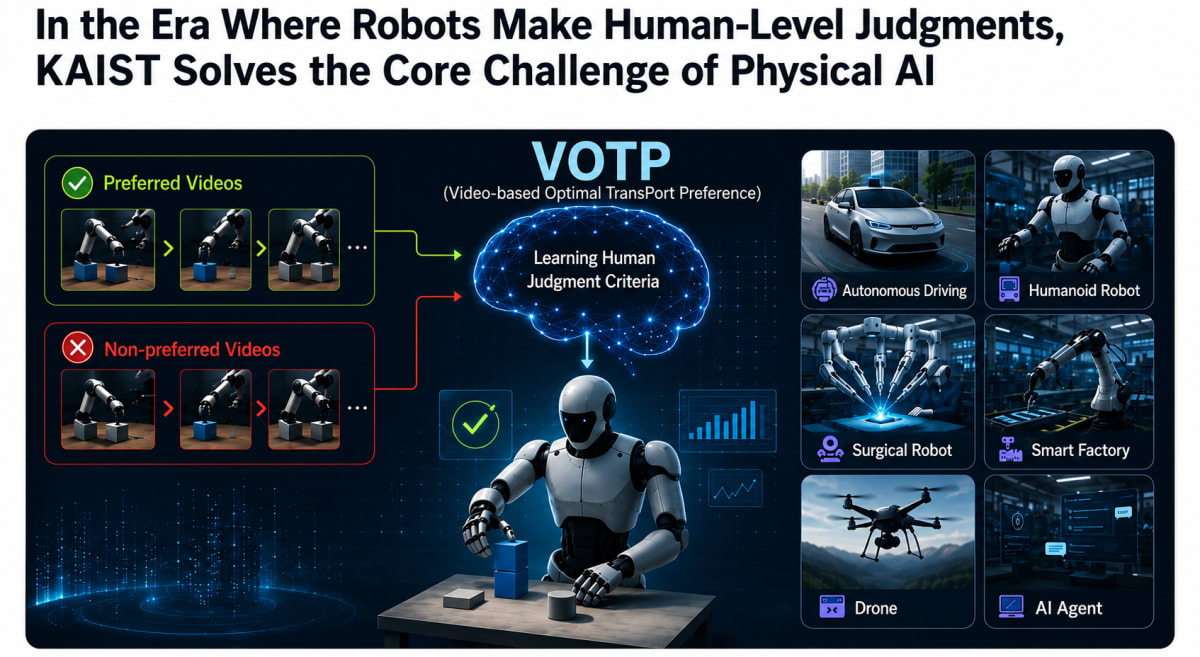
That's exactly what researchers at Korea Advanced Institute of Science and Technology (KAIST) have achieved. Their new technology, called VOTP, allows artificial intelligence to learn human judgment and preferences from just a few demonstration videos instead of requiring thousands of individual human evaluations.
Professor Chang D. Yoo and his team tackled one of the biggest roadblocks in creating "physical AI," the kind that powers surgical robots, self-driving cars, and factory machines. Until now, training these systems to make good decisions required humans to manually evaluate tens of thousands of actions, a process that took enormous time and money.
The breakthrough mimics how humans naturally learn. When we watch someone perform a task well and poorly a few times, we quickly grasp what good looks like. VOTP gives machines this same ability.
Here's why it matters: When a surgical robot needs to stitch a wound or an autonomous vehicle approaches a busy intersection, it must choose the best action among countless options. The AI needs what researchers call a "reward function," essentially a mental rulebook of what humans consider good or bad choices.
The research earned top honors at the International Conference on Machine Learning 2026, one of AI's most prestigious gatherings. Out of nearly 24,000 submitted papers, VOTP was selected for an oral presentation, an achievement given to only the top 0.7 percent.
The Ripple Effect
This technology could transform entire industries almost overnight. Robot manufacturers won't need months of expensive human feedback to train their systems. Medical facilities could deploy surgical robots faster. Factories could implement smart machinery without lengthy programming periods.
The applications stretch far beyond what we typically think of as robots. Smart factories, drones, computer-operating AI agents, and humanoid robots could all benefit from this faster, cheaper training method. Any machine that needs to understand human satisfaction and intent just got a shortcut to learning.
The research team tested their algorithm across various environments and tasks, proving it works reliably in different situations. The AI doesn't just memorize specific examples; it truly grasps the underlying principles of what humans want.
PhD student Tung M. Luu led the research as first author, with support from South Korea's Ministry of Science and ICT. The work represents years of effort to bridge the gap between how machines learn and how humans naturally teach.
Professor Yoo believes this technology will "accelerate the era of robots making human-like judgments." As physical AI moves from research labs into our daily lives, understanding human intentions becomes critical for safety and usefulness.
The era of helpful, intuitive robots just got closer, and it required solving a deceptively simple problem: teaching machines to learn the way we do.
More Images
Based on reporting by Google News - South Korea Breakthrough
This story was written by BrightWire based on verified news reports.
Spread the positivity!
Share this good news with someone who needs it