AI Tool Cuts Years Off Drug Discovery Process
Scientists from Ohio State and an Indian university just created an AI that designs medications humans can actually make in labs. The breakthrough could slash the decade-long, billion-dollar drug development timeline and help fight cancer and drug-resistant diseases.
Getting a new drug from computer screen to patient currently takes about ten years and costs over a billion dollars. Researchers just made a tool that could dramatically speed up the hardest part of that journey.
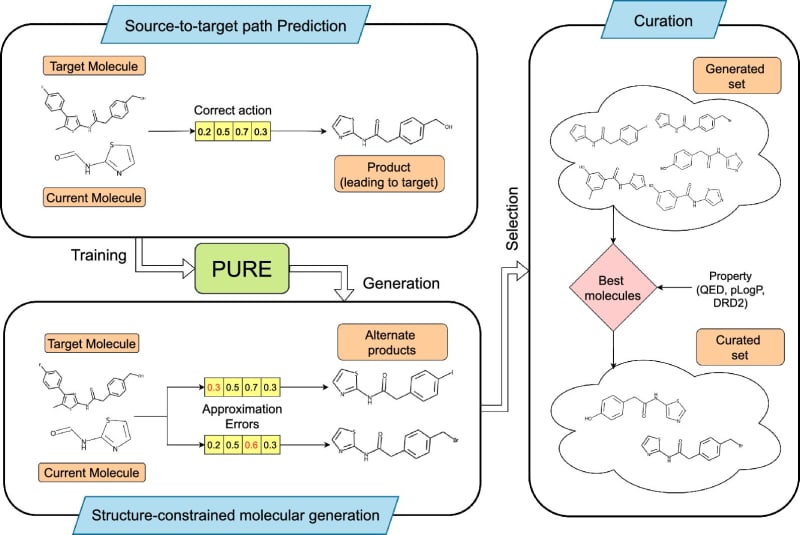
Scientists from The Ohio State University and the Indian Institute of Technology Madras developed PURE, an artificial intelligence system that creates drug-like molecules designed to be synthesized in real laboratories. The framework stands apart because it thinks like a chemist, not just a computer.
Here's the problem PURE solves. Most AI drug discovery tools generate molecules that look amazing on paper but are nearly impossible to actually make in a lab. It's like designing a beautiful house that defies the laws of physics.
PURE works differently. It simulates how drugs are actually built in laboratories, step by step, using templates from real chemical reactions. The system uses self-supervised learning to recognize patterns in existing molecules, then applies reinforcement learning to explore new possibilities naturally.
Professor Srinivasan Parthasarathy explained the framework offers game-changing benefits for early-stage pharmaceutical research. It can identify alternative drug candidates when diseases develop resistance or when medications cause liver problems.
The team tested PURE on standard benchmarks including drug-likeness, dopamine receptor activity, and solubility. The AI delivered more diverse and original molecules than existing tools and generated possible synthesis routes without being specifically trained on those metrics.
The Ripple Effect
What makes this breakthrough particularly exciting is its versatility. PURE works as a general-purpose engine that can tackle multiple diseases and property objectives using a single trained model.
B. Ravindran from IIT Madras highlighted what sets PURE apart. The system doesn't just optimize specific metrics but learns how molecules actually transform, treating chemical design as a sequence of actions guided by real reaction rules.
The implications extend beyond medicine. Parthasarathy noted the PURE framework provides a promising foundation for accelerating discovery of new materials across industries.
The collaborative team included researchers from both universities who combined expertise in computer science, chemistry, and machine learning. Their findings appeared in the Journal of Cheminformatics, making the methodology available to researchers worldwide.
This tool arrives at a critical moment when drug resistance threatens to reverse decades of medical progress and when diseases like cancer demand faster development of personalized treatments.
PURE brings us one step closer to AI systems that reason through complex scientific challenges the way human experts do, but at speeds no human could match.
More Images

Based on reporting by Phys.org
This story was written by BrightWire based on verified news reports.
Spread the positivity!
Share this good news with someone who needs it