AI Trained on Physics Speeds Up Scientific Discovery
Scientists created AI models that learn from real physics data, not text or images. These breakthrough tools can solve problems across astronomy, fluid dynamics, and more by recognizing universal physical patterns.
Scientists just took AI in a completely new direction, and it could change how research gets done forever.
Instead of training artificial intelligence on words or photos like ChatGPT, researchers from the Polymathic AI collaboration taught their models using real scientific data from physics experiments. The result? AI that can tackle exploding stars, Wi-Fi signals, and bacterial movement with the same underlying knowledge.
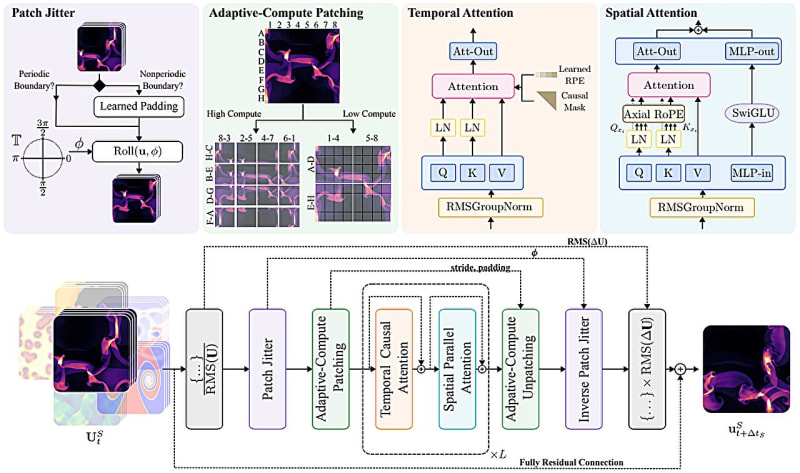
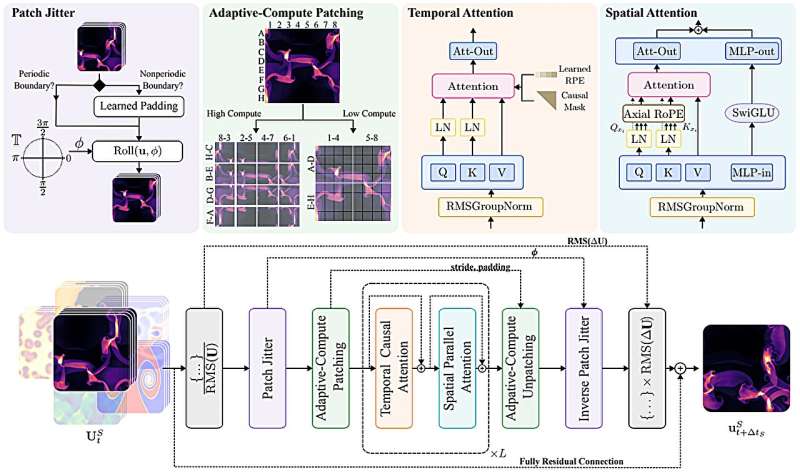
The team unveiled two new models called Walrus and AION-1. Walrus specializes in fluids and fluid-like systems, learning from 15 terabytes of data covering everything from neutron star collisions to Earth's atmospheric layers. AION-1 focuses on astronomy, trained on over 200 million observations from major sky surveys totaling 100 terabytes of information.
What makes these models special is their ability to transfer knowledge between fields. When one scientific area has already figured out certain physics, the AI can apply those lessons to completely different problems. It's like how our senses work together—if you can't see something clearly, your other senses help fill in the gaps.
"Maybe you have new physics in your scenario that your field isn't used to handling," said lead developer Michael McCabe from Polymathic AI. The models give researchers a head start, especially when working with limited data or tight budgets.
Dr. Miles Cranmer from Cambridge's Department of Applied Mathematics calls the success "awe-inspiring." The fact that a multi-disciplinary physics model works at all—let alone this well—validates years of hopeful research.
The Ripple Effect
These foundational models are already proving their worth in ways traditional AI can't match. When astronomers capture a fuzzy galaxy image, AION-1 can extract detailed information by drawing on patterns from millions of other galaxies. Scientists don't need to start from scratch or work through countless possible models anymore.
The models also excel in low-data situations, a common challenge in cutting-edge research. By understanding universal physical principles rather than memorizing specific scenarios, they can make accurate predictions even with limited information from new experiments.
Perhaps most exciting, the team open-sourced both the code and datasets. Dr. Payel Mukhopadhyay from Cambridge's Institute of Astronomy is thrilled about what the scientific community will build next. Researchers worldwide can now adapt these tools to their own problems without massive computational resources.
The breakthrough represents a fundamental shift toward general-purpose AI for physical simulation—one model that works across many scientific challenges instead of requiring retraining each time.
Science just got a powerful new partner in the quest for discovery.
More Images
Based on reporting by Google: scientific discovery
This story was written by BrightWire based on verified news reports.
Spread the positivity!
Share this good news with someone who needs it