Amazing Discovery: Webb Telescope Unlocks Secrets of 'Monster Stars' and Black Hole Birth
Scientists using the Webb Telescope have made an exciting breakthrough in understanding mysterious "little red dots" in space—they're actually gigantic ancient stars that show us how the universe's first black holes were born! This discovery brings us closer than ever to understanding the early cosmos.
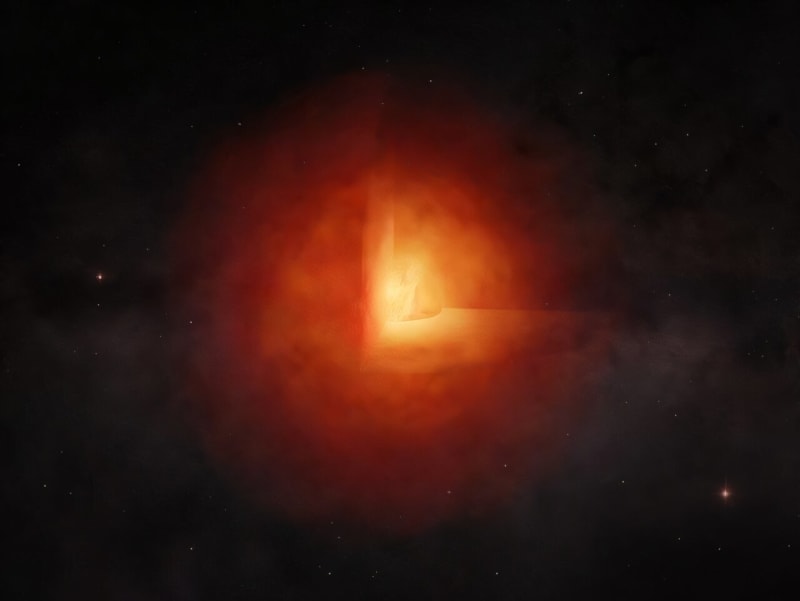
In a thrilling cosmic revelation, astronomers at the Center for Astrophysics | Harvard & Smithsonian have solved one of space's most intriguing mysteries using NASA's James Webb Space Telescope. Those puzzling "little red dots" scattered across the distant universe? They're actually magnificent supermassive stars—about a million times the mass of our sun—offering us an unprecedented window into how the universe's first black holes came to be.
The discovery, presented at the 247th meeting of the American Astronomical Society in Phoenix, represents a major leap forward in our understanding of the early cosmos. "Little red dots have been a point of contention since their discovery," explained lead researcher Devesh Nandal. "But now, with new modeling, we know what's lurking in the center of these massive objects, and it's a single gigantic star in a wispy envelope."
What makes this finding so remarkable is its elegant simplicity. Previously, scientists struggled to explain these mysterious objects, proposing complex theories involving black holes, accretion disks, and dust clouds. The new research shows that a single massive star can naturally produce all the distinctive signatures scientists have been observing: extreme brightness, a unique V-shaped spectrum, and rare hydrogen emissions.
These "monster stars" are nothing short of spectacular. Imagine a star so massive that its outer layers extend far into space, creating an enormous, diffused envelope. At its core, nuclear reactions produce tremendous amounts of energy, but this energy spreads across such a vast volume that the star's surface actually appears cooler, giving it that distinctive red glow that initially puzzled researchers.
Perhaps most exciting is what these stars represent: we're witnessing the final, brilliant moments before these giants collapse into black holes. "If our interpretation is right, we're not just guessing that heavy black hole seeds must have existed. Instead, we're watching some of them be born in real time," Nandal shared enthusiastically. "That gives us a much stronger handle on how the universe's supermassive black holes and galaxies grew."
The James Webb Space Telescope, designed to detect longer wavelengths of light than its predecessor Hubble, has proven itself an invaluable tool for unlocking the universe's secrets. Since its first deep images in 2022 revealed these intriguing red dots, scientists have been working tirelessly to understand what they were seeing.
Looking ahead, researchers are optimistic about finding additional little red dots that are less massive than those in the current study. Such discoveries would help them understand even more about these fascinating stellar giants and refine their models of early universe evolution.
This breakthrough demonstrates the incredible progress we're making in understanding our cosmic origins. Every discovery like this brings us closer to answering fundamental questions about where we came from and how the universe evolved into the magnificent expanse we observe today. The ability to watch black holes being born in real time is a testament to human ingenuity and our endless curiosity about the cosmos.
Based on reporting by Phys.org
This story was written by BrightWire based on verified news reports.
Spread the positivity! 🌟
Share this good news with someone who needs it
More Good News
 🌐 Global News
Astronomers Make Thrilling Discovery of Ancient Galaxy Cluster That Rewrites Cosmic History
 🌐 Global News
Groundbreaking Discovery Reshapes Our Understanding of the Early Universe
 🌐 Global News
Scientists Discover Adorable 'Platypus Galaxies' That Rewrite Cosmic History
Joke of the Day
Why did the librarian get kicked out of class?
Explore Categories
Quote of the Day
"Do not go where the path may lead, go instead where there is no path and leave a trail."
— Ralph Waldo Emerson