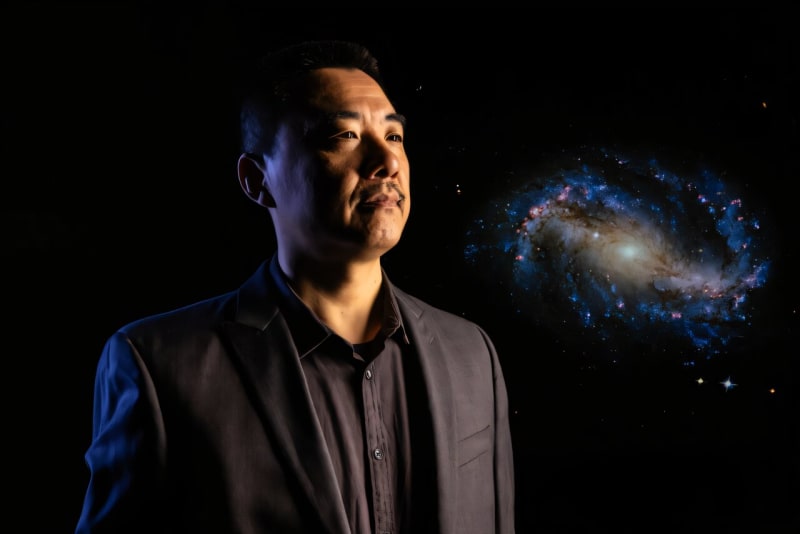
Scientists Discover Adorable 'Platypus Galaxies' That Rewrite Cosmic History
Astronomers at the University of Missouri have made a delightful discovery using the James Webb Space Telescope—unusual cosmic objects nicknamed "platypus galaxies" that challenge everything we thought we knew about how galaxies form. These charming celestial oddities suggest the early universe was far more creative and flexible than previously imagined.
In an exciting breakthrough that's capturing the imagination of scientists worldwide, researchers at the University of Missouri have discovered something truly extraordinary lurking in the depths of space—and they've given it the most endearing name possible: "platypus galaxies."
Using NASA's remarkable James Webb Space Telescope, astronomy professor Haojing Yan and his enthusiastic team spotted these cosmic curiosities that blend characteristics in ways never seen before. Just like the beloved duck-billed platypus combines features from different animals, these celestial objects mix traits that astronomers thought couldn't exist together.
"Each property on its own is familiar to us," Yan explained with evident excitement. "But when added together, they create something we've never seen before."
What makes these objects so special? They appear point-like, similar to stars or brilliant quasar cores, but when scientists analyzed their light, they discovered narrow emission lines—the unmistakable signature of galaxies actively forming new stars. It's a cosmic puzzle that has researchers thrilled about the possibilities.
This fascinating discovery opens up wonderful new questions about our universe's early days. Current theories suggest galaxies formed through dramatic, violent collisions—think cosmic car crashes on an unimaginable scale. But these platypus galaxies hint at a gentler story.
"These 'platypus galaxies' may have formed quietly, without such dramatic events," Yan noted. "This suggests the early universe may have been more flexible and creative than we thought."
The implications are genuinely inspiring. Rather than following a single rigid formula, the cosmos appears to have experimented with multiple approaches to galaxy formation—like an artist trying different techniques to create masterpieces.
Graduate student Bangzheng "Tom" Sun, who co-authored the study, perfectly captured the excitement: "If these objects are really a new type of galaxy, it tells us we've been missing part of the story. And we're just beginning to uncover it."
The team's work represents collaboration at its finest, including undergraduate student Riley Shive as a co-author—demonstrating how scientific discovery brings together researchers at all career stages. Their findings were proudly presented at the 247th meeting of the American Astronomical Society.
What's particularly wonderful is that this discovery is just the beginning. The team plans to study hundreds of additional cosmic objects to see if they share these unusual traits. Using spectroscopy—essentially reading light like a cosmic barcode—they'll unlock secrets about the age, chemical makeup, and star formation in these distant galaxies.
Each new observation from the James Webb Space Telescope reminds us that the universe still holds countless surprises, waiting to teach us something new. These platypus galaxies prove that even after decades of astronomical research, the cosmos continues to delight, surprise, and inspire us with its endless creativity.
As we peer deeper into space and further back in time, we're not just learning about distant galaxies—we're discovering that our universe is far more diverse, imaginative, and wonderful than we ever dared to imagine.
Based on reporting by Phys.org
This story was written by BrightWire based on verified news reports.
Spread the positivity! 🌟
Share this good news with someone who needs it
More Good News
 🌐 Global News
Astronomers Make Thrilling Discovery of Ancient Galaxy Cluster That Rewrites Cosmic History
 🌐 Global News
Groundbreaking Discovery Reshapes Our Understanding of the Early Universe
 🌐 Global News
Amazing Discovery: Webb Telescope Unlocks Secrets of 'Monster Stars' and Black Hole Birth
Joke of the Day
Why did the librarian get kicked out of class?
Explore Categories
Quote of the Day
"Do not go where the path may lead, go instead where there is no path and leave a trail."
— Ralph Waldo Emerson